
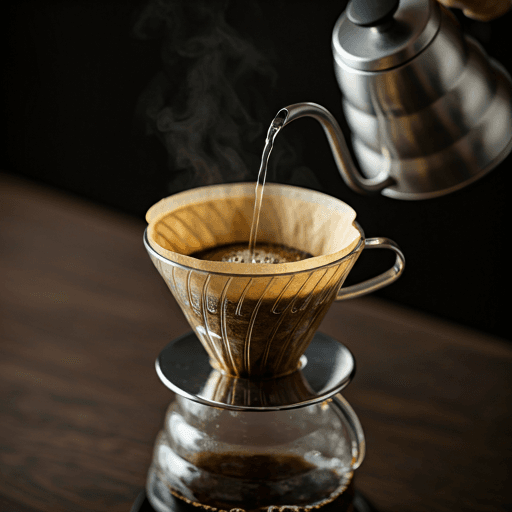
Black coffee is coffee brewed and served with nothing added: no milk, no cream, no sugar. That is the whole definition. Whether you brew with a drip machine, a pour-over cone, a French press, an espresso shot or a spoon of instant, the moment you drink it plain, you are drinking black coffee. It is the most honest version of the drink, because there is nowhere for the flavor to hide.
People often assume black coffee means a specific brew or a specific strength. It does not. It is defined entirely by what you leave out. A delicate light-roast pour-over and a bold dark-roast espresso are both black coffee, as long as they reach the cup unadorned.
What counts as black coffee
Black coffee is a serving style, not a brewing method. Any way you make coffee can produce a black cup:
- Drip and filter — the classic mug from a home coffee maker, brewed and poured plain.
- Pour-over — hand-poured through a cone such as a V60, prized for clarity.
- French press — full-immersion steeping that gives a heavier, fuller body.
- Espresso — a small, concentrated shot. On its own it is black coffee; add hot water and it becomes an Americano, still black.
- Instant — soluble coffee crystals dissolved in hot water, taken plain.
- Moka pot or percolator — stovetop brews that land somewhere between filter and espresso in intensity.
The one rule is what you add: nothing. The second a splash of milk or a spoon of sugar goes in, it stops being black. If you want the full step-by-step on the methods themselves, see our guide on how to make coffee.
Black and white coffee: the simple contrast
The clearest way to understand black coffee is to set it against its opposite. The "black and white coffee" distinction is exactly what it sounds like. Black coffee is plain. White coffee is coffee with milk or cream added. That single difference changes the taste, the texture and the look of the cup.
| Aspect | Black coffee | White coffee (with milk) |
|---|---|---|
| Added dairy | None | Milk, cream or a dairy-free alternative |
| Flavor | Pure coffee — bitter, acidic, sweet and aromatic notes all exposed | Softer, rounder, sweeter; milk mellows bitterness |
| Body | Clean to syrupy, depending on method | Creamy and fuller from milk fat |
| Calories | Near zero | Rises with the amount and type of milk |
| Examples | Long black, Americano, plain drip, espresso | Latte, cappuccino, flat white, cafe au lait |
"White coffee" is an everyday term in many parts of the world for any coffee taken with milk. A latte or a cafe au lait are both, broadly, white coffees. Note that "white coffee" can also refer to a specific lightly roasted, under-developed bean style, but in the black-versus-white sense it simply means coffee with milk.
How black coffee tastes — and why the beans matter more
Drink coffee plain and you taste everything: the bean's origin, the roast level, the freshness, the grind, the water, even the brewing skill. There is no milk to round off the edges and no sugar to paper over bitterness. That is exactly why black coffee can be either revelatory or rough.
A well-made black cup is rarely just "bitter." Good coffee carries sweetness, acidity that reads as brightness or fruitiness, and aromatic notes ranging from cocoa and nuts to citrus and florals. Cheap, stale or carelessly brewed coffee, on the other hand, has nowhere to hide its flaws when served black — which is why people who dislike black coffee have often only ever had a poor cup of it.
Three things move the needle most:
- Beans and freshness. Quality beans, ground close to brewing, taste dramatically better neat. The bean type matters too — see arabica vs robusta beans explained for why one tastes sweeter and the other bolder.
- Roast level. Lighter roasts keep more origin character and acidity; darker roasts taste deeper, smokier and more bitter. Neither is "correct" — it is a matter of taste.
- Brew method. Filter and pour-over give a clean, light cup; French press gives heavier body; espresso gives an intense, concentrated shot. Each frames the same beans differently.
Calories and caffeine in a black cup
Brewed black coffee is essentially calorie-free — a standard cup carries only around two to five calories, with no fat and no sugar. Calories only start climbing once milk, cream, sugar or syrups go in. That near-zero figure is one reason black coffee is so popular with people watching what they eat.
Caffeine is a different story and depends on the brew, not on the lack of milk. A typical cup of black coffee delivers roughly 80 to 100 mg of caffeine, though espresso, strength and serving size all shift that number. Contrary to a common myth, dark roasts do not pack more caffeine than light roasts — if anything, light roast is fractionally higher by volume. For the full picture, read our guide to caffeine. We cover the wider health angle separately in black coffee benefits, so we will not repeat it here.
How to make a good black cup
If black coffee has tasted harsh to you before, the fix is almost always better inputs, not added milk. Here is a reliable approach.
- Start with fresh, decent beans. Buy whole beans and use them within a few weeks of their roast date.
- Grind just before brewing. Coffee goes stale fast once ground. A burr grinder and the right grind size for your method make an outsized difference.
- Get the ratio right. A common starting point is about one part coffee to fifteen to seventeen parts water by weight. Too little coffee tastes thin and sour; too much tastes harsh.
- Mind the water. Use clean, filtered water just off the boil — around 90 to 96 C / 195 to 205 F. Boiling water can scorch the grounds and add bitterness.
- Match method to taste. Want clarity? Try a pour-over. Want body? Reach for a French press. Want intensity? Pull an espresso.
- Tweak, do not drown. If a cup still reads too bitter, a tiny pinch of salt or a dash of cinnamon can soften it without turning it into white coffee.
What about iced black coffee?
Black coffee does not have to be hot. Brew it strong, chill it, and pour it over ice for a refreshing plain iced cup. Cold brew — coffee steeped in cold water for many hours — is a popular black-coffee variant that tastes naturally smoother and less acidic. See what is cold coffee for the whole chilled category and how the styles differ.
Is black coffee for you?
Black coffee rewards good ingredients and a little curiosity. Drinking it plain is the fastest way to actually taste what is in your cup, to notice the difference between origins and roasts, and to appreciate the craft behind a well-pulled shot or a careful pour-over. If your first sips are not love at first taste, treat it as a tuning exercise: better beans, a fresher grind and the right water transform the experience.
And there is no shame in milk. The black-and-white choice is purely personal — plenty of serious coffee lovers drink both depending on the bean and the mood. To keep exploring, dig into how coffee roasting works and how it shapes everything you taste in that simple, honest black cup.