
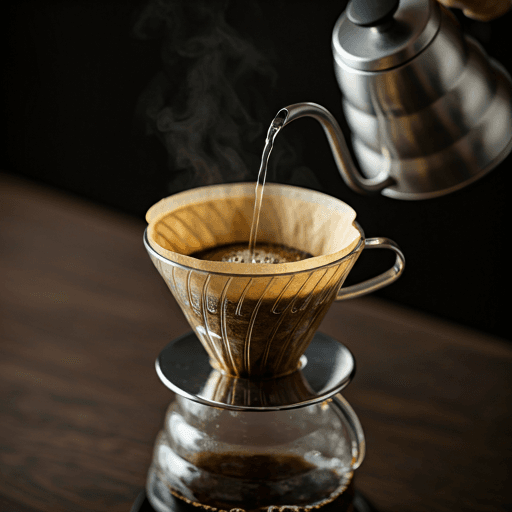
To brew with a V60, you grind coffee medium-fine, rinse the paper filter, add the grounds, and pour hot water in stages over roughly two and a half to three and a half minutes. Start with a bloom, then a few steady pulse pours, aiming for a ratio near 15 to 16 grams of water per gram of coffee. That is the whole method. Everything below makes each step reliable, so you can pull a clean, sweet cup out of the same cone every morning.
The Hario V60 is the most popular pour-over coffee dripper in the world, and for good reason. It is simple, forgiving once you learn its habits, and capable of a brighter, cleaner cup than most other brewers. This guide walks you through V60 pour over from the first rinse to the last drip.
What the V60 is and why its shape matters
The Hario V60 is a cone-shaped dripper that holds a paper filter. The name comes from its geometry: a "V" cone with a 60-degree angle. Hario, a Japanese glassware company, refined the design through the early 2000s and released the V60 commercially in 2005. It earned a global following after baristas put it to work on the World Brewers Cup stage through the 2010s.
Three design features do the real work, and knowing them helps you brew better:
- The 60-degree cone funnels water toward a single point, so the brew concentrates flow through the center of the coffee bed.
- One large hole at the bottom means the V60 does not control the flow rate for you. You do, through grind size and how you pour. That is what makes it expressive, and a little less automatic than a flat-bottom brewer.
- Spiral ribs on the inside lift the paper off the cone wall. Air can escape and water drains freely, instead of the filter sealing flat against the cone and choking the brew.
The takeaway: a V60 is a manual brewer. You are the flow controller. That sounds intimidating and is not, it just means a couple of variables are in your hands.
The gear you need for brewing V60
You can brew a good cup with very little, but a few tools move you from guesswork to consistency.
| Item | Why it helps | Essential? |
|---|---|---|
| V60 cone | The dripper itself. Plastic, glass, ceramic or metal all brew well; ceramic and glass hold heat a touch better. | Yes |
| V60 paper filters | Cone-shaped filters made for the V60. Flat or Chemex filters will not seat correctly. | Yes |
| Burr grinder | An even, adjustable grind is the single biggest quality lever in pour over. | Strongly recommended |
| Gooseneck kettle | The narrow spout lets you pour slowly and place water exactly where you want it. | Recommended |
| Digital scale | Weighing coffee and water makes your brew repeatable. A built-in timer is a bonus. | Recommended |
| Carafe or mug | Catches the brew. A server with markings helps you hit a target weight. | Yes |
If you are buying gear, our coffee grinder guide and electric kettle guide cover what to look for. A burr grinder matters more than the cone you choose.
Ratio, grind and water temperature
Coffee-to-water ratio
A reliable starting point is 1:16, one gram of coffee to sixteen grams of water. Many brewers prefer 1:15 for a slightly bolder cup. In practice that looks like:
- One mug: 15 g coffee to about 240 to 250 g water.
- Two mugs / a small batch: 22 to 25 g coffee to about 350 to 400 g water.
Water is measured in grams because one milliliter of water weighs one gram, which is why a scale beats a measuring cup here. Adjust to taste: more water per gram makes a lighter cup, less makes it stronger.
Grind size
Aim for medium-fine, roughly the texture of table salt or sea salt, gritty between the fingers but not powdery. This is the variable you will tune most. Too coarse and water rushes through; too fine and it stalls. The grinding-at-home guide explains how to dial this in.
Water temperature
Use water just off the boil, around 90 to 96 degrees C (about 195 to 205 degrees F). If your kettle has no temperature control, boil it, then let it rest for roughly 30 seconds before pouring. Light roasts like the hotter end of that range; darker roasts can take slightly cooler water.
How to brew with a V60: step by step
Here is the full method. Read it once, then keep it nearby for your first few brews.
- Boil and weigh. Heat your water and weigh your coffee, say 20 g for a roughly 320 g brew at 1:16.
- Rinse the filter. Fold the seam of the paper, seat it in the cone, and pour hot water through it into your carafe. This rinses away papery taste and preheats the cone and vessel. Pour out that rinse water.
- Add coffee and zero the scale. Tip the grounds in, give the cone a light tap to level the bed, and tare your scale to zero.
- Bloom. Start your timer and pour roughly twice the weight of the coffee in water, about 40 g for 20 g of grounds, wetting all the grounds. Let it sit 30 to 45 seconds. The bed swells and releases trapped carbon dioxide; this "bloom" lets the rest of the water extract evenly.
- First main pour. Pour in slow spirals from the center outward, stopping short of the paper edge. Bring the weight up to roughly 60 percent of your total (around 190 g for a 320 g brew). Pour at a gentle pace, not a flood.
- Second pour. When the water level drops, pour again up to your full target weight (320 g here). Keep the stream steady and centered.
- Let it draw down. Stop pouring once you hit your target. A small swirl of the cone settles the bed and evens out the extraction. Wait for the stream to slow to occasional drips.
- Serve. The bed should look flat and slightly domed, not crater-walled. Lift the cone, swirl the carafe, and pour. Total time, from the start of the bloom to the last drip, should land around 2:30 to 3:30.
That is one V60 pour over, start to finish. Taste it before you change anything, your tongue is the real instrument.
Troubleshooting: too fast or too slow
Almost every V60 problem comes down to flow rate, and flow rate is mostly grind size. Use this as your quick diagnosis.
| What you notice | Likely cause | Fix |
|---|---|---|
| Drains very fast (under ~2:15), tastes thin, sour, watery | Under-extraction, water rushes through | Grind one notch finer; pour a little slower; keep water hot |
| Drains slowly (over ~3:45), tastes harsh, bitter, dry | Over-extraction or a clogged bed | Grind one notch coarser; stir the bloom less; avoid aggressive pouring |
| Sour and weak even at the right time | Water too cool, or grind slightly coarse | Use hotter water; grind a touch finer |
| Bed leaves a tall crater on the walls | Pour went straight at the paper, channeling water | Pour in the center, spiral gently, do not hit the edges |
A simple rule of thumb: sour and weak, grind finer; bitter and harsh, grind coarser. Change one variable at a time so you know what did the work. Fines pushed into the paper by over-stirring are a common cause of a slow, stalled drawdown, so go easy when you agitate the bloom.
How the V60 compares to other brewers
The V60 makes a clean, bright, tea-like cup that highlights the character of good beans, which is why specialty cafes love it. It rewards attention, but it also gives you more to do than a press. If you want a fuller, heavier body with almost no technique, a French press immersion brew is more forgiving. If you want pour-over flavor with a sturdier, more portable brewer, the AeroPress is a great companion method. Many home brewers keep a V60 for clarity and a press or AeroPress for days they want zero fuss.
Quick tips to brew better, faster
- Grind right before brewing. Coffee goes stale fast once ground; fresh grinds taste noticeably better.
- Weigh everything. The single fastest way to make your brew repeatable is a scale.
- Keep the bed level. Pour in the center, spiral outward, and a gentle swirl at the end keeps extraction even.
- Use fresh beans. Coffee within a few weeks of its roast date blooms more and tastes sweeter.
- Change one thing at a time. Grind, ratio, temperature, pour speed, adjust one, taste, repeat.
The beauty of the V60 is that it gives you a window into the coffee. Once the basic method is muscle memory, you can spend years dialing in beans, ratios and pours, and the cone never gets in your way. Brew a few rounds, taste honestly, and tweak one variable at a time. When you want to feel how much body a brewer adds, run the same beans through a different method and compare, that side-by-side habit teaches you more about coffee than any single recipe.