
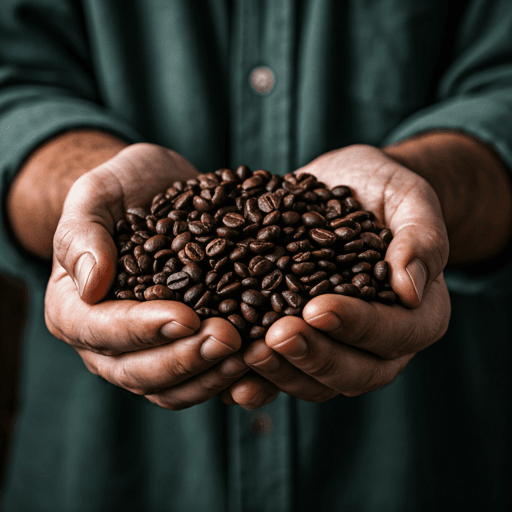
The short answer: the coffee beans price in India for whole roasted beans runs from around ₹600 per kg for mass-market supermarket blends to roughly ₹1,400-2,800 per kg for freshly roasted specialty single origin, with most decent everyday beans landing around ₹1,000-1,600 per kg. What you pay depends on the species (arabica or robusta), whether it is a blend or single origin, the roaster's freshness, and pack size. This guide breaks the coffee beans price down by tier and brand so you can read a label and know whether you are paying a fair number.
We are talking about whole roasted beans here, not ground powder and not green beans. If you want powder rates instead, see our coffee powder price per 1kg guide. For raw green arabica and farm-gate numbers, see the arabica coffee price guide.
Coffee beans price in India at a glance
Prices below are typical online and retail bands as of 2026. They are honest "around" ranges, not a live feed. Coffee is a commodity layered with roasting and branding, so a single kilo can swing widely. Use these as a sense-check.
| Tier | Typical price (₹/kg) | What you get |
|---|---|---|
| Mass-market blend | ₹600-1,000 | Supermarket arabica-robusta blends, longer shelf-life, less freshness focus |
| Everyday roaster blend | ₹1,000-1,600 | Roast-to-order blends, decent freshness, good for milk drinks |
| Specialty single origin | ₹1,400-2,800 | Estate-traceable, roast date printed, peak flavour clarity |
| Premium / rare lots | ₹2,800-5,000+ | Microlots, competition-grade, monsooned or honey-processed rarities |
Two structural facts set the floor. First, India grows mostly arabica and robusta, and robusta is cheaper, so a blend with more robusta costs less. Second, freshness costs money. A roaster who roasts to order and prints a roast date carries more wastage than a factory packing for a 12-month shelf life, and that shows up in the coffee beans price.
What drives the coffee beans price
Species: arabica vs robusta
Robusta is the cheaper bean and tolerates a lot. Arabica is smoother, more aromatic, and costs more to grow and buy. Most everyday Indian blends mix the two. A 100% arabica bag almost always costs more than an 80:20 or 70:30 arabica-robusta blend at the same roaster. For the full head-to-head, read arabica vs robusta explained, and for the live market spread see arabica vs robusta price today.
Blend vs single origin
A "blend" combines beans from several estates or regions for a consistent, repeatable cup. A "single origin" comes from one estate or region and tastes of that place. Single origins usually cost 20-60% more than the same roaster's house blend because the supply is smaller and traceability is paid for. If you are unsure what the term means, see what is blend coffee.
Freshness and roast date
This is the biggest hidden value driver. Specialty beans carry a printed roast date; supermarket beans usually carry only a "best before". Beans are at their best in the two to four weeks after roasting. Paying more for a roast-dated bag is often worth it because the cup is noticeably better.
Processing and rarity
Washed beans are the baseline. Natural, honey, monsooned malabar, and peaberry lots cost more because yields are lower and handling is fussier. Cultivar matters too — Indian selections like S795, Cauvery (Catimor), Kent, and SLN lines behave differently. For the deep dive, see coffee bean varieties and types.
Pack size
Per-kilo rates drop as pack size rises. A 250g specialty bag at ₹450 is ₹1,800/kg; the same bean in a 1kg bag often lands nearer ₹1,400-1,500/kg. Buying 500g or 1kg is the simplest way to cut your per-cup cost, as long as you will finish it within a month of roasting.
Coffee beans price by brand in India
These are example brands to compare factually. We do not make, own, or stock any of them. Bands below are typical 2026 online prices; always check the brand's own site or a marketplace for the current number.
| Brand | Type | Typical price (₹/kg, whole bean) |
|---|---|---|
| Tata Coffee Grand | Mass-market blend | ₹600-900 |
| Continental / Cothas (bean lines) | Blend | ₹700-1,100 |
| Lavazza (Gold / Crema e Gusto, India) | Italian blend | ₹1,200-1,800 |
| Blue Tokai | Single origin / blend | ₹1,400-2,400 |
| Black Baza | Specialty, shade-grown | ₹1,600-2,600 |
| Sleepy Owl (bean SKUs) | Blend | ₹1,600-2,500 |
| Davidoff | Premium imported | ₹2,000-3,500 |
| Araku | Estate single origin | ₹1,800-3,200 |
A pattern emerges. Indian factory brands (Tata, Continental, Cothas) anchor the bottom. Specialty roasters (Blue Tokai, Black Baza, Araku) sit in the middle-to-upper band and print roast dates. Imported premium names (Lavazza, Davidoff) cost more partly for the bean and partly for the brand and import path. For named-brand deep dives, see our Lavazza beans guide, the Davidoff premium coffee guide, and Starbucks beans in India.
Is a higher coffee beans price worth it?
Often, yes — but only if you brew well and finish the bag fresh. Here is a plain way to think about value.
- For milk drinks (latte, cappuccino): a ₹900-1,400/kg blend is plenty. The milk masks subtle flavour, so paying ₹2,500/kg for a delicate single origin is wasted in a cappuccino.
- For black coffee, pour-over, French press: spend up. A clean single origin around ₹1,600-2,400/kg rewards you with clarity you can actually taste.
- For espresso at home: a dark or medium-dark blend around ₹1,200-1,800/kg with some robusta gives crema and body. See how to make espresso at home.
The cheapest real upgrade is not a pricier bean — it is grinding fresh. Whole beans hold flavour far longer than pre-ground powder. A modest grinder pays for itself in cup quality. See our coffee grinder buying guide and how to grind beans at home.
Cost per cup, the number that matters
Forget per-kilo for a second. A standard cup uses about 10-12g of beans. So 1kg makes roughly 80-100 cups. At ₹1,500/kg that is around ₹15-19 per cup of beans — cheaper than any café, even for genuinely good coffee. Even a ₹2,800/kg specialty bag is under ₹35 a cup. The per-kilo number looks big; the per-cup number is small.
| Beans price (₹/kg) | Cups per kg (~11g) | Bean cost per cup |
|---|---|---|
| ₹800 | ~90 | ~₹9 |
| ₹1,500 | ~90 | ~₹17 |
| ₹2,800 | ~90 | ~₹31 |
Where to buy coffee beans (and find a fair price near you)
You have four honest routes, each with a different price profile.
- Roaster websites: best for freshness and traceability. Blue Tokai, Black Baza, Araku and others ship pan-India. Roast date printed; price reflects it.
- Marketplaces (Amazon, BigBasket, Flipkart): widest brand range, frequent deals. Watch the roast/best-before date — stock can be older.
- Local roasteries and specialty cafés: buy by weight, sometimes roast-to-order. Walk in and ask for the roast date. To find one, see coffee roasters near you and best coffee roasters in India.
- Supermarkets and kirana: cheapest mass-market blends, least freshness focus. Fine for milk-heavy drinks.
For city-specific roasteries and cafés, our location guides point you to real spots — for example Bengaluru, Mumbai, or Pune. There is no fake "lowest price near you" feed; the honest move is to check two roaster sites and one marketplace, then compare per-kilo on the same pack size.
How to read a coffee bean label before you pay
A quick checklist to judge whether a coffee beans price is fair:
- Species/blend: 100% arabica costs more than an arabica-robusta blend.
- Roast date: printed and recent is worth a premium; only a "best before" suggests a factory pack.
- Origin: single estate (Coorg/Kodagu, Chikmagalur, Baba Budangiri, Araku, Wayanad) named = traceable, usually pricier.
- Roast level: light/medium for clarity, dark for milk and espresso. See roast levels explained.
- Pack size: always convert to ₹/kg to compare apples to apples.
For a fuller buying walk-through, our best coffee beans buying guide covers brands, roast and freshness in depth. Treat the bands here as your quick sense-check before you hit the buy button.