
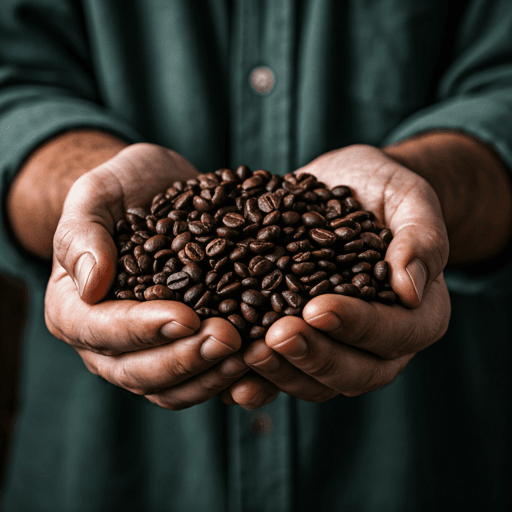
The arabica coffee price in India usually sits in two bands. Green (raw) arabica at the farm gate runs roughly ₹450 to ₹750 per kg depending on the Coffee Board grade, while roasted whole-bean arabica at retail typically runs from around ₹800 per kg for everyday blends up to ₹1,400 to ₹2,400 per kg for specialty single origins. There is no single "today's" number — the arabica price moves with the global market, the harvest, the grade, and how far the bean has travelled from estate to bag.
This guide breaks down what you are actually paying for, the realistic INR bands by grade, and how to read a quoted arabica rate so you are not over- or under-paying. For the two-species head-to-head, see our guide on arabica vs robusta beans; for the live market mechanics, see arabica vs robusta price today.
Arabica coffee price in India: the quick bands
Prices change weekly, so treat these as honest ranges, not a quote. We use "around" and "from" on purpose — anyone showing you an exact rupee figure for "today" is quoting a single supplier on a single day.
| What you are buying | Typical India band (₹/kg) | Notes |
|---|---|---|
| Green arabica, farm gate (Coffee Board grades) | around ₹450 – ₹750 | Plantation AA at the top; cherry and lower grades below |
| Green arabica, wholesale / bulk supplier | around ₹440 – ₹650 | Varies with volume and grade |
| Roasted arabica, everyday blends (retail) | from around ₹800 – ₹1,200 | Supermarket and value roasters |
| Roasted arabica, specialty single origin | around ₹1,400 – ₹2,400 | Estate-named, fresh-roasted, small-batch |
The jump from green to roasted reflects roasting loss (beans lose 15–20% of their weight as moisture in the roaster), roasting skill, packaging, freshness, and brand. A bag of fresh single-origin from a named roaster is a different product from a sack of commodity green, even at the same species.
Green arabica: how the farm-gate price is graded
India's Coffee Board classifies arabica by how it was processed and by bean size. The grade is the single biggest driver of the green arabica price, so it helps to recognise the labels on a quote.
| Grade | What it means | Relative price |
|---|---|---|
| Plantation (washed) AA | Wet-processed, large uniform beans — the premium tier | Highest (around ₹700+/kg seen) |
| Plantation A / AB / B | Washed, progressively smaller / mixed bean sizes | Mid-to-high |
| Plantation PB (peaberry) | Single round bean, naturally scarce (5–10% of cherries) | Premium, prized |
| Cherry (natural) A / AB / B | Sun-dried with the fruit on, fruitier cup | Often a little below comparable Plantation |
"Plantation" in Indian coffee means washed arabica, not an estate name. "Cherry" means it was dried with the fruit intact (natural process), which is cheaper to do and tends to price a notch under the equivalent washed lot. Larger, more uniform beans (AA over AB over B) command more because grading is mostly about bean size and defect limits.
For where these regions and grades come from, see our practical types of coffee beans in India guide, and for cultivars and processing styles, coffee bean varieties explained.
Roasted arabica retail price: what you pay per kg
Once green arabica is roasted and bagged, the price reflects the roaster's craft and freshness as much as the bean. Here is the honest retail landscape for buying roasted arabica beans in India.
- Everyday / value blends: from around ₹800 to ₹1,200 per kg. Often arabica-robusta blends sold in supermarkets or by large roasters.
- Mid specialty: roughly ₹1,200 to ₹1,600 per kg. Named-region arabica from roasters like Blue Tokai, Sleepy Owl, Black Baza, or Beanrove.
- Premium single origin: around ₹1,600 to ₹2,400+ per kg for estate-named, micro-lot, or competition-grade arabica.
As a rough anchor, specialty roasters often price a 250 g bag of single-origin arabica at around ₹350 to ₹600, which works out to roughly ₹1,400 to ₹2,400 per kg. Imported or branded lines (Lavazza, Davidoff) sit across the mid-to-premium band depending on the line. For brand-by-brand detail see our best coffee beans buying guide; for whole-bean retail rates by grade and brand, see coffee beans price in India.
Arabica price per cup: the number that actually matters
For a home, office, or outlet, the headline ₹/kg is less useful than the cost per cup. A kilo of roasted beans yields a lot of coffee, so a "premium" bag is cheaper per cup than most people assume. A single espresso shot uses roughly 8–10 g of ground coffee; a filter or pour-over cup uses around 12–18 g. So one kilo gives you very roughly 100 to 125 espresso shots or 60 to 80 brewed mugs.
| Roasted arabica band (₹/kg) | Per espresso shot (~9 g) | Per filter mug (~15 g) |
|---|---|---|
| Everyday blend, around ₹900 | around ₹8 | around ₹14 |
| Mid specialty, around ₹1,400 | around ₹13 | around ₹21 |
| Premium single origin, around ₹2,000 | around ₹18 | around ₹30 |
Seen this way, stepping up from a value blend to a traceable single-origin arabica adds only a few rupees a cup — far less than the gap in the ₹/kg sticker suggests. Waste matters more than grade for a busy site: stale beans, over-dosing, and bad extraction lose more money than choosing the cheaper bag ever saves.
Why the arabica price moves
The single biggest mover is the global market. India is a price-taker — arabica is benchmarked on the New York "C" contract, so a frost or drought in Brazil or Vietnam ripples into Indian farm-gate rates within weeks. On top of that:
- Harvest and weather: a short Indian crop (Karnataka's Coorg/Kodagu, Chikmagalur, Baba Budangiri) lifts prices.
- Rupee–dollar rate: since arabica is dollar-benchmarked, a weaker rupee raises the local number.
- Grade and processing: washed Plantation AA over natural cherry B, as covered above.
- Form and distance: green vs roasted, bulk sack vs retail bag, commodity vs traceable single origin.
This is also why arabica almost always costs more than robusta: it yields less per tree, grows at higher altitude, is more disease-prone, and cups sweeter and more aromatic. To learn how to actually read a futures chart, see how to read coffee price charts.
Green or roasted: which arabica price should you compare?
Most buyers should compare roasted bean prices, not green. Green arabica is cheaper per kg, but it is unroasted, has a 15–20% roasting weight loss to come, and needs a roaster, skill, and time before it is drinkable. Only buy green if you roast in-house. For everyone else, the roasted ₹/kg is the honest comparison. For the difference between green and roasted, and the roast levels in between, see green vs roasted coffee beans.
How to read a quoted arabica rate
When a supplier sends you a number, check four things before you compare it to anything: green or roasted, grade, quantity, and date. A ₹650/kg green Plantation AB quote and a ₹1,500/kg roasted single-origin quote are not the same product and should not be compared head-to-head. Ask whether the figure is GST-inclusive, what the minimum order is, and whether it is delivered or ex-estate.
Rule of thumb: if a price looks far below the bands above, it is usually robusta, a blend, an older lot, or a lower grade — not a bargain arabica.
For the broader picture of how coffee is priced in India, our coffee prices in India explained guide ties green, powder, and retail together, and the coffee powder price guide covers ground and filter powder specifically.
Buying arabica without overpaying
For home brewing, buy roasted whole beans in 250 g–500 g packs and grind fresh — paying mid-specialty rates for a fresh, traceable arabica beats a cheap stale kilo. For an office or outlet, the per-cup economics matter more than the headline ₹/kg, so factor in waste, brewing method, and machine type. We do not claim a live "today's" arabica price — the aim is to help you brew it well once you have the beans.