
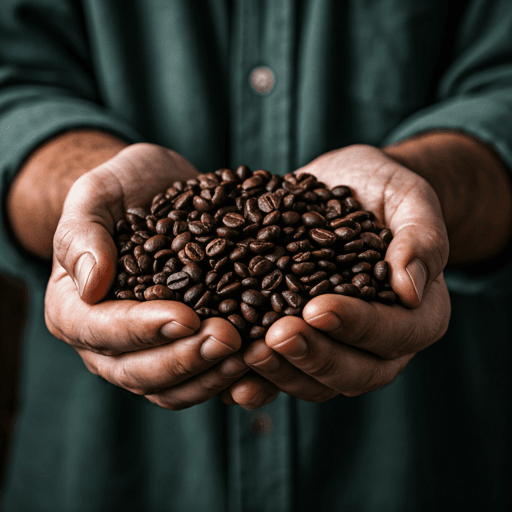
The coffee price you pay in India is really three different prices stacked together: the raw bean price set on global markets, the retail price of a pack on the shelf, and the price of a finished cup at a cafe like Costa, Starbucks or your local roaster. Bean prices move daily on commodity exchanges, but for a home, office or cafe buyer what matters more are the durable ranges and the forces behind them. This guide explains how the coffee price works in India — from the farm in Karnataka to the cup in your hand — so you can spend smartly instead of guessing.
We will not quote a "today's rate" here on purpose: commodity prices change by the hour, so any single number would be wrong within a day. Instead, we focus on typical bands, what makes them move, and what each one means for your monthly coffee budget.
The three coffee prices you actually deal with
When people say "coffee price," they could mean any of three very different things. Keeping them separate is the single most useful habit for an Indian buyer.
| What you are pricing | Who sets it | Typical India range | What it tells you |
|---|---|---|---|
| Green (raw) bean, per kg | Global futures + local mandi | ~Rs 200–800/kg depending on grade | The commodity cost before roasting |
| Roasted/packed retail, per 250g | Brand + retailer | ~Rs 150–600 per pack | What you spend at home |
| A cafe cup | The cafe | ~Rs 150–350 per drink | Mostly rent, labour and milk, not beans |
The big surprise for most readers is the last row. A cafe cappuccino can cost 30–50x the value of the coffee inside it, because the bean is a small slice of the bill. The rest is milk, rent, staff, equipment, packaging and brand.
What drives the global coffee price
India grows world-class coffee, but the price floor is set globally. Two beans, two markets, two stories.
Arabica vs robusta
- Arabica — smoother, more aromatic, grown at higher altitude (Chikmagalur, Coorg, the Western Ghats). It usually trades at a premium and is benchmarked on the New York / ICE arabica market.
- Robusta — stronger, more bitter, higher caffeine, and the backbone of Indian filter coffee and most instant. It is benchmarked on the London / ICE robusta market. India is one of the world's notable robusta exporters.
As a rough rule, arabica costs more per kg than robusta, though the gap widens and narrows with each harvest. If you want a deeper split, see our guide on arabica vs robusta coffee price today.
The levers that move the number
- Weather and harvest — frost or drought in Brazil and Vietnam (the two giants), and monsoon timing in Karnataka, Kerala and Tamil Nadu, swing global supply fast.
- USD–INR — coffee is priced internationally in dollars. A weaker rupee raises the landed cost of imported beans and equipment, even if the dollar price is flat.
- Supply chain steps — green bean to your cup passes through curing, export/import fees, roasting, packaging, distribution and the cafe's overheads. Most of the value is added after the farm gate.
- Demand and speculation — futures traders, large roasters hedging, and rising domestic cafe demand all nudge prices.
Coffee price at home: beans, ground and instant
For home buyers, the cheapest cup almost always comes from buying coffee and brewing it yourself. Here is how the formats compare in India.
| Format | Typical pack price | Cost per cup (rough) | Best for |
|---|---|---|---|
| Instant coffee | ~Rs 150–500 / jar | ~Rs 3–8 | Speed, no equipment |
| Filter coffee powder (chicory blend) | ~Rs 150–350 / 250g | ~Rs 5–12 | South Indian kaapi at home |
| Whole beans / ground (specialty) | ~Rs 300–700 / 250g | ~Rs 12–30 | Espresso, French press, pour-over |
Even premium single-origin beans land far below cafe pricing per cup once you brew at home. If you are weighing brands, our roundup of the best coffee brands in India breaks down value across instant, filter and specialty — and shows where paying more genuinely buys a better cup versus where you are paying for the label.
Costa Coffee prices and cafe-cup economics in India
Costa coffee prices in India sit in the premium-cafe band, broadly alongside other international chains. A standard cappuccino or latte at Costa typically falls in the upper end of the Rs 200–350 range, with larger sizes, flavoured syrups, plant milks and seasonal specials pushing it higher. Airport and mall outlets usually price above standalone stores. Costa, like most chains, runs a loyalty programme (earn "beans," redeem for free drinks), which quietly lowers your effective price if you are a regular.
To put cafe pricing in context, here is roughly how the major formats compare for a medium milk-based drink:
- Local / standalone cafe: ~Rs 120–220
- Premium chains (Costa, Starbucks, Blue Tokai, Third Wave): ~Rs 200–400+
- South Indian filter coffee at a darshini or tiffin centre: ~Rs 15–60
- Office pantry machine (per cup, all-in): often under Rs 10–25
The gap between that last line and the chains is the whole argument for owning a machine. For comparison shopping across brands, see our notes on Starbucks coffee prices in India. None of these cafe prices are mostly "coffee" — the bean is typically the smallest line item; rent, labour and milk dominate.
Rule of thumb: at a premium chain, you are paying mostly for the room and the service. At home or in an office pantry, you are paying mostly for the coffee — which is why per-cup costs collapse.
Coffee price for offices and cafes: the machine math
If you serve coffee at scale — an office, a co-working floor, an institution or a cafe — the question shifts from "price per cup at a counter" to "cost of ownership." That is where a machine changes the economics entirely.
What a machine costs up front (India)
- Home coffee makers / drip: ~Rs 2,000–10,000
- Home & boutique espresso (semi-automatic): ~Rs 15,000–60,000+
- Office fully-automatic bean-to-cup: ~Rs 60,000–3,00,000+ depending on volume
- Tea & coffee vending machines (office/institution): often available on rental or with consumable contracts
For a full breakdown of models and brackets, see our coffee machine price guide for India, which maps each bracket to a daily cup count.
Why per-cup cost falls so fast
Once the machine is in, your recurring cost is just beans or premix, milk and a little maintenance. An office serving even 50 cups a day will usually pay back a vending or bean-to-cup machine within months versus buying out — and the per-cup price often lands well under Rs 25, sometimes under Rs 10 on premix systems. The bigger your daily volume, the more lopsided the savings. A quick way to sanity-check any machine is to divide its price by the cups you expect over two years, then add roughly Rs 5–15 per cup for consumables; if that total beats your current cafe or pantry spend, the machine pays for itself.
How to track live coffee prices (without getting it wrong)
If you genuinely need the live commodity number — say you run a cafe and buy green beans — track it from the source rather than a stale blog figure:
- Commodity exchanges: ICE robusta (London) and ICE arabica (New York) set the global benchmarks.
- Indian financial / mandi platforms: commodity-price sites and broker chart platforms publish daily arabica and robusta rates in INR per kg, plus Coffee Board reference prices.
- Read the chart, not the headline: look at the trend over weeks, not one spike, so a single bad-weather scare does not panic your buying.
For a buyer, the takeaway is simpler than the data: budget against the durable ranges above, and treat daily swings as noise unless you are purchasing raw beans by the sack.
Quick answers: getting the best coffee price
- Cheapest good cup: brew at home or on an office machine — single-digit to low double-digit rupees.
- Best cafe value: standalone cafes and filter-coffee spots beat premium chains on price; loyalty programmes (like Costa's) trim the chain premium if you are a regular.
- Lowest cost at volume: own or rent a machine — vending and bean-to-cup crush per-cup costs for offices and institutions.
- Don't chase the daily rate: unless you buy green beans, the commodity tick doesn't change your monthly bill much.
The bottom line for Indian buyers
Coffee price in India makes sense once you split it into bean, pack and cup. The bean is cheap and globally set; the pack is where home buyers win; the cup is where rent and milk — not coffee — drive the bill. If you are serving more than a handful of cups a day at home, in an office or in a cafe, owning the right machine is almost always the lowest long-run price per cup.