
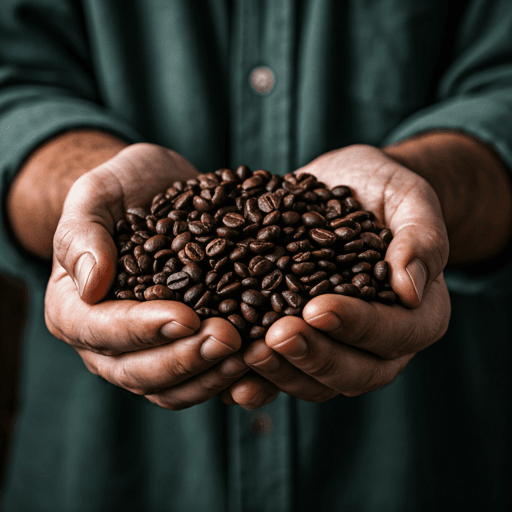
There are two types of coffee beans that matter in India: arabica and robusta. Arabica is the smoother, more aromatic, higher-priced bean; robusta is bolder, stronger, more caffeine-heavy and cheaper. India grows both, and roughly 70% of what the country produces is robusta, with arabica making up the rest. This guide takes the India-practical view: what the species mean for your cup, where each grows, what the grades on the bag say, and which to buy for filter coffee, espresso or a home brew.
If you want a deep, side-by-side flavour and chemistry breakdown, read our dedicated arabica vs robusta beans explainer. Here we stay close to the ground: Indian estates, Indian grades, Indian buying decisions.
The two types of coffee beans you'll actually find
Globally there are four commercial species (arabica, robusta, liberica and excelsa), but in India almost everything you buy is one of two: Coffea arabica (often written C arabica) and Coffea canephora, which the trade calls robusta. The arabica vs robusta choice is the single biggest flavour and price decision you'll make.
| Trait | Arabica beans | Robusta beans |
|---|---|---|
| Taste | Sweeter, fruity, floral, chocolate and nut notes, gentle acidity | Bold, woody, earthy, bitter, grainy; heavy body |
| Caffeine | Lower (around 1.2-1.5%) | Higher (around 2.2-2.7%) |
| Crema (espresso) | Lighter, finer | Thick, lasting crema |
| Grows at | Higher altitude, cooler hills | Lower, warmer elevations |
| Price band | Higher (premium green often ₹700-850/kg) | Lower (green often ₹420-550/kg) |
| Best for | Single-origin pour-overs, lighter milk drinks | South Indian filter coffee, strong espresso blends, instant |
That price gap is real and persistent. As a rough mid-2026 anchor, mild arabica traded around ₹800/kg green while robusta sat closer to ₹500/kg. Numbers move daily, so treat these as bands, not a live quote. For current market reading see our arabica vs robusta price today piece and the wider coffee beans price guide.
Where liberica and excelsa fit
You'll occasionally hear about liberica and excelsa. In India they're rare, niche and mostly experimental, not something you'll find on a supermarket shelf. If you want to go down the cultivar and processing rabbit hole, our coffee bean varieties explained guide covers them along with washed, natural and honey processing.
Where coffee beans grow in India
Indian coffee is a Western Ghats and Eastern Ghats story. Karnataka alone grows about 70% of the national crop, with Kerala and Tamil Nadu next, and a fast-rising tribal-grown crop in Andhra Pradesh. Altitude, shade and rainfall decide whether a hillside suits delicate arabica or hardy robusta.
| Region | State | Mainly grows | Known for |
|---|---|---|---|
| Coorg (Kodagu) | Karnataka | Arabica and robusta | India's largest coffee district; balanced, chocolatey cups |
| Chikmagalur | Karnataka | Arabica and robusta | Birthplace of Indian coffee; complex, full-bodied beans |
| Baba Budangiri | Karnataka | Arabica | Historic high-altitude estates; aromatic arabica |
| Wayanad | Kerala | Robusta | Smooth, low-acid, creamy robusta |
| Araku Valley | Andhra Pradesh | Arabica | Tribal-grown, organic, shade-dried; fruity single origins |
| Nilgiris/Pulneys | Tamil Nadu | Arabica and robusta | Hill-station estates, bright arabica |
Five of these were recognised with GI tags in 2019: Coorg arabica, Chikmagalur arabica, Baba Budangiris arabica, Araku Valley arabica and Wayanad robusta. A GI tag is a useful trust signal that the bean is genuinely from that region. For a single-origin deep dive, read our Indian single-origin coffee guide.
One bean India made famous: Monsooned Malabar
Monsooned Malabar isn't a separate species or region so much as a process. Green beans from the Malabar coast are exposed to the south-west monsoon winds for weeks, which swells them, fades their colour and mellows the acidity into a heavy, musty, low-acid cup. It's an Indian signature you'll see on premium bags worldwide, usually as an arabica.
Reading the grades: what AA, PB, Plantation and Cherry mean
Indian bags often carry a grade like "Plantation A" or "Robusta Cherry AA". This is a separate label from the species, and it confuses a lot of first-time buyers. Two things are being described: how the bean was processed, and how big it is.
Processing names
- Plantation = washed arabica (the cherry's skin and pulp removed before drying). Cleaner, brighter cup.
- Cherry = natural / sun-dried (the bean dries inside the whole cherry). Heavier, fruitier, more rustic.
- Parchment = washed robusta.
Size grades
India also sorts by screen size: AAA and AA are the largest, then A, B and C, with PB (peaberry) graded separately. Peaberry forms when only one seed develops inside the cherry instead of two, giving a small, dense, rounded bean, and it occurs in only about 5-10% of cherries, which is why it costs more. Bigger isn't automatically better, but large, uniform beans fetch the top price in a lot.
| Label you'll see | What it tells you |
|---|---|
| Plantation AA | Washed arabica, large uniform beans, premium |
| Plantation PB | Washed arabica peaberry, dense, prized |
| Cherry AA | Natural-processed arabica, large beans, fruitier flavour |
| Robusta Cherry AA | Sun-dried robusta, bold, big crema for espresso |
| Robusta Parchment AB | Washed robusta, cleaner robusta cup |
Indian cultivars worth knowing
Within arabica, India grows specific cultivars bred at the Central Coffee Research Institute for rust resistance and cup quality. You don't need to memorise these, but they explain why two arabicas can taste different.
- S795 — the workhorse Indian arabica, a Kent-derived selection covering roughly a quarter to a third of the country's arabica acreage; reliable, balanced, nutty-chocolatey.
- Selection 9 (Sln.9) — an Ethiopian-Timor hybrid that won a Fine Cup award in 2002; prized for flavour.
- Cauvery (Sln.12) — a Catimor-parentage, high-yield, rust-resistant volume variety.
- Chandragiri (Sln.13) — a newer Sarchimor selection with very high rust resistance.
On the robusta side, S.274 and CxR hybrids dominate estate planting. These are the beans behind most strong Indian espresso blends and instant coffee.
Which type of coffee bean should you buy?
Match the bean to the brew, not to a snob hierarchy. Robusta vs arabica isn't a "worse vs better" contest; each does a job.
- South Indian filter coffee: a robusta-heavy or arabica-robusta blend, often with chicory, gives the strong, syrupy decoction kaapi is known for. See best filter coffee powder and what is South Indian filter coffee.
- Espresso: a blend with some robusta builds thick crema and punch; pure arabica gives a sweeter, more nuanced shot. Read the best coffee beans buying guide.
- Pour-over / French press at home: single-origin arabica from Araku, Coorg or Chikmagalur shows off fruit and acidity. Grind it fresh.
- Everyday strong, value coffee: robusta or a robusta-led blend stretches your budget without going weak.
Whatever you pick, freshness and grind matter more than most people think. Buy whole beans where you can and grind to order. Our grinding at home guide and the coffee grinder buying guide cover the practical side. Many of the best Indian roasters such as Blue Tokai, Black Baza, Beanrove and Sleepy Owl print the estate, cultivar, processing and roast date right on the bag, which is exactly what you want to look for.
Arabica vs robusta: a quick recap
Arabica is the aromatic, sweeter, pricier hill bean; robusta is the bold, strong, value bean that powers filter coffee, espresso crema and instant. India grows both across the Western and Eastern Ghats, and the grade on the bag tells you the processing and size. Pick by brew, buy fresh, grind fresh.