
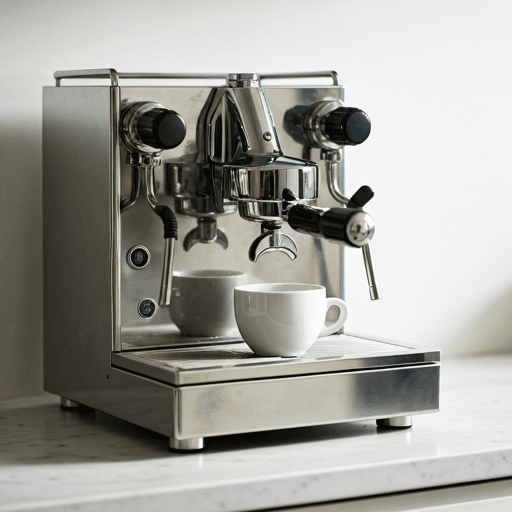
The barista express espresso machine is Breville's all-in-one "bean to espresso" machine — model BES870 — that packs a conical burr grinder, a 15-bar pump and a manual steam wand into one countertop unit. It is built for someone who wants to grind fresh, pull a real shot and steam milk by hand, without buying three separate gadgets. This guide walks through how it actually works, how to dial it in, what upkeep it needs, and who should buy it versus who should look elsewhere.
One quick orientation note before anything else. Breville is an Australian brand, founded in 1932. In the UK and across much of Europe the Breville name is owned by an unrelated company, so the very same machines are sold there under the Sage brand instead. So if you are shopping in Britain, the "Sage Barista Express" (model SES875) is the same machine as the Breville Barista Express (BES870) — only the badge and a couple of in-box accessories change. Throughout this guide, "Breville" and "Sage" mean the same hardware.
What the Barista Express espresso machine actually is
The Barista Express belongs to a category Breville calls "all-in-one" or "bean to espresso." That is the whole pitch: it grinds, doses, brews and steams from one box. It is a semi-automatic espresso machine, which is the most common type for home enthusiasts. Semi-automatic means the machine controls the pump and water temperature, but you stay in charge of the craft — choosing the grind, dosing, tamping, and steaming the milk yourself. That is exactly why people love it and exactly why it frustrates a few people who expected a one-button automatic.
If you are new to the vocabulary, it helps to read our espresso explainer first — espresso is the concentrated shot that sits under almost every cafe drink, and the Barista Express exists to pull that shot well at home.
The model number, decoded
You will see the bes870xl barista express on US listings, and "BES870" on the Breville site. The "XL" suffix is largely a retail/colour-variant tag in North America; the core machine is the BES870. The equivalent Sage unit in the UK is the SES875 (also listed as BES875UK), which differs only by a temperature-control milk jug in the box. When people search breville bes870xl they are looking at this exact machine.
How the Breville Barista Express works, part by part
The Barista Express is best understood as four tools fused together. Here is what each part does.
| Component | What it is | Why it matters |
|---|---|---|
| Integrated conical burr grinder | Built-in stainless steel burrs with around 30 grind settings, grinding straight into the portafilter | Fresh grinding moments before brewing is the single biggest lever on espresso quality |
| Dose control | You set how much coffee is ground per shot | A repeatable ~18 g dose is what makes shots consistent day to day |
| 15-bar pump | Italian-style pump that pushes hot water through the puck under pressure | Pressure is what extracts espresso and builds crema; ~9 bar reaches the puck in practice |
| Thermocoil heating + digital (PID-style) temperature control | A single thermocoil heats water; electronics hold it to a precise target | Stable brew temperature means more consistent extraction shot to shot |
| Manual 360-degree steam wand | A swivel wand you operate by hand to texture milk | You learn to make real microfoam for lattes and cappuccinos and pour latte art |
| 54 mm stainless portafilter | The basket-and-handle you lock into the group head | Larger than cheap 51 mm baskets; takes an ~18 g double dose |
Two specs are worth flagging plainly because they shape who the machine suits. First, it uses a single thermocoil, not a dual boiler. In practice that means you brew, then switch to steam, with a short wait between — you cannot pull a shot and steam milk at the same instant the way a prosumer dual-boiler machine can. For one or two drinks at a time, this is a non-issue. Second, the grinder is genuinely good but it is a single-burr grinder built to a price, so very serious home baristas sometimes pair the machine with a separate standalone grinder later. For most people, the built-in grinder is exactly the convenience they wanted.
Tank, filters and the box
The Barista Express carries a removable ~67 oz (about 2 litre) water reservoir and ships with a carbon water filter that drops into the tank. In the box you typically get the portafilter, single-wall and dual-wall (pressurised) baskets, a tamper, the milk jug, a cleaning disc and tablets, and an Allen key. The single-wall baskets are for fresh-ground coffee once you can grind well; the dual-wall baskets are the forgiving "training wheels" that produce crema even if your grind is not dialled in yet.
Daily use: pulling a shot, step by step
The everyday rhythm on a Breville Barista Express espresso machine is quick once it is muscle memory.
- Grind into the portafilter. Lock the portafilter into the grinding cradle and let the machine dose your set amount straight into the basket.
- Level and tamp. Distribute the grounds level, then press firmly and evenly with the tamper. A level, even puck prevents channelling, where water finds a fast path and ruins extraction.
- Lock in and brew. Insert the portafilter into the group head and start the shot.
- Watch the shot. A balanced double aims for roughly 36 g of liquid out from an ~18 g dose in around 25–30 seconds. Honey-like flow, not a thin stream or a fast gush.
- Steam the milk. Purge the wand, submerge the tip, stretch then texture the milk into glossy microfoam, then wipe and purge the wand again.
- Pour. Combine for a latte, cappuccino or flat white. If you want to nail the difference between those, see our guide to what a cappuccino is and what a latte is.
Dialing it in: getting from "okay" to genuinely good
"Dialing in" just means adjusting variables until the shot tastes right. On the Barista Express you mostly change one thing: grind size. The rule is simple and worth memorising.
- Shot pours too fast (gushes, finishes in under ~20 seconds, tastes sour and thin): grind finer.
- Shot pours too slow (drips, takes over ~35 seconds, tastes bitter and harsh): grind coarser.
- Keep the dose steady (around 18 g) and the target yield steady (around twice the dose) while you adjust grind, so you only change one variable at a time.
The Barista Express has two grind adjustments: an outer dial for grind size you use daily, and an inner burr adjustment for the rare case where the outer range cannot get fine enough — usually because the beans are very fresh or oily. Beans matter as much as the machine. Freshly roasted beans need a slightly coarser grind for the first few days as they release gas, then you adjust finer. For background on choosing and storing beans, see our notes on grinding coffee at home and arabica versus robusta.
Change one variable at a time. If you adjust grind, dose and tamp all at once, you will never know which change fixed (or broke) the shot.
Upkeep and cleaning
The Barista Express is low-drama to maintain, but it does need routine care to keep tasting good.
- Daily: wipe and purge the steam wand right after every use so milk does not dry inside it; backflush-rinse the group head with a quick blank shot; empty the drip tray.
- Weekly-ish: a proper backflush with the supplied cleaning disc and tablet when the machine's clean light prompts you.
- Periodically: a grinder cleaning cycle to clear oil build-up on the burrs, and a descale when the descale indicator flashes — how often depends entirely on your local water hardness. Hard water means descaling more often. The carbon water filter in the tank helps, and using filtered water reduces scale.
Skipping descaling is the most common reason these machines slow down or fail early, so do not ignore that light.
Who the Barista Express suits — and who should look elsewhere
| Great fit if you... | Look elsewhere if you... |
|---|---|
| Want cafe-style espresso and milk drinks at home and enjoy the hands-on ritual | Want one-touch coffee with zero learning curve — a super-automatic or pod machine fits better |
| Want grinder, brewer and steamer in one footprint at a sensible price | Want to brew and steam simultaneously for a crowd — that needs a dual-boiler machine |
| Are willing to spend a week learning to dial in | Just want black filter coffee or a single quick cup — a drip maker or pod is simpler and cheaper |
| Like the idea of upgrading the grinder later without replacing the machine | Are a serious enthusiast who already knows they want separate prosumer gear from day one |
On cost: the Barista Express sits in the upper-mid tier of home espresso. It is more of an investment than a pod machine or a basic drip maker, but far less than prosumer dual-boiler machines. Exact prices vary by country, retailer and any sale, so treat it as "all-in-one mid-range" rather than chasing a specific figure. The value case is that buying a separate grinder, espresso machine and steamer of similar quality usually costs more in total.
How it fits in the wider Breville and Sage range
The Barista Express is the most popular model in a whole family of "Barista" machines, and it sits inside an even larger Breville/Sage espresso lineup. If you are deciding which one to buy, this guide is the single-model deep dive — but the comparison work lives in the sibling guides:
- To compare the Barista Express against its closest cousins (the Express Impress, the Barista Pro and the Barista Touch), read the Barista Express family decision guide.
- For the whole espresso lineup from the entry-level Bambino up to the prosumer Dual Boiler and Oracle, see the Breville espresso machines guide.
- For the broadest brand overview — including non-espresso machines like the Precision Brewer drip and the Nespresso-by-Breville pod units — see Breville and Sage coffee machines.
- For a longer hands-on opinion of this exact model, see our Barista Express review.
Final word
The Breville Barista Express earns its reputation by doing one job well: it turns whole beans into a genuinely good espresso and steamed milk at home, in one machine, for a fair price — provided you are happy to learn the craft. It rewards a little patience with dialing in and a little discipline with cleaning. If that sounds like you, it is one of the easiest home-espresso recommendations to make. If you would rather press a button and walk away, keep exploring — our coffee maker buying guide and the full Breville espresso lineup will point you to a better-suited machine.