
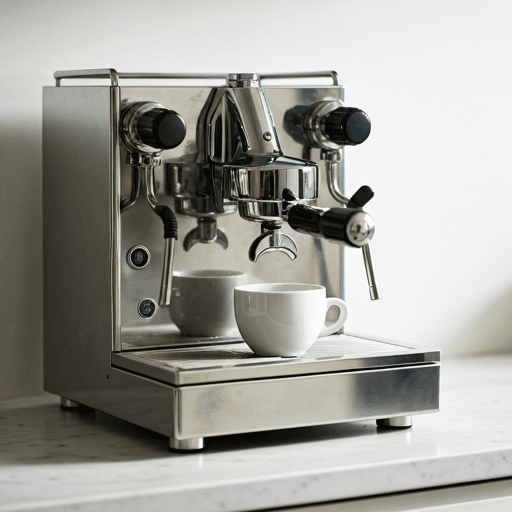
The Breville espresso machine range runs from the compact, grinder-free Bambino at the entry end, through the all-in-one Barista family (Express, Express Impress, Pro and Touch) in the middle, up to the prosumer Dual Boiler and the fully automated Oracle and Oracle Touch at the top. One important thing first: Breville is an Australian brand, and the exact same machines are sold as Sage in the UK and parts of Europe, and as Breville in the US, Canada and Australia. Same hardware, two names. This guide compares the whole lineup end to end so you can match a model to your budget, skill level and how much you want the machine to do for you.
Breville espresso machine lineup at a glance
If you only remember one thing, make it this: every Breville espresso machine is a manual or semi-automatic pump machine that pulls real shots at around 9 bars of pressure with a 15-bar pump. What changes as you move up the range is the grinder (built in or not), the heating system, the milk steaming (manual, assisted or fully automatic) and whether the machine can brew and steam at the same time. The brand also makes drip and pod machines, but those sit outside the espresso range — see our full Breville/Sage coffee machine overview for the bigger picture.
| Tier | Model | Grinder | Heating | Milk | Best for |
|---|---|---|---|---|---|
| Entry | Bambino | No (add own) | ThermoJet | Manual wand | Small spaces, low budget |
| Entry+ | Bambino Plus | No (add own) | ThermoJet | Automatic | Hands-off milk, tight counter |
| All-in-one | Barista Express (BES870) | Built-in | ThermoCoil | Manual wand | Learning espresso start to finish |
| All-in-one | Barista Express Impress (BES876) | Built-in | ThermoCoil | Manual wand | Consistency without tamp skill |
| All-in-one | Barista Pro | Built-in | ThermoJet | Manual wand | Faster heat-up, shot timer |
| All-in-one | Barista Touch | Built-in | ThermoJet | Automatic | Touchscreen, presets, ease |
| Prosumer | Dual Boiler | No (add own) | Dual boiler | Manual wand | Serious home baristas |
| Top | Oracle / Oracle Touch | Built-in, auto | Dual boiler | Automatic | Cafe results, minimal effort |
How to choose a Breville espresso machine
Three questions cut through the whole range. First, do you want the machine to include a grinder, or do you already own (or want to choose) a separate one? Second, how much do you want to do by hand — tamping, steaming, dialing in — versus letting the machine handle it? Third, do you need to brew espresso and steam milk at the same time, which only the dual-boiler models can do? Your answers point you to a tier far faster than any spec sheet.
Do you want a built-in grinder?
Fresh grinding matters more to espresso than almost anything else, so a built-in grinder is genuinely convenient. The Bambino and Bambino Plus do not have one — you grind elsewhere and load the basket yourself. The entire Barista family and the Oracle have an integrated conical burr grinder. The Dual Boiler also has no grinder, on the logic that buyers at that level often pair it with a high-end standalone grinder. If you are weighing a separate grinder, our coffee grinder buying guide covers what to look for.
How hands-on do you want to be?
This is the real spectrum in the lineup. The Bambino, Barista Express, Barista Pro and Dual Boiler all use a manual steam wand and (apart from the Impress) manual tamping — you are the barista. The Bambino Plus, Barista Touch and Oracle add automatic milk steaming, letting you set froth level and temperature. The Oracle goes furthest, automating grinding, dosing, tamping and frothing. There is no wrong answer here; it is purely about how much of the ritual you enjoy versus how much you just want a good flat white on a busy morning.
Entry tier: the Bambino and Bambino Plus
The Bambino is the smallest Breville espresso machine and the natural starting point for anyone with limited counter space or a tight budget. Both Bambino models use Breville's ThermoJet heating system, which reaches brew temperature in about three seconds — genuinely fast. They share the same espresso quality, a 54mm portafilter and low-pressure pre-infusion. The differences are practical: the Bambino has a manual steam wand and a smaller water tank, while the Bambino Plus adds automatic milk frothing with temperature and texture settings, a stainless-steel portafilter and a larger reservoir.
Because neither has a grinder, factor in a separate burr grinder when you compare them to an all-in-one. A Bambino plus a decent grinder gives you flexibility and arguably better grinding than the built-in units — at the cost of more counter space and another purchase. If you are new to pulling shots, our guide on how to make espresso at home walks through the basics on any of these machines.
All-in-one tier: the Barista family
This is where most home buyers land, because each Barista model is a complete bean-to-cup espresso setup: grinder, brewer and steam wand in one footprint. The Breville coffee and espresso machine concept really lives here. Within the family there are four models, and the differences are easy to summarize.
| Model | Heating | Tamping | Grind settings | Display | Milk |
|---|---|---|---|---|---|
| Barista Express (BES870) | ThermoCoil | Manual | 18 | Pressure gauge | Manual wand |
| Barista Express Impress (BES876) | ThermoCoil | Assisted (Impress) | 25 | Dose LED | Manual wand |
| Barista Pro | ThermoJet | Manual | 30 | LCD + shot timer | Manual wand |
| Barista Touch | ThermoJet | Manual | 30 | Touchscreen | Automatic |
Barista Express (BES870)
The original and still the most recommended starting point for learning espresso end to end. It uses a ThermoCoil heating element, an integrated 18-setting conical burr grinder, a 54mm portafilter, a 15-bar pump and a classic pressure gauge that teaches you to read your extraction. You grind, dose and tamp by hand, which is exactly why it is such a good teacher. One trade-off of its single ThermoCoil: you cannot brew and steam at the same instant. For a model-specific walkthrough, see our Barista Express deep dive and the Barista Express review.
Barista Express Impress (BES876)
The Breville Barista Express Impress is the same core machine as the Express, but it swaps manual tamping for Breville's Impress Puck System: assisted tamping that applies a consistent pressure and finishes with a small barista twist, plus an intelligent dosing system that remembers the last shot and corrects the next one. It steps the grinder up to 25 settings and adds a dose-feedback LED. If your shots come out uneven because tamping is hard to nail by hand, the Impress is the model that fixes that for you.
Barista Pro and Barista Touch
The Barista Pro upgrades to the faster ThermoJet heating system and adds a shot timer and a digital LCD — handy if heat-up speed and at-a-glance feedback matter to you. The Barista Touch goes further with a full color touchscreen, drink presets and, crucially, automatic milk steaming, so you set froth and temperature once and let it run. The Barista family is the clearest place to compare these four side by side; our dedicated Barista Express family guide goes deeper on which one to pick.
Prosumer and top tier: Dual Boiler, Oracle and Oracle Touch
At the top of the range, the headline upgrade is the dual-boiler design: one boiler for brewing and a separate one for steaming, so you can pull a shot and texture milk simultaneously with rock-steady temperature. This is the feature serious home baristas pay for, and it is what separates these models from everything below.
The Dual Boiler is the enthusiast's machine: no built-in grinder, a 58mm portafilter, excellent thermal stability and full manual control — pair it with a quality grinder and it punches well above its tier. The Oracle and Oracle Touch take that dual-boiler core and automate the workflow: automatic grinding, dosing, tamping and milk steaming, with the Touch adding a touchscreen. Note that newer Oracle variants exist with a ThermoJet system rather than dual boilers (so they brew and steam separately), so always check the exact model before assuming dual-boiler behavior.
| Model | Boilers | Grinder | Tamping | Milk | Portafilter |
|---|---|---|---|---|---|
| Dual Boiler | Two | No (add own) | Manual | Manual wand | 58mm |
| Oracle | Two | Built-in, auto | Automatic | Automatic | 58mm |
| Oracle Touch | Two | Built-in, auto | Automatic | Automatic | 58mm |
Matching a model to you
Here is the short version. Tight space or smallest spend, and you do not mind a separate grinder: Bambino (or Bambino Plus for hands-off milk). Want one machine that does everything and you enjoy learning: Barista Express. Want that, but with consistency baked in: Barista Express Impress. Value speed, a shot timer or a touchscreen with auto milk: Barista Pro or Barista Touch. A serious home barista who wants simultaneous brew-and-steam and will add a top grinder: Dual Boiler. Cafe-quality drinks with the least effort and budget is no obstacle: Oracle or Oracle Touch.
A note on cost and the Breville vs Sage naming
Prices climb steadily from the Bambino up to the Oracle Touch, and they vary by country, retailer and sale period, so treat any single figure you see as a snapshot rather than gospel. The general shape is reliable: entry models are the most affordable, the Barista family sits in the mid range, and the dual-boiler machines are the premium tier. Remember the naming split — in the UK or Europe you will see these exact machines badged as Sage, and elsewhere as Breville. The specs and model codes (like the BES870) match across both.
Breville's strength across the whole espresso range is packing real, dial-in-able espresso into approachable machines, which is why the Barista Express in particular has become such a popular first "proper" espresso machine. Once you have narrowed the tier, dig into the model-specific pages: the Barista family comparison for the all-in-one decision, the BES870 deep dive for the single most popular model, and the full brand overview if you also want to weigh drip and pod options. From there, learning to pull a balanced shot is its own rewarding rabbit hole.