
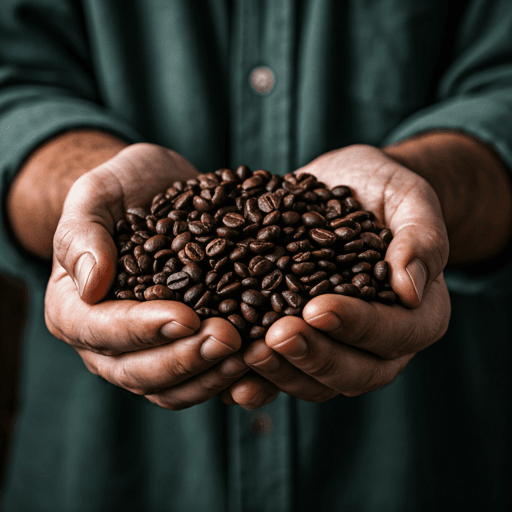
Coffee beans are the seeds of the coffee cherry, the fruit of the Coffea plant. Each bright-red cherry usually holds two seeds, and those seeds are what we roast, grind, and brew. So when you buy a bag of coffee beans, you are really buying roasted seeds of a tropical fruit. This guide explains where the bean comes from, the two species that dominate your cup, the difference between green and roasted beans, roast levels, single-origin versus blend, and how whole beans become the drink in your mug.
What are coffee beans, exactly?
A coffee bean is a seed. Coffee plants in the Coffea genus flower and then grow small fruits called coffee cherries. As a cherry ripens it turns from green to bright red or purple, and inside it sits a pair of seeds pressed flat against each other. Those seeds are the coffee beans. The word "bean" is a bit of a misnomer, since coffee is not a legume, but the shape stuck and the name has too.
Most cherries contain two seeds. Occasionally a cherry grows just one rounded seed instead of two flat ones, and that single seed is called a peaberry. The Coffea genus is large, with well over a hundred species, but only a couple matter for almost everything you drink. People talk about "bean coffee" or "beans coffee" to distinguish whole or ground roasted beans from instant powder, but the raw material is always the same: the seed of the coffee cherry.
From cherry to seed
After harvest, the fruit and its layers have to be removed to free the seeds. Producers use a few methods. The washed (wet) process removes the fruit before drying, which tends to give a cleaner, brighter cup. The natural (dry) process dries the whole cherry around the seed, which can add fruity, fermented sweetness. The honey or pulped-natural process sits between the two. The seeds that emerge are pale green and are called green coffee. They are graded, bagged, and shipped to roasters around the world.
The two main species: Arabica and Robusta
Almost all coffee on the market comes from two species. Knowing the difference between them tells you a lot about what is in your cup before you even taste it.
- Arabica (Coffea arabica) is the most cultivated species, making up roughly 60 percent of world production. It grows at cooler, higher altitudes, is more delicate to farm, and generally tastes sweeter and more complex, with notes that can run from citrus and berry to chocolate and nuts. It carries less caffeine.
- Robusta (Coffea canephora) is hardier, grows at lower, warmer altitudes, and resists pests and disease better. It carries noticeably more caffeine, tastes bolder and more bitter, and produces a thick crema, which is why it often appears in espresso blends and in instant coffee.
Neither species is simply "better." Arabica is prized for nuance, while a good Robusta adds body, caffeine, and crema. Many blends use both on purpose. If you want to go deeper, see our explainers on Arabica coffee beans and Arabica versus Robusta, plus the wider tour of coffee bean varieties and types. A third species, Liberica, exists but is rare by comparison.
| Feature | Arabica | Robusta |
|---|---|---|
| Share of world production | ~60% | ~40% |
| Growing altitude | Higher, cooler | Lower, warmer |
| Caffeine | Lower | Higher |
| Typical flavor | Sweet, fruity, complex | Bold, bitter, earthy |
| Often used in | Specialty, single-origin | Espresso blends, instant |
Green versus roasted coffee beans
The seed that leaves the farm is green and raw. Green coffee beans are firm, pale, and grassy, with little of the aroma you associate with a fresh bag of coffee. They are stable and store well, which is why coffee travels the world as green beans and gets roasted close to where it is sold. On their own, green beans taste vegetal and sharp, closer to a herbal tea than to a morning cup.
Roasting is the transformation. Applying heat browns the seed, drives off moisture, and triggers hundreds of chemical reactions that build the flavors, oils, and brown color we recognize as coffee. A green coffee seed only becomes "coffee" in the everyday sense once it has been roasted. For a closer look at that contrast, read green versus roasted coffee beans, and to understand the craft behind the heat, see what a coffee roaster does.
Roast levels in brief
Roasters stop the process at different points, and where they stop shapes the taste. The three broad bands are:
- Light roast — stopped soon after the first crack. The beans are light brown, dry, and matte, with the brightest acidity and the most of the bean's origin character. Think tea-like, fruity, or floral.
- Medium roast — a balanced middle ground. The beans are medium brown with no surface oil, blending origin flavor with caramel, toffee, and chocolate notes. This is the most popular everyday roast.
- Dark roast — taken past the second crack. The beans are dark and oily, bolder and smokier, with low acidity and notes of dark chocolate and toasted nuts. Roast character dominates origin character here.
Darker does not mean stronger in caffeine. Roast level mostly changes flavor, not the kick.
Single-origin versus blend
Once you start reading bags, two more terms show up: single-origin and blend.
- Single-origin coffee comes from one place — a single country, region, farm, or even one lot within a farm — and often a single harvest. The goal is to show off that specific terroir: the soil, altitude, and climate that make one origin taste different from another. Single-origin beans are where you taste the most distinctive, place-driven flavors.
- Blend coffee mixes beans from different farms, regions, or countries to build a consistent, intentional flavor profile. Blends are easier to keep tasting the same all year because a roaster can adjust the mix as crops change with the seasons. Most espresso and supermarket coffee are blends.
Neither is superior. Reach for single-origin when you want to explore and taste a place; reach for a blend when you want reliability and balance every morning.
Whole bean versus ground
Roasted coffee is sold two ways: as whole beans or pre-ground. A whole coffee bean stays fresher far longer because less of its surface is exposed to air. Once you grind, the surface area explodes and the coffee starts losing aroma within minutes to hours. Buying whole beans and grinding just before you brew is the single easiest upgrade for better-tasting coffee at home.
Grind size also has to match your brew method — coarse for a French press, medium for drip, fine for espresso. If you are setting up at home, our guide to grinding coffee beans and our overview of how to make coffee walk through matching the grind to the method. Pre-ground coffee is convenient and perfectly good when used fresh, but a sealed bag of whole beans gives you more flavor and flexibility.
How the coffee bean becomes your cup
It helps to see the whole journey in order. Each coffee seed travels a long way before it reaches your mug.
- Grow and harvest — the Coffea plant flowers and produces cherries, which are picked when ripe and red.
- Process — the fruit is removed by washed, natural, or honey methods, leaving the green coffee seeds.
- Dry and export — green beans are dried, graded, bagged, and shipped to roasters worldwide.
- Roast — heat browns the beans and builds aroma and flavor, to a light, medium, or dark level.
- Grind — roasted beans are ground to a size that suits your brew method.
- Brew — hot water extracts the soluble flavors, and the coffee bean finally becomes a drink.
That sequence is the reason two bags labeled "coffee" can taste worlds apart. Species, origin, processing, roast level, freshness, and grind all stack on top of each other.
Quick answers about coffee beans
Are coffee beans actually beans? No. They are the seeds of a fruit, not a legume, but the "bean" name stuck because of their shape. Can you eat them? Yes — roasted coffee beans are edible and sometimes coated in chocolate, though they are very concentrated in caffeine. What about coffee seeds you might plant? A raw green coffee seed can sometimes be germinated, but the green beans sold for brewing are dried and meant for roasting, not planting.
The takeaway
At heart, coffee beans are simply roasted seeds from the fruit of the Coffea plant, mostly Arabica or Robusta, sold green or roasted, as single-origin or blend, whole or ground. Once you understand those few variables, a coffee aisle stops being intimidating and starts being a menu. From here, keep exploring — dig into the world of coffee roasters or browse the full coffee hub to find your next favorite cup.