
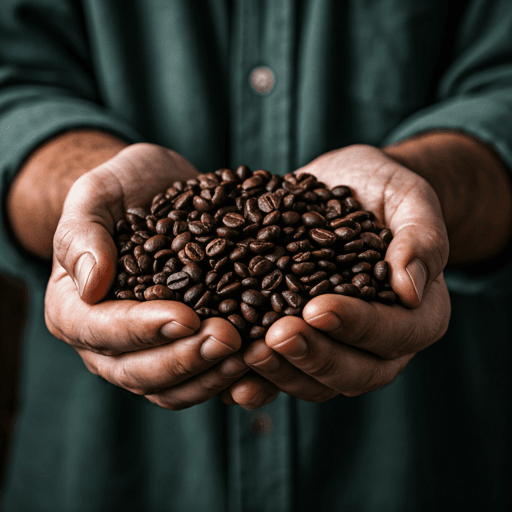
Almost every conversation about roasting stops at the moment the beans leave the drum. The profile has been driven, the drop has been called, the batch is done. Except it isn't. A freshly discharged batch is a pile of very hot, very porous solids sitting in still air, and it holds enough stored energy to keep transforming itself for minutes afterward. Cooling is not cleanup. It is the final act of the roast, and it is the one most often left to chance.
The good news is that cooling is unusually easy to get right once you understand what you are fighting: not time, not gas, but heat that has nowhere to go.
Carryover: the roast that happens after the roast
Cooks know this effect as carryover cooking. Pull a roast joint from the oven and its core temperature keeps climbing for several minutes, because the hot outer layers are still conducting energy inward. Coffee behaves the same way, only faster, because each bean is a small, low-mass object with a huge amount of internal surface area.
Two things drive carryover in coffee specifically. First, the bean's own thermal mass — at discharge the surface may already be shedding heat while the interior is still near its peak. Second, the browning reactions in coffee are partly exothermic in the late stages. That is the same energy release that makes the run toward second crack feel like the roast is accelerating on its own. If beans sit in a warm, still bed, that self-generated heat has nowhere to escape and the reactions continue.
Practically, this means the number on your bean probe when you pull the batch is not the end of the story. Your drop temperature sets where the roast is aimed; the cooling rate decides where it actually lands. Roasters often find their profiles drifting darker between winter and summer for no reason they can see in the curve. The curve is fine. The cooling changed.
The four-minute benchmark
The widely repeated benchmark in specialty roasting is that a batch should reach roughly ambient temperature in about four minutes; some machine builders cite a wider four-to-six-minute window for a full load. Some roasters express it as a temperature target rather than a clock target — generally cited as getting the bean mass below somewhere around 30–40 °C (roughly 86–104 °F) inside that window, at which point meaningful chemical change has effectively stopped.
Treat these figures as rules of thumb, not laws: batch size, bean density, roast level and room conditions all move the target. What is consistent is the direction of the failure: slow cooling reads in the cup as flatness. Tasters describe over-long cool-downs as baked, dull, papery, thin in sweetness, with the fruit acidity smeared into something vaguer. Because the extra development happens invisibly, in a tray, after the data logger has stopped, it is easy to misattribute the fault to the profile.
Cooling is also where a batch's development can quietly overrun its intended window. A carefully judged development ratio built over ten or twelve minutes can be undone by three extra minutes of slow, unstirred cooling.
Air cooling: the specialty default
Air cooling is the standard on essentially every modern specialty machine. The hardware is simple: a shallow, perforated tray — usually stainless — with a fan moving ambient air through the bean bed, and a rotating arm that keeps the beans turning so no part of the pile insulates itself.
What the tray is actually doing
Three mechanisms run at once. Forced convection strips heat from the bean surfaces. The moving air carries away the steam and volatile-laden vapor the beans expel in the first moments after discharge. And the stirring arm keeps the bed shallow and mobile, so beans at the bottom are constantly swapped with beans at the top.
That last point is the one home and small-batch roasters underrate. A static bed of hot coffee is an excellent insulator. The outer beans cool quickly and the core of the pile can stay hot far longer than the four-minute benchmark suggests. Depth matters more than fan power: a thin, agitated layer cooled by a modest fan will usually beat a deep, still pile under a strong one.
Where air cooling struggles
Air cooling is only as good as the air. A hot roastery in high summer, a poorly ventilated room, or a cooling fan drawing its intake from the exhaust side of the machine will all stretch the cool-down. So will over-large batches for the tray, and — counterintuitively — over-fast stirring, which on some designs lifts beans out of the airflow rather than through it. Most integrated cooling systems on production roasting machines are sized for a full batch from a dark drop, so the honest test is a full load on your hottest day, not a half load in the morning.
Water quenching: why industry uses it and specialty distrusts it
Water quenching means spraying a fine mist of water onto the beans, either into the drum during the last seconds or into the cooling bin immediately after. The water flashes to steam almost instantly, and the latent heat of vaporization pulls an enormous amount of energy out of the beans very quickly. As a heat-removal tool it is brutally effective.
The case for it
Large industrial roasters run continuously, discharge very large volumes, and need the reaction stopped now — not in four minutes. Quenching does that reliably at any scale and in any ambient conditions. It also settles chaff and dust, and is argued to recover some aromatic character otherwise lost as vapor during a long air cool.
The case against
Freshly roasted coffee leaves the drum very dry — commonly cited at only around 1–2% moisture, down from roughly 10–12% in the green. Quenching puts some of that water back. That is the whole controversy. Added moisture accelerates staling reactions, and published work on water-quenched versus air-quenched coffee has reported faster degassing in higher-moisture samples and differences in the behavior of certain sulfur compounds consistent with faster oxidation — the kind of change associated with a quicker loss of "just-roasted" freshness, even where most aroma compounds behaved similarly.
There is also a straightforward integrity problem. Water is heavier than steam, and anyone judged on finished weight has an obvious incentive to over-quench. Specialty roasting spent much of the last two decades distancing itself from that practice, and the sensory objection reinforced it: over-quenched lots are frequently described as flat, metallic, leathery or muted.
The nuanced position, held by plenty of experienced production roasters, is that a very light quench used purely as a heat brake is a legitimate tool, and that the reputational damage comes from quenching used as a yield trick. For small and mid-size specialty work, air cooling is nearly always sufficient.
Cooling methods compared
| Method | How it removes heat | Typical setting | Moisture added | Main trade-off |
|---|---|---|---|---|
| Perforated tray + fan + stirring arm | Forced convection through an agitated bed | Specialty drum roasters, all sizes | None | Performance depends on ambient air and batch depth |
| Fluid-bed / separate cooling column | High-velocity air suspends and cools the beans | Air roasters, two-stage industrial lines | None | Fast and even, but bulky and noisy |
| Water quench (light mist) | Latent heat of vaporization | Commercial and industrial volume roasting | Small | Faster staling; heavy skepticism in specialty |
| Water quench (heavy) | Latent heat plus direct wetting | Large-scale commodity roasting | Significant | Flat, metallic notes; short shelf life |
| Colander and fan | Convection plus manual agitation | Home and sample roasting | None | Labor-intensive; easy to under-agitate |
| Two-sieve pour | Convection during transfer, plus air contact in free fall | Home roasting, small batches | None | Very messy with chaff; needs a sink or outdoor space |
Cooling at home
Home roasters usually have no cooling tray at all, so the batch goes from a sealed hot chamber into whatever is on the counter. This is the single easiest place for a home setup to lose quality, and it costs nothing to fix.
Colander and fan
The workhorse method. A wide metal mesh colander over or in front of a box fan, beans in a shallow layer, stirred continuously with a wooden spoon or whisk. Wide beats deep every time — two colanders holding a thin layer each will beat one holding a mound. Metal, not plastic, and never a solid bowl: the whole point is air passing through the bed.
The two-sieve method
Pour the beans back and forth between two colanders or sieves from a height. Each transfer exposes every bean to moving air, and the free fall does a very good job of separating the remaining chaff. Do it over a sink, a bin, or outdoors, because chaff travels. Roasters who use this method typically report a batch down to handling temperature within a few minutes.
What not to do
Do not leave beans in the roasting chamber to coast down; on many home machines that is exactly where the residual heat is highest. Do not spread them on a baking tray and walk away. And do not put hot beans in the fridge or freezer to speed things up — condensation on a bean that is still warm reintroduces exactly the moisture that quenching is criticized for, on the worst possible surface. Air, movement, thin layers. That is the entire technique.
Where cooling ends and degassing begins
It is worth being precise about the handover, because the two stages get conflated constantly. Cooling is heat removal, and it is finished in minutes. What follows is degassing — the slow release of carbon dioxide trapped in the bean's cell structure, which plays out over days and drives the familiar advice to rest coffee before brewing. Cooling does not replace resting, and resting does not fix bad cooling.
They do interact, though. A batch that cooled slowly has already spent some of its aromatic capital, so the rest window that follows starts from a lower ceiling. And a batch quenched with water tends to move through its degassing curve faster while also staling faster — a combination that shortens the useful plateau at both ends.
Once the beans are at ambient temperature and no warmer than the room, they are ready to be weighed, bagged and rested. Warm coffee sealed into a container will sweat, so the discipline is simple: fully cool before packaging, then follow normal practice for storing whole beans — one-way valve, minimal headspace, away from light and heat.
Diagnosing a cooling problem
Cooling faults are sneaky because they never appear on the roast curve. Suspect cooling when the cup is dull and slightly baked despite a profile that looks textbook; when identical profiles taste darker in summer than in winter; when beans look oilier than the roast level should justify; or when a full batch tastes flatter than a half batch of the same coffee.
The diagnostic is straightforward. Time the cool-down with a stopwatch and put a probe or an infrared thermometer into the bean mass — not on the tray. If you are past four or five minutes, fix the airflow, halve the bed depth, or stir more before you touch a single thing in the profile. In the wider arc of what roasting actually does to a green bean, cooling is the cheapest control you have: no fuel, no new equipment, no re-engineering of a curve. Just heat, and a fast, deliberate exit for it.