
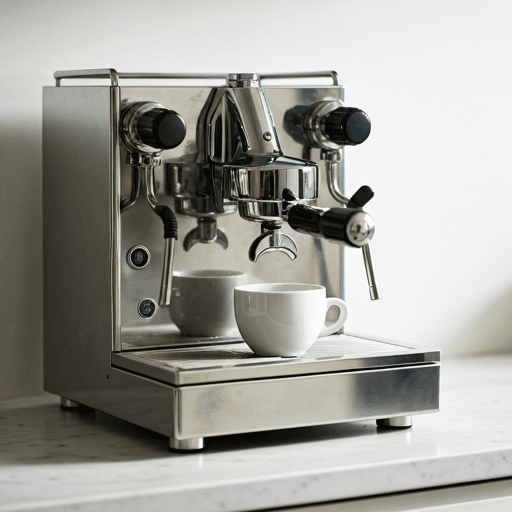
The Rancilio Silvia is a long-running Italian single-boiler, single-group home espresso machine — affectionately nicknamed "Miss Silvia" — that has earned a cult following as a durable, semi-commercial-feeling platform that rewards good technique. It pairs a full-size 58mm portafilter and a genuinely powerful steam wand with a simple, honest design, but on the classic model you manage the brew temperature yourself rather than letting electronics do it for you. This guide explains what the Silvia is, who it suits, the key things to know before you buy, and how it stacks up against the other machines people cross-shop.
What is the Rancilio Silvia?
The Rancilio Silvia is a manual, semi-automatic prosumer espresso machine made by Rancilio, an Italian company far better known for the commercial café machines behind many espresso bars. Silvia borrows a lot of that commercial DNA and shrinks it into a compact, heavy, stainless-steel box built for a home counter. It has been in production for a long time and has evolved gently across revisions rather than being reinvented, which is a big part of its appeal: parts, guides, and community knowledge are everywhere.
"Semi-automatic" here means the machine controls water temperature and pressure through a boiler and a pump, but you do the rest — you grind, dose, distribute, tamp, and decide when to start and stop the shot. There is no built-in grinder, no milk automation, and no touchscreen. That deliberate simplicity is why so many people treat Silvia as their first "serious" espresso machine and a classic way to learn the craft on a platform that will not fall apart while you practice.
Who the Rancilio Silvia is for
Silvia suits the hands-on beginner-to-intermediate who wants to genuinely learn espresso, not just press a button. If you enjoy the ritual — dialing in a grinder, reading the shot, steaming your own microfoam — and you are happy to trade convenience for control and long-term durability, it is a natural fit. It also appeals to people who want one machine that can last many years and be repaired rather than replaced.
It is a poorer fit if you want walk-up, one-touch lattes, if nobody in the household wants to fuss with technique, or if you need to brew and steam back-to-back for a crowd without pausing. Households that value speed and convenience over craft are usually happier with a super-automatic or a pod machine. If you are still weighing formats, our guide on how to choose an espresso machine walks through the trade-offs before you spend anything.
Key things to know before you buy
It is a single boiler — so you brew, then steam
The classic Silvia has one boiler that heats water for both brewing and steaming, but not at the same time. You pull your espresso at brew temperature, then flip the machine into steam mode and wait while the boiler climbs to a much hotter steam temperature. That means espresso and milk happen sequentially, with a short wait between, rather than simultaneously. For one or two drinks it is a minor rhythm to learn; for a steady stream of milk drinks it is the machine's main limitation.
Temperature surfing on the base model
Because the classic Silvia uses a simple thermostat rather than a PID controller, boiler temperature cycles up and down around a target instead of holding a precise number. Enthusiasts manage this with a routine known as "temperature surfing" — watching the heating light and timing the shot to a consistent point in the cycle so every espresso lands in a similar temperature window. It sounds fiddly, and at first it is, but it becomes second nature and is a big reason Silvia is seen as a machine that teaches you. Owners often add an aftermarket PID kit to remove the guesswork, which is one of the platform's most popular modifications.
A commercial-grade 58mm portafilter and brass group
Silvia uses a full-size 58mm portafilter — the same diameter used on many commercial machines — seated in a heavy brass group head. This matters more than it sounds. The 58mm size opens up a huge world of standard baskets, tampers, and accessories, and the thermal mass of the brass group helps stability once the machine is fully warmed up. It also means the skills and tools you build here transfer directly to bigger machines later.
A strong steam wand
For a home machine, Silvia's steam wand is genuinely capable. Steam power is a common weak point on entry-level espresso makers, and here it is a strength — enough to build proper microfoam for latte art once you have the technique, provided you accept the brew-then-steam wait of a single boiler. Steam performance is one of the areas where Silvia punches above many machines at a similar level.
Silvia Pro and Pro X add a dual boiler and PID
Rancilio also offers upgraded models — commonly the Silvia Pro and Silvia Pro X — which move to a dual-boiler layout with PID temperature control. In practice that means you can brew and steam at once, temperatures are held precisely without surfing, and the workflow is faster and more forgiving. They sit at a higher tier and cost more; the classic Silvia remains the simpler, single-boiler entry point. Exact specifications and features vary by model and revision, so confirm the details on the specific version you are considering.
You still need a good grinder and some practice
No espresso machine, Silvia included, can outrun a poor grind. Espresso lives or dies on a grinder that produces a consistent, fine, adjustable particle size, and budgeting for a capable grinder alongside the machine is not optional — it is the single biggest factor in your cup. Add a decent tamper and a little patience, and expect a learning curve of days to weeks before shots come together reliably.
What to look for: how the Rancilio Silvia compares
Choosing Silvia is really a choice about boiler type, control, and how much you enjoy the process. Here is a qualitative look at the aspects that matter most and why.
| Aspect | Rancilio Silvia (classic) | Why it matters |
|---|---|---|
| Boiler layout | Single boiler (brew, then switch to steam) | Sets your workflow: espresso and milk are sequential, not simultaneous |
| Temperature control | Thermostat; no PID on the base model (temperature surfing); PID on Pro models | Affects shot-to-shot consistency and how much fuss dialing in takes |
| Portafilter | Commercial-style 58mm in a brass group | Standard-size accessories, better thermal stability, skills that transfer |
| Steam wand | Strong for a home machine | Proper microfoam for latte art is achievable with practice |
| Pump | Vibration pump | Typical at this level; reliable and serviceable, a little noisier than a rotary pump |
| Control style | Fully manual, semi-automatic | Maximum control and learning; minimal automation or convenience |
| Build and repairability | Heavy, simple, well-documented, mod-friendly | Long lifespan and a strong upgrade path (PID kits, and more) |
| Relative cost | Mid-range for a "serious" home machine; Pro models cost more | You pay for durability and control rather than gadgets |
Single boiler vs heat-exchanger vs dual boiler
The three common layouts trade off convenience against price and size. A single boiler like the classic Silvia is the simplest and most affordable, at the cost of the brew-then-steam wait. A heat-exchanger (HX) machine lets you brew and steam near-simultaneously from one boiler with a clever plumbing trick. A dual boiler simply dedicates one boiler to each job for the most stable simultaneous performance — the compact Profitec Pro 300 is a good example of that higher tier, brewing and steaming at once with PID on both boilers. If simultaneous milk-and-espresso is a priority, that points you up the range toward the Silvia Pro or a dedicated dual boiler; if you mostly drink straight espresso or one milk drink at a time, the single boiler is plenty.
Manual control vs convenience
Silvia is firmly on the manual end. That is the point — it is a teaching machine — but be honest about your household. If the appeal of espresso for you is craft and repeatability you can influence, Silvia rewards that. If it is speed and hands-off consistency, look at automatic machines instead.
Build quality and upgrade potential
Few home machines are as documented and as modifiable as Silvia. The community has produced PID kits, tools, and step-by-step maintenance guides for years, so a well-kept Silvia can serve for a very long time and grow with your skills. That repairability and mod culture is a genuine part of the value, not a footnote.
Steam performance
If milk drinks matter to you, Silvia's steam is a highlight relative to its tier. The catch is always the single-boiler wait, not the wand's power. Moving to a Pro model removes the wait rather than adding steam strength.
Rancilio Silvia vs other classic entry machines
The Silvia's most obvious sibling in spirit is another long-serving single-boiler icon; our Gaggia Classic guide covers that alternative in depth, and the two are frequently cross-shopped as first "real" espresso machines with big modding communities. If your priority is keeping spend down while still getting a machine you can learn on, the wider landscape of lower-cost options is covered in our roundup of the best budget espresso machines. Silvia tends to be positioned a rung above the cheapest starters on durability and steam, and a rung below prosumer HX and dual-boiler machines on convenience.
Is the Rancilio Silvia worth it?
For the right owner, yes. The Rancilio Silvia is not the fastest, the most convenient, or the most automated machine you can buy, and it does not pretend to be. What it offers is a durable, repairable, commercial-flavored platform with a full-size portafilter, strong steam, and a design simple enough to understand and modify — a machine that teaches you espresso and can keep going for many years while it does. If you want push-button lattes it is the wrong tool; if you want to genuinely learn the craft on something built to last, Miss Silvia has earned her reputation.