
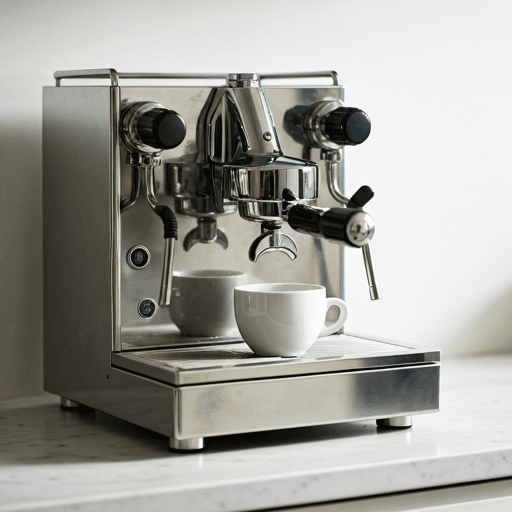
To choose an espresso machine, start with one honest question: how much do you want to do? The machines fall into five families — manual lever, semi-automatic, automatic, super-automatic (also called bean-to-cup), and capsule/pod — and they trade hands-on control for convenience along a sliding scale. Pick the family that matches your skill, your budget and your patience first, then worry about brands and specs. This guide walks you through all five, the features that genuinely matter, and the common traps.
Espresso is a small, concentrated coffee made by forcing hot water through finely ground, tamped coffee under pressure — around 9 bar is the long-standing target. Every machine below does that one job; they just differ in how much of the work they hand to you versus a motor and a microchip. Espresso is the base of nearly every café drink, from a cappuccino to a latte, so getting the machine right shapes a lot of cups to come.
The five types of espresso machine, compared
Here is the quick map before we go deeper. Think of it as a spectrum from "you are the barista" to "the machine is the barista."
| Type | You control | Best for | Effort |
|---|---|---|---|
| Manual / lever | Everything, including the pressure | Hobbyists who love the craft | High |
| Semi-automatic | Grind, dose, tamp, start/stop | Most home enthusiasts | Medium |
| Automatic | Grind, dose, tamp (machine times the shot) | People who want consistency with some hands-on | Medium-low |
| Super-automatic / bean-to-cup | Press a button | Convenience-first households and offices | Low |
| Capsule / pod | Insert capsule, press | Lowest fuss, fastest, smallest learning curve | Lowest |
Manual / lever machines
A lever machine is the purist's tool. You grind, dose and tamp the coffee, then raise and lower a spring or piston lever to pre-infuse and then push water through the puck yourself. The phrase "pulling a shot" comes from exactly this motion. You feel the pressure build in your hand, which is part of the appeal — and the steep learning curve. Lever machines reward practice with espresso that you have shaped end to end, but they are unforgiving of a bad grind and they ask the most of you. They sit at the premium and enthusiast tier, and they are not the right first machine for most people.
Semi-automatic machines
This is the sweet spot for a huge share of home enthusiasts. You still grind, dose and tamp the coffee and lock the portafilter in, but an electric pump delivers water at the right pressure for you. You decide when to start and stop the shot. That single bit of automation removes the hardest manual variable — pressure — while leaving you full creative control over the parts that shape flavour: grind, dose, distribution and timing. If you want to learn real espresso skills without fighting a lever, a semi-automatic is usually the answer. It is also the format most "prosumer" home machines use.
Automatic machines
An automatic espresso machine is a semi-automatic with one extra trick: volumetric control. You still grind, dose and tamp, but the machine measures the water and stops the shot for you at a pre-set volume. That means more shot-to-shot consistency and one less thing to time. If you love the ritual of preparing the coffee but would rather the machine handled the stopwatch, an auto espresso machine is a comfortable middle ground.
Super-automatic / bean-to-cup machines
A super-automatic, often sold as "bean-to-cup," automates the whole chain. It has a built-in burr grinder, doses and tamps internally, extracts the shot, and on many models steams or froths the milk automatically too. You add whole beans and water, press a button for espresso, cappuccino or latte, and walk away. The trade is control and ceiling: you cannot fine-tune the puck the way a barista does, so the very best cup an enthusiast machine can produce is usually out of reach. But for a busy household, a shared office, or anyone who values one-touch reliability over tinkering, a super-automatic espresso machine is hard to beat. Brands like De'Longhi build heavily in this space — see our De'Longhi espresso machines guide for how their range is laid out.
Capsule / pod machines
Capsule machines are the lowest-effort, fastest, most foolproof option. You drop in a sealed capsule, press a button, and a consistent shot-style coffee comes out in seconds with almost no skill required and nothing to clean from a puck. The flavour is reliable but capped — many people describe pod coffee as "strong coffee" rather than true café espresso, because you cannot adjust the grind, dose or pressure. There is also ongoing cost and waste to weigh: capsules are a per-cup expense, and single-serve formats create more packaging waste than loose beans, though recyclable and compostable capsule options keep growing. If you want one perfect-enough cup with zero learning curve, this is the category.
How to choose an espresso machine by skill, budget and convenience
Forget the spec sheet for a moment. Three questions sort most of the field.
How much skill do you want to develop?
- I want to learn the craft and chase the best possible cup. Look at semi-automatic, then perhaps lever later. These reward practice.
- I want good coffee with some control, but not a hobby. Automatic or a higher-end semi-automatic with a quality grinder.
- I just want a great drink at the touch of a button. Super-automatic / bean-to-cup, or capsule if you want it even simpler.
What is your real budget — including the grinder?
This is the trap that catches first-time buyers. For any machine where you grind your own beans, the grinder is not an accessory — it is arguably the more important purchase. Espresso needs a very fine, even, flour-like grind, and a cheap grinder cannot deliver that consistently. A modest machine paired with a good grinder will out-pull an expensive machine paired with a poor one. Budget for both together, or buy a super-automatic or capsule machine where the grinding (or the capsule) is handled for you. Talk about cost in tiers — entry-level, mid-range, premium — rather than chasing a number; prices vary widely by country and retailer.
How much convenience do you need day to day?
Be honest about mornings. A semi-automatic asks for five focused minutes and a tidy-up. A super-automatic asks for a button press and an occasional rinse cycle. A capsule machine asks for almost nothing. Many enthusiasts buy more machine than their actual routine supports, and the gear ends up unused. Match the machine to the morning you really have.
Espresso equipment and specs that actually matter
Once you have picked a family, a handful of features in the espresso equipment do the heavy lifting. Most of the rest is marketing.
How the machine heats water: thermoblock vs boiler
- Thermoblock / thermocoil: heats water on demand as it flows through a metal block. It warms up fast (often under a minute) and is common on entry and mid-range machines. Great for one or two drinks; less ideal for back-to-back milk steaming.
- Single boiler: one boiler for brewing and steaming, so you brew, then switch and wait to steam. Affordable and capable, but slower for milk drinks.
- Heat exchanger (HX): one steam boiler with brew water heated through it, letting you brew and steam at the same time. A step up in workflow.
- Dual boiler: separate boilers for brew and steam, so you can pull a shot and steam milk simultaneously with stable temperatures. The premium-tier choice for milk-drink households and the best temperature stability.
Temperature control (PID)
A PID controller holds the brew temperature steady shot to shot, often within a fraction of a degree, instead of letting it drift several degrees the way a simple thermostat does. For anyone who wants to dial in and improve, a PID is the practical floor — without it you can never tell whether a taste change came from your grind tweak or a random temperature swing. It is one of the most worthwhile features to pay up for on a semi-automatic.
Pressure
You will see "15 bar" or "19 bar" on the box. That is the pump's maximum, not what reaches the coffee — true espresso extracts at a stable ~9 bar at the puck, and well-designed machines manage that for you. Do not pick a machine on its headline bar number alone; stable pressure across the whole 25-30 second shot matters far more than a big peak figure.
Portafilter size and built-in grinder
On semi-automatics, a 58mm portafilter is the commercial standard, which means accessories and skills carry over if you upgrade. Smaller 51mm or 54mm portafilters are common on compact machines and are perfectly capable for home use. If a machine has a built-in grinder (many automatics and all super-automatics do), check that its grind is genuinely fine and adjustable enough for espresso — a weak built-in grinder undermines the whole machine.
The milk system
If you mostly drink cappuccinos and lattes, the milk system deserves real weight. A manual steam wand gives you the best microfoam and latte-art potential but takes practice. An automatic frother or carafe is more convenient and consistent but less expressive. Match it to whether you want to learn milk texturing or just want it done.
What about the beans and the grind?
No machine fixes bad inputs. Use fresh beans within a few weeks of their roast date, and grind right before brewing — ground coffee stales within minutes. For espresso you want a fine, even grind and a consistent dose (commonly in the high-teens of grams for a double, but follow your basket). Whatever the machine, the shot is only as good as the coffee going in. If you are brand new to actually pulling shots, our walkthrough on how to make espresso at home covers grind, dose, tamp and timing step by step.
Quick decision shortcuts
- First espresso machine, want to learn: mid-range semi-automatic with a PID, paired with a proper grinder.
- Lots of milk drinks, no patience for waiting: dual-boiler semi-automatic, or a super-automatic with an auto milk system.
- One-touch, low-maintenance household or office: super-automatic / bean-to-cup.
- Speed and zero learning curve above all: capsule / pod.
- You love the ritual and want maximum control: lever — but ideally as a second machine after you have the fundamentals.
The bottom line
Choosing an espresso machine is really about choosing your relationship with the coffee. Decide how much you want to do, set a budget that includes a good grinder, and let the specs — heating system, PID, milk option — break the final tie. If you are still weighing espresso against simpler brewing methods altogether, step back to our broader framework on how to choose a coffee maker, and explore brand-specific options like the Breville espresso machines guide once you know which family fits you. The right machine is the one you will actually use, every morning, happily.