
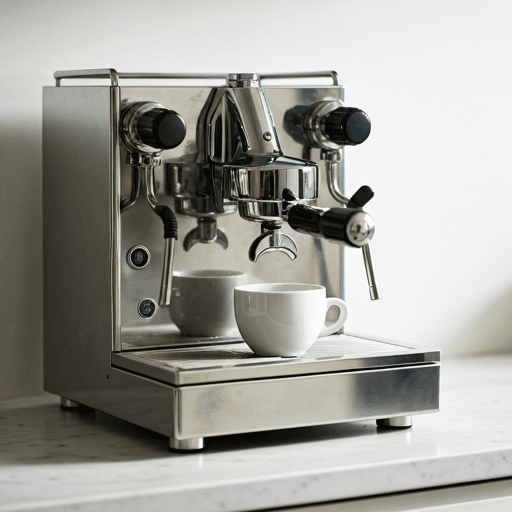
The Profitec Pro 300 is a compact, German-made prosumer espresso machine built around a true dual-boiler system: it has one boiler for brewing and a separate boiler for steaming, both governed by PID temperature control. In practice that means a home barista can pull a shot and steam milk at the same time, with commercial-style temperature stability, from a machine that takes up remarkably little counter space. It sits at the more affordable end of the serious dual-boiler world, but it is still a premium purchase and it needs a good separate grinder to do its job.
This guide walks through what the machine is, who it suits, the key things worth knowing before you commit, and how to weigh it against a heat-exchanger or single-boiler alternative. For the wider category context, see our overview of high-end espresso machines; the specific trade-offs are unpacked in the sections below.
What is the Profitec Pro 300?
The Profitec Pro 300 is a single-group home espresso machine from Profitec, a German manufacturer in the same family as ECM. It is one of the most compact dual-boiler machines you can buy: a stainless-steel body roughly 25 cm (about 10 inches) wide, which is unusually narrow for a machine that carries two separate boilers. Despite the small footprint it is engineered like a scaled-down commercial machine, with a 58 mm portafilter, a proper steam wand, and a heated group.
The whole point of the Pro 300 is to bring the two features serious home baristas care about most, a dual-boiler layout and precise PID temperature control, into a package that fits on a normal kitchen counter. It is a "prosumer" machine: more capable and more repairable than a typical entry-level appliance, but designed for the home rather than a busy cafe. Note that Profitec has since introduced a successor (the Profitec Move) that carries the same compact dual-boiler philosophy forward, so exact styling and internal revisions vary by model year and market, hedge any spec against the current listing.
Who the Pro 300 is for
This is a machine for someone who has decided they want cafe-quality milk drinks and repeatable espresso at home and is ready to invest accordingly. It rewards a user who will dial in a grinder, weigh their doses, and steam their own microfoam. If you mainly drink black espresso or the occasional single cup, a single boiler or even a good manual setup may serve you just as well for less. But if you routinely make back-to-back cappuccinos or lattes, the ability to brew and steam simultaneously without waiting is exactly what a profitec pro 300 dual boiler setup buys you.
Key things to know about the Profitec Pro 300
A useful Profitec Pro 300 review comes down to a handful of design decisions. Here is what actually matters day to day.
Dual boilers plus PID
The Pro 300 uses two independent boilers, a smaller brass brew boiler dedicated to espresso temperature and a larger stainless-steel boiler for steam and hot water. Because they are separate, brewing and steaming never compete for the same heat, so you can extract a shot and texture milk at once. The PID controller holds the brew boiler to a tight tolerance (Profitec quotes control to within about a degree) and the display doubles as a shot timer. Being able to set an exact brew temperature and see it hold is the single biggest reason people step up to a machine like this. Approximate boiler volumes are on the order of 0.4 litres for the brew boiler and roughly three-quarters of a litre for steam, though you should treat exact figures as revision-dependent.
A genuinely small footprint
Footprint is the Pro 300's headline trick. At around 25 cm wide and roughly 38 to 42 cm deep and tall, it is one of the narrowest dual boilers available, which is why it turns up so often on shortlists for small kitchens. That compactness does come with trade-offs, chiefly smaller boilers than a full-size machine, but for most home volumes it is a sensible balance. Heat-up is quick for the class, often under ten minutes from cold.
The 58 mm portafilter and steam wand
The Pro 300 uses a commercial-standard 58 mm portafilter, the same size used on cafe machines. That matters because it opens up a huge world of aftermarket baskets, tampers, and bottomless portafilters, and because 58 mm is the size most espresso technique and accessories are built around. The steam wand is powerful for the machine's size, dry steam with enough pressure to build proper latte-art-ready microfoam, which is really the payoff of having a dedicated steam boiler.
Water tank and plumbing
The Pro 300 draws from an internal water reservoir, and it carries a generously sized tank for its class (around three litres), so refills are infrequent. It uses a vibration pump rather than a rotary pump. It is primarily a tank-fed machine; plumb-in behaviour varies by revision and market, and it is not the machine to assume a direct water line on, so confirm the current configuration before you plan a plumbed setup. For most home users the tank is the intended and simplest way to run it.
It needs a separate grinder
Like almost every prosumer profitec espresso machine, the Pro 300 does not include a grinder, and it is unforgiving without a good one. Espresso lives or dies on grind consistency and fine adjustment, so budget for a quality burr grinder alongside the machine, not as an afterthought. Pairing a capable machine with a weak grinder is the most common way people end up disappointed with an otherwise excellent setup.
What to look for when weighing up a compact dual boiler
If you are cross-shopping, these are the axes that separate machines like this from the alternatives. Deciding among them is really the heart of choosing any compact dual boiler espresso machine.
Dual boiler vs heat-exchanger vs single boiler
A dual boiler (like the Pro 300) has fully separate brew and steam circuits, giving independent temperature control and true simultaneous brewing and steaming. A heat-exchanger draws brew water through a single steam boiler, so it can also brew and steam at once but with less direct control over brew temperature. A single boiler does one thing at a time, you brew, then wait for it to heat up to steam, which is slower but simpler and cheaper. For milk-drink lovers who want temperature precision, the dual boiler is the most flexible; for espresso purists on a budget, a single boiler can be plenty. Our guide to dual-boiler espresso machines unpacks that trade-off in detail.
PID and temperature control
PID (proportional-integral-derivative) control is what lets you set and hold a precise brew temperature. On a machine at this level it should be adjustable, stable, and easy to read. The Pro 300 delivers this on the brew side and adds a shot timer, which together make dialling in far more repeatable than temperature-guessing on an un-PID'd machine.
Footprint and heat-up
Measure your counter, including height under cabinets and clearance to lift the tank lid or fill from the top. Compact machines like this one win on space but tend to have smaller boilers, which can mean shorter continuous steaming before a brief recovery. For a household making a couple of drinks at a time, that is rarely a real limitation.
Build quality and serviceability
Part of what you pay for at this tier is longevity and repairability, standard commercial-style parts, a stainless body, and a maker with a spare-parts ecosystem. Profitec's shared lineage with ECM means it draws on established German build practices. A machine you can descale, gasket, and service is one you keep for many years, which is a big part of the value case for spending more up front.
Steam performance
If milk drinks are your reason for buying, steam power and the quality of the wand matter as much as the brew side. A dedicated steam boiler, as on the Pro 300, gives dry, consistent steam that makes silky microfoam achievable with practice. This is the clearest everyday advantage of a dual boiler over an entry-level single-boiler machine.
Profitec Pro 300 at a glance
The table below summarises the features that define the machine and why each one matters. Cost is described qualitatively only, this is a premium machine, positioned toward the more accessible end of the serious dual-boiler market rather than as a budget buy.
| Feature | Profitec Pro 300 | Why it matters |
|---|---|---|
| Boiler layout | True dual boiler (separate brew and steam) | Brew and steam at the same time with independent temperature |
| Temperature control | PID on the brew boiler, with shot timer | Set and hold a precise, repeatable brew temperature |
| Portafilter | 58 mm commercial standard | Wide accessory choice and standard espresso technique |
| Footprint | Very compact (about 25 cm wide) | Fits small kitchens where full-size dual boilers won't |
| Steam | Dedicated steam boiler and wand | Dry, powerful steam for latte-art microfoam |
| Water supply | Large internal tank, vibration pump (plumb-in varies, hedge) | Infrequent refills; simple counter-top use |
| Grinder | Not included, needs a separate quality grinder | Grind quality determines how good the espresso can be |
| Cost tier | Premium, toward the accessible end of dual boilers | Serious investment, but repairable and long-lived |
How it compares to the alternatives
The most useful way to place the Pro 300 is against the two main alternatives. Compared with a heat-exchanger machine, it trades a little size and outright steam-boiler capacity for genuinely independent brew-temperature control. Compared with a classic single-boiler machine, it removes the wait between brewing and steaming altogether, at a higher price and with a bit more complexity. A good touchstone on the single-boiler side is the Rancilio Silvia, the iconic one-boiler home machine that many baristas learn on, where you brew first and then "temperature surf" up to steam. If you value simplicity and cost, that route is proven; if you value simultaneous milk drinks and set-and-forget temperature, the dual-boiler Pro 300 is the upgrade path.
Ultimately the Profitec Pro 300 earns its place by putting two genuinely useful capabilities, a dual-boiler system and PID control, into a footprint most kitchens can spare, without asking for cafe-machine space. It is not the cheapest way into espresso, and it is only as good as the grinder and the practice behind it. But for a home barista who is serious about milk drinks and wants a machine to keep for years, it is one of the most sensible compact dual boilers to build a coffee routine around. When you are ready to compare it more widely, our how to choose an espresso machine guide is the place to start.