
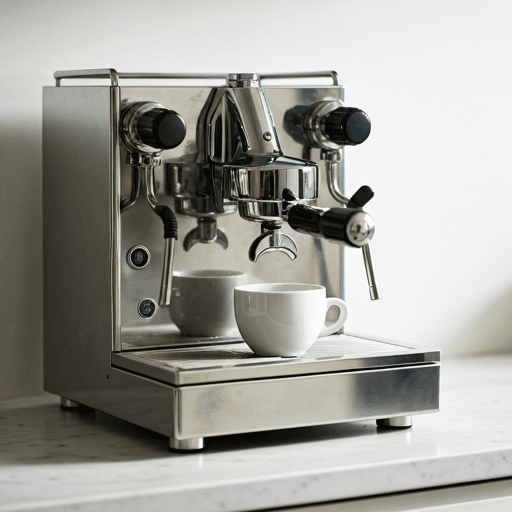
A dual boiler espresso machine is an espresso machine with two separate boilers (or two independently heated circuits): one held at brew temperature, around 93C / 200F, and a hotter one for steam, around 125C / 257F. Because the two never share a tank, you can pull a shot and steam milk at the same time, each at its own stable, dialed-in temperature. That single capability is the whole reason these machines exist, and it is what separates them from cheaper designs.
This is an editorial buying guide, not a ranked review. Below we explain what a dual boiler does, how it stacks up against the two other common boiler layouts, what you gain and what you pay for, and a plain checklist for deciding whether you actually need one.
What is a dual boiler espresso machine?
A dual boiler espresso machine runs two boilers in parallel. The brew boiler heats only the water that goes through the coffee, and it is kept at a relatively gentle brewing temperature. The steam boiler runs much hotter to generate the pressurized steam that textures milk. Each boiler usually has its own PID (Proportional-Integral-Derivative) controller, a small bit of electronics that holds a set temperature very tightly.
That precision is the point. A basic thermostat can let boiler temperature swing 5 to 10F as it cycles on and off. A good PID typically trims that variance to under 1F, so shot after shot lands on the same number. Higher-end machines also heat the group head, the metal block the portafilter locks into, so the water does not cool on its way out. The result is a setup built for repeatability: you choose a brew temperature, and the machine holds it whether it is your first cup or your fifth.
Single boiler vs dual boiler vs heat exchanger
To know whether a dual boiler is worth it, it helps to see the three layouts side by side. The real question every design answers differently is: can you brew and steam at the same time, and how stable is the brew temperature?
Single boiler
A single boiler machine uses one boiler for both jobs. It heats to brew temperature for the shot, then you flip a switch and wait while it climbs to steam temperature, then wait again for it to cool back down before the next shot. You cannot do both at once. This is the most affordable and most compact layout, it warms up fast, and it is genuinely fine if you mostly drink espresso, Americanos, or other black coffee. The friction shows up only when you make milk drinks: the single boiler vs dual boiler gap is really a gap in waiting time and milk-drink throughput.
Heat exchanger espresso machine
A heat exchanger espresso machine, often shortened to HX, is the clever middle ground. It runs one large boiler at steam temperature and passes fresh brew water through a tube (the heat exchanger) that sits inside that hot boiler. The water picks up heat as it travels to the group head without ever mixing with the steam water, so you can brew and steam simultaneously from a single boiler. The catch is temperature management: because the brew water borrows heat from a much hotter boiler, its temperature drifts depending on how long the machine has been idle. After a quiet stretch the first shot can run hot, so HX owners often run a quick "cooling flush" of water through the group before pulling. It is a learnable habit, not a flaw, but it is a habit.
Dual boiler
A dual boiler sidesteps the HX compromise entirely. Two boilers mean the brew water is never borrowing heat from the steam side, so brew temperature is set directly and held steady, no cooling flush required, no warm-up guesswork. You also get simultaneous brew and steam like an HX, plus the tight, independent temperature control of a PID on each side. The trade-off is that you are paying for, powering, and maintaining two boilers instead of one.
| Boiler type | Brew + steam at once? | Brew temp stability | Warm-up | Relative cost | Best for |
|---|---|---|---|---|---|
| Single boiler | No (switch and wait) | Good with PID, but no overlap | Fast | Entry-level | Mostly-black-coffee drinkers, small counters, tight budgets |
| Heat exchanger (HX) | Yes | Variable; usually needs a cooling flush | Medium | Mid-range to premium | Frequent milk drinks, owners happy to learn the flush routine |
| Dual boiler | Yes | Most stable; set and hold each side | Slower | Premium | Precision seekers and busy milk-drink households |
The benefits of a dual boiler
- Brew and steam at the same time. No flipping modes, no waiting. You can be steaming a pitcher of milk while the shot runs underneath.
- Shot-to-shot temperature stability. Independent PID control on the brew boiler removes temperature as a variable, which is exactly what you want when you are dialing in a new coffee and changing one thing at a time.
- Fast back-to-back drinks. Because the brew boiler recovers quickly and never has to swing to steam temperature and back, it is hard for your workflow to outrun the machine. That matters when you are making four cappuccinos for guests.
- No cooling-flush guesswork. Unlike a heat exchanger, the brew temperature is what you set, cold morning or not.
- Headroom to grow. Adjustable brew temperature by the degree and strong, steady steam give you room to refine technique for years.
The trade-offs and costs
Two boilers cost more to buy, full stop, so dual boilers sit at the premium end. They are bigger and heavier, draw more power, and generally take longer to reach full readiness; expect the steam side in particular to need several minutes (often well under ten) before it has the pressure to steam and brew at once. There is also more to keep up: two boilers and more plumbing mean more to descale and, eventually, more that can need service. None of this is a dealbreaker, but it is the honest other side of the convenience. If you want to weigh a single specific machine against the field, our Breville Dual Boiler guide walks through one popular example in detail.
Who should get one, and who can skip it
A dual boiler makes the most sense if you make milk drinks often, value temperature precision, or run a busy morning where several cappuccinos go out back to back. Enthusiasts who like to dial in single-origin coffees, and households where lattes and flat whites are the daily order, get the clearest payoff.
You can comfortably skip it if you drink mostly espresso or black coffee, make one or two cups a day, or are working with a tight budget or a small counter. In those cases a quality single boiler with a good PID, or a heat exchanger if you want occasional simultaneous steaming, often delivers most of the experience for less money and less bulk. The broader trade-offs are covered in our guide on how to choose an espresso machine.
How to choose a dual boiler espresso machine
- Do you truly need simultaneous brew and steam? If most of your drinks are black, a single boiler may serve you just as well for far less.
- How important is temperature precision? If you change variables to dial in coffees, independent PID control on each boiler is the headline feature to look for.
- Build, size and warm-up. Measure your counter and check the height under your cabinets. Heavier, better-insulated machines tend to hold heat well but take up more room and take longer to warm.
- Tank or plumbed. Most home machines use a removable water tank; some prosumer models can be plumbed to a water line and drain. Plumbing is convenient but needs the right spot.
- Budget tier and upkeep. Think in qualitative tiers, entry-level, mid-range, premium, and factor in ongoing descaling and the higher cost of servicing two boilers down the line.
- Pair it with a grinder. A precise machine is only as good as the grind feeding it. Budget for a capable burr grinder alongside the machine, not as an afterthought.
Well-known dual boiler machines
Plenty of makers build dual boilers, and naming them here is purely illustrative, not an endorsement or a ranking. In the home and "prosumer" space, the Breville Dual Boiler (sold as Sage in some regions) is a widely owned example with PID control and a heated group. Traditional Italian and European prosumer brands such as Profitec, ECM and Rocket make dual boiler models aimed at enthusiasts, and La Marzocco's home machines bring a commercial dual boiler heritage to the kitchen. Each changes the cabinet, controls and steam power, but the underlying two-boiler principle is the same. For a wider field of options across all boiler types, browse our overview of the best espresso machines.
The bottom line
A dual boiler espresso machine buys you two things money cannot easily fake: the freedom to brew and steam at once, and rock-steady temperature you can dial to the degree. If you live on milk drinks or chase precision, that is a real upgrade. If your cup is usually black or your routine is occasional, a single boiler or a heat exchanger espresso machine will likely make you just as happy. Once you have the hardware sorted, the next step is technique, so read up on how to make espresso at home and let the gear earn its keep.