
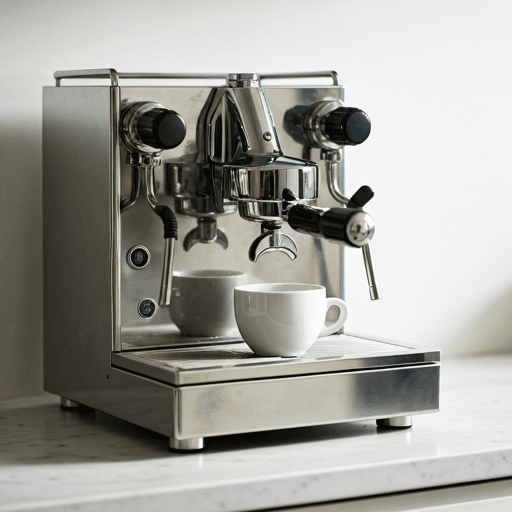
The Breville Dual Boiler is a prosumer home espresso machine, model BES920, built around two separate boilers: one heats water for the shot and one makes steam, so you can brew and steam at the same time. Many people type "Breville double boiler" into search, but the correct product name is the Breville Dual Boiler (sold as the Sage Dual Boiler in some regions). It is a hands-on, dial-it-in-yourself machine for people who want cafe-style control at home, not a one-touch bean-to-cup automatic.
What the Breville Dual Boiler is
An espresso machine has two jobs that want very different temperatures. Brewing a shot wants water around 90-96 C (roughly 194-205 F). Steaming milk wants something much hotter to make pressurized steam. A single-boiler or single-heater machine has to keep flipping between those two states, which means waiting and small temperature swings. A dual boiler simply uses one boiler for each job, so neither has to compromise.
The Breville Dual Boiler runs a dedicated brew boiler and a separate steam boiler, with PID temperature control keeping the brew side rock-steady (Breville quotes precision within a couple of degrees). The brew temperature is adjustable in a sensible range for espresso, and the steam boiler delivers strong, dry steam on demand. Because the two boilers are independent, you can extract a shot at the exact temperature you set while texturing milk at the same moment, the way a barista works behind a counter.
What PID control actually does
PID stands for proportional-integral-derivative, which is a fancy way of saying the machine smooths out temperature instead of just switching a heater on and off. The result is consistency: the same recipe tastes the same cup after cup, because the brew water lands at the temperature you dialed in rather than drifting. Temperature stability is the single biggest reason enthusiasts step up to a machine like this.
Breville double boiler vs Breville Dual Boiler: same machine, two spellings
If you have searched "Breville double boiler," you are looking for this same machine. "Double boiler" is the common misspelling; Breville calls it the Dual Boiler, and the model code is the Breville BES920. In the United Kingdom, Europe and Australia the brand trades as Sage, so the identical machine is sold as the Sage Dual Boiler. A double boiler, in cooking, is actually a pot-over-water setup for melting chocolate, which is why the espresso machine is properly a "dual" boiler. Same hardware, two names, one idea: two boilers doing two jobs at once.
Why enthusiasts step up to the dual boiler
Beyond the two boilers, the BES920 carries the kind of features you normally find on small commercial machines:
- Simultaneous brew and steam. No waiting to switch modes mid-drink, so making two milk drinks back to back is quick and the shot temperature never has to recover.
- Powerful, adjustable steam. The steam boiler produces strong steam for fast, fine microfoam, and you can set the steam temperature to taste.
- Programmable pre-infusion. A gentle low-pressure soak before full pressure helps the puck saturate evenly and reduces channeling, which gives a sweeter, more even shot.
- A shot clock and pressure gauge. You can watch extraction time and pump pressure in real time, the two key feedback signals for dialing in a recipe.
- A 58 mm portafilter. This is the commercial standard size, so baskets, tampers and accessories are easy to find, and the larger basket helps even extraction.
- Volumetric shot control. You can program shot volumes so the machine stops itself, or run fully manual.
None of this is automated for you. The Dual Boiler gives you the tools; you supply the grind, dose and tamp. That trade-off is exactly the appeal for a home barista who wants to learn the craft.
Dual boiler vs single boiler or thermocoil: what it means for you
Most of Breville's more affordable machines use a single heating system rather than two boilers. Here is how the two approaches compare in practice.
| Heating system | What it is | What it means for you |
|---|---|---|
| Dual boiler (Breville Dual Boiler / BES920) | Two independent boilers plus PID, one for brewing and one for steaming | Brew and steam at the same time; very stable temperature; powerful steam. Longer warm-up from cold (about 10-15 minutes); no built-in grinder. |
| Single boiler | One boiler that switches between brew and steam temperatures | Simpler and often cheaper, but you wait while it heats up or cools down between pulling a shot and steaming milk. |
| Thermocoil / ThermoJet (Barista Express, Barista Pro) | One fast-heating element that flash-heats water on the way through | Near-instant warm-up and great for back-to-back shots, but it still toggles between brew and steam, so it does not run both as freely as a dual boiler. |
The headline difference is freedom. A dual boiler lets you brew and steam in parallel with steady temperature; the single-circuit machines are quicker to wake up and usually bundle a grinder, which makes them a friendlier first machine. If you are weighing these options, our guide on how to choose an espresso machine walks through the trade-offs in more detail.
Who the Breville Dual Boiler is for
This machine suits the home barista who wants prosumer control and is happy to dial everything in by hand. It rewards practice: weighing your dose, choosing a grind, tamping level, watching the shot clock and pressure gauge, and texturing your own milk. If that sounds like a fun project rather than a chore, the Dual Boiler is a machine you can grow into for years.
It is not the right pick if you want to press one button and walk away. For that, a bean-to-cup or a fully automatic Breville like the Oracle range is a better fit. Two things to plan for:
- It has no built-in grinder. Unlike the Barista Express or Barista Pro, the Dual Boiler expects you to bring your own grinder. A good burr grinder, such as the Breville Smart Grinder Pro, matters as much to your cup as the machine itself.
- There is a learning curve. Espresso is a skill. The pay-off is real cafe-quality drinks at home, but the first week is about getting consistent.
How it compares to other Breville espresso machines
Breville's espresso lineup spans beginner to enthusiast, and the Dual Boiler sits near the serious-hobbyist end.
Versus the Barista Express and Barista Pro
The Barista Express and the newer Barista Pro are all-in-one machines with an integrated grinder and a single ThermoJet or thermocoil heater. They are excellent starter machines and heat up fast, but because they use one heating circuit they cannot brew and steam as freely as a dual boiler, and they use a smaller 54 mm portafilter. The Dual Boiler drops the built-in grinder and steps up to two boilers, a 58 mm portafilter and finer temperature control.
Versus the Oracle range
The Breville Oracle, Oracle Touch and Oracle Jet build automation on top of a dual-boiler setup. They automatically grind, dose and tamp, and the Touch adds automatic milk texturing, so you get dual-boiler temperature stability with far less manual work. The trade-off is price and a bit less hands-on involvement. In short: the Dual Boiler is the manual prosumer machine, the Oracle is the automated one, and the Barista Express is the all-in-one beginner machine.
Keeping a Breville Dual Boiler running well
A dual-boiler machine is an investment, and a little routine care keeps it tasting clean and extends its life. Wipe and purge the steam wand after every milk drink, backflush the group with the supplied blind basket, and descale on the schedule the machine prompts (more often in hard-water areas). The machine has on-screen cleaning and descale alerts to guide you. For a full walk-through, see our Breville descaling and cleaning guide. Using filtered or softened water is the easiest way to slow scale build-up in the first place.
The bottom line
The Breville Dual Boiler is a genuine step into prosumer territory: two boilers, steady PID temperature, simultaneous brew and steam, and the manual control that lets you actually learn espresso. It asks more of you than a one-touch machine and needs a separate grinder, but it gives back consistency and the satisfaction of pulling your own shots. If you are still deciding where to start, compare it against the rest of the family in our Barista Express guide, and read up on how to choose an espresso machine before you commit.