
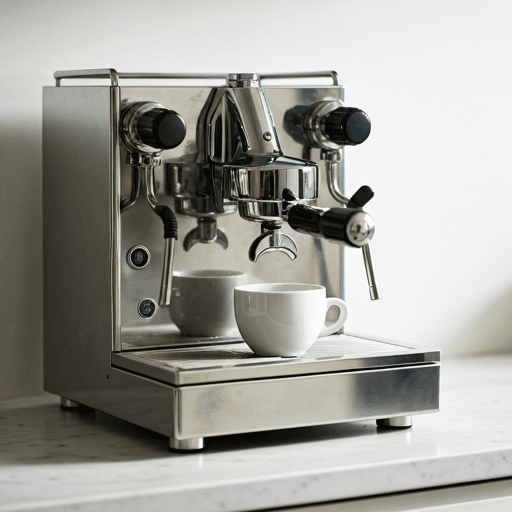
Descaling a Breville coffee machine means flushing limescale and mineral buildup out of its boiler and internal water path, usually with a Breville descaler solution dissolved in fresh water. Most Breville espresso machines tell you when it is due with a DESCALE light, and the whole cycle takes roughly 20 to 30 minutes. Below is what descaling does, how to run the cycle safely, how often to do it, and how it differs from everyday cleaning.
What descaling actually does (and why it matters)
Every time your machine heats water, dissolved minerals -- mainly calcium and magnesium -- are left behind as hard, chalky scale. That scale coats the heating element, narrows the boiler and pipes, and clogs the group head over time. Descaling dissolves and rinses those deposits away.
Why bother? Scale is a quiet performance killer. It insulates the heating element so the machine struggles to hit and hold the right brew temperature, which dulls extraction and flavor. It restricts flow, so shots run slow or weak. Left long enough, it can damage pumps and valves and shorten the machine's life. A descaled machine simply brews hotter, faster, and tastes cleaner. To get the best from those shots, pair good maintenance with good technique in our guide to how to make espresso at home.
The DESCALE light on Breville espresso machines
Many Breville espresso machines -- the Barista Express, Barista Pro, Barista Touch and similar -- count how much water has passed through and light a DESCALE indicator when it is time. On button models this is usually a dedicated light; on touchscreen models a descale prompt appears in the settings or maintenance menu. The light is a reminder, not an emergency: finish your current coffee, then set aside half an hour. If your model has no alert, go by a schedule based on your water and how often you brew, covered further down.
Using a Breville descaler (and why not vinegar)
Breville sells its own descaler in powder sachets and a liquid form, both built around food-safe citric acid. Using a Breville descaler -- or another descaler approved for espresso machines -- matters for two reasons. First, it is formulated to dissolve scale without attacking the metals and seals inside the machine. Second, using the recommended product keeps you on the right side of the warranty.
It is tempting to reach for white vinegar, but Breville and most other makers advise against it. Vinegar is acetic acid, which can corrode rubber seals and certain metal parts, and it leaves a smell that lingers in the water path. Plain citric acid powder is sometimes used as a cheaper substitute, but it can be too aggressive on aluminum boilers and can leave its own residues, so the safest route is the manufacturer's solution at the dose printed on the pack. Always check your model's manual, because exact quantities and steps vary between machines.
How to descale a Breville coffee machine, step by step
The details differ by model, so treat this as the general shape of how to descale Breville machines, and follow your manual for the exact button presses.
- Empty and clean. Remove and empty the drip tray and the water tank. Take out the water filter if one is fitted -- you do not want to descale through it.
- Mix the solution. Fill the tank to the descale line with fresh water and add the correct amount of Breville descaler powder or liquid, stirring until fully dissolved.
- Enter descale mode. On many button models you press and hold the 1 CUP and STEAM buttons together for a few seconds until the descale lights show. Touchscreen models have a descale option in the menu. If your machine has no descale function, just run the solution through as if brewing until the tank empties.
- Run it through every outlet. Let the machine pump solution through the group head, then through the steam wand, then through the hot-water outlet, so scale is cleared from all three paths.
- Rinse thoroughly. Empty the tank, rinse it, refill with clean water and run a full cycle through every outlet with no descaler in it. Do this rinse at least twice so none of the solution is left behind.
- Refit and test. Replace the water filter, wipe the machine down, and pull a throwaway shot of plain water before you brew for real.
How often should you descale?
There is no single answer, because it depends almost entirely on your water. The harder your water -- the more dissolved minerals it carries -- the faster scale forms. As a rough guide, soft water might need descaling every three months, medium water every one to two months, and hard water every three to four weeks. Heavy daily use shortens the gap further.
The easiest way to descale less often is to feed the machine softer water: fit the supplied water filter and replace it on schedule, or fill the tank with filtered or low-mineral water. Many Breville models include a hardness test strip and a filter holder for exactly this reason. If you are still shopping, water compatibility is worth weighing alongside the other criteria in our guide to how to choose an espresso machine.
Descaling vs cleaning vs backflushing
Descaling is only half of espresso-machine upkeep, and it is easy to confuse with the other half. Descaling tackles mineral scale in the water system. Cleaning and backflushing tackle coffee oils and grounds in the brew path. You need both, on different schedules.
| Task | What it removes | How often (typical) |
|---|---|---|
| Descaling | Limescale and mineral buildup from the boiler and water path | Every 1-3 months by water hardness, or when the DESCALE light shows |
| Backflushing / cleaning cycle | Coffee oils and fine grounds from the group head, shower screen and solenoid valve | About weekly, with a Breville cleaning tablet and the blind filter |
| Daily wipe-down | Surface coffee residue and milk from the wand, tray and portafilter | After every session |
Backflushing uses a blind (blank) filter basket and a Breville cleaning tablet, run on the machine's cleaning cycle, to push water back through the group head. It does nothing for scale, just as descaler does nothing for coffee oils -- which is why both belong in the routine.
A note for Sage owners
If your machine says Sage rather than Breville, you have the same hardware. Breville sells its espresso machines under the Sage brand across the UK and much of Europe, so a Sage descaler and a Breville descaler are the same product under different labels, and every step above applies. For more on the range and what each model does, see our overview of Breville espresso machines and the deep dive on the Breville (Sage) Barista Express.
The takeaway
Descaling is the least glamorous part of owning an espresso machine and one of the most rewarding to stay on top of. Half an hour every few weeks or months -- guided by your water and that DESCALE light -- protects the boiler, holds the brew temperature steady, and keeps every cup tasting the way it should. Pair Breville descaling with a weekly backflush and a daily wipe-down, and a good machine will reward you for years.