
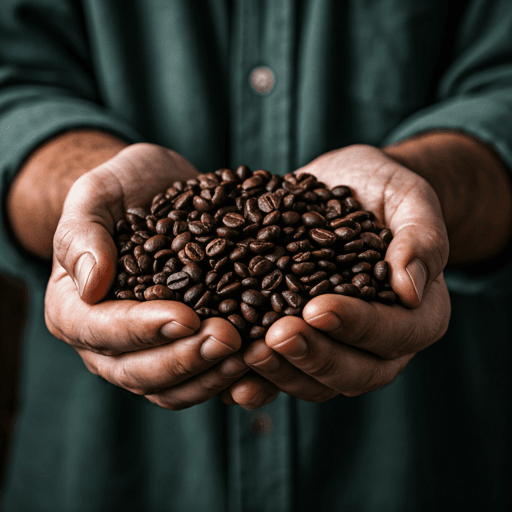
Peruvian coffee is mild, sweet, nutty and gently bright washed Arabica, grown almost entirely by smallholding families on the eastern slopes of the Andes at high altitude. It is also one of the world's largest sources of certified organic and fair-trade coffee. This guide covers what the cup tastes like, where it grows, and the one fact that explains the whole origin: almost nobody in Peru farms coffee at scale.
What Peruvian coffee is
Peru grows Arabica, overwhelmingly washed, across a long ribbon of mountain forest on the eastern side of the Andes — coffee turns up in something like 17 of the country's 24 regions. The species detail lives in our guide to Arabica coffee beans; what matters here is that the national crop is overwhelmingly Arabica rather than split with Robusta, and that the washed process — pulping the cherry and fermenting off the fruit before drying — is the near-universal default. That is why Peru coffee tastes clean rather than fruity-wild.
By export volume Peru sits somewhere around ninth in the world, depending on the year and who is counting. But in one narrow category it leads outright: it is widely described as the world's leading producer of certified fair-trade and organic Arabica. Coffee supports close to a third of Peru's agricultural workforce, which tells you this is not a boutique crop grown on a handful of showpiece estates.
Why smallholders define Peruvian coffee
This is the single most important fact about the origin, and everything else follows from it. Peruvian coffee comes from upwards of 200,000 producers, and the farms are tiny — commonly cited figures run from a bit over one hectare to around three, depending on the survey and the region. There is no Peruvian equivalent of the vast mechanised Brazilian fazenda. There is a mountainside, a family, and a few hectares of coffee trees, picked by hand.
Because a couple of hectares cannot support a mill, an export licence or a cupping lab, growers organise into cooperatives that aggregate lots, handle export, run training, and — crucially — hold the certifications. Cooperative membership is not universal; a commonly cited figure puts roughly a fifth of smallholders inside a formal producer organisation, with the rest selling to intermediaries. That structure explains both of Peru's reputations at once. It explains the certifications, because a co-op can carry an audit that one family never could. And it explains the origin's historic reputation for inconsistency, because pooling hundreds of small deliveries into one exportable lot averages everything toward the middle. Blend a superb picker's cherries with a neighbour's underripe ones and you get a decent, unremarkable, extremely reliable coffee.
The organic story, told honestly
Peru's organic reputation is real — roughly 90,000 hectares are certified — but the usual marketing version of it gets the history backwards. A great deal of Peruvian coffee started out, in the phrase the trade actually uses, organic by default: farms in remote valleys, hours from a road, that were not using agrochemicals because inputs were hard to reach and hard to obtain, not because anyone had made a philosophical decision. The trees were effectively organic long before anyone certified them.
What changed is that cooperatives realised this existing reality could be formalised. If members were already farming without synthetics, the gap between what they did and what a certifier required was small and worth closing. Certification followed the farming rather than the other way round. Some co-ops have been at it for a long time — CECOVASA, the well-known co-op union in the Sandia valleys of Puno, began organic production in the late 1990s.
That framing is truer and more interesting than the marketing one, and it comes with an honest caveat: certification labels describe farming and trading practices, not cup quality. Organic tells you what was not sprayed. Fair-trade tells you something about how the transaction was structured. Neither is a tasting note, and neither is a promise that the coffee in your cup is good. Plenty of certified Peru is ordinary; plenty is lovely. The label cannot tell you which.
Where it grows and why the land matters
Peruvian coffee grows on the eastern Andean slopes, where the mountains fall away toward the Amazon basin. Regional spans start as low as around 900 m, but much of the crop — and nearly all the interesting part of it — sits between roughly 1,200 and 2,000 m (about 4,000 to 6,500 ft), with some farms higher. Altitude does the work here: cool nights slow cherry maturation, which builds density and sugar, and that is where Peru's sweetness and soft acidity come from. The main harvest runs roughly April to September, with the bulk of picking concentrated in the earlier months.
The north — Cajamarca, Amazonas, San Martín — is the production heartland; Cajamarca's Jaén and San Ignacio provinces are the names you will see most often on bags. Junín, centred on the Chanchamayo and Satipo valleys, is the historic central zone. Cusco and Puno, in the south, are smaller and more remote, and Puno in particular has a following for unusually juicy, fruit-forward lots. Cajamarca, San Martín, Junín and Amazonas together account for the large majority of national output.
At a glance: Peru's coffee regions
| Region | Typical altitude | Typical flavour |
|---|---|---|
| Cajamarca (north) | ~900–1,950 m | Sweet, bright acidity, red and yellow fruit; the specialty flagship |
| Amazonas (north) | ~900–2,100 m | Clean and sweet, floral at the top end; the highest ceiling |
| San Martín (north) | ~900–1,200 m | Mild, chocolatey, low acidity, soft body |
| Junín / Chanchamayo (central) | ~900–1,800 m | Balanced, creamy body, dark and yellow fruit, caramel |
| Cusco (south) | ~900–2,000 m | Clean and bright with fruit clarity |
| Puno (south) | ~900–1,800 m | Juicy, tropical fruit, caramel and molasses sweetness |
Treat these as tendencies, not rules. Farm, variety, altitude and processing swing a cup further than a regional label does.
Varieties and the leaf rust reckoning
The traditional Peruvian variety mix is Typica and Bourbon — old, tall, flavour-forward, disease-prone — plus a large amount of Caturra. Typica in particular survived in Peru long after more industrialised origins replaced it, which is part of why the country has old-fashioned, gentle, classical flavours.
Then came roya. The coffee leaf rust epidemic that swept Latin America around 2012–2013 hit Peru hard; loss estimates vary widely by source and region, but they are large, and the damage was severe enough to trigger a national emergency response and a renovation push. Much of the replanting used rust-resistant varieties descended from the Timor hybrid — Catimor above all. That saved farms and livelihoods, and it left a real trade-off behind: Catimor is hardy but rarely as expressive in the cup as the Typica and Bourbon it replaced, and researchers have raised concerns about how much of Peru's planted area now rests on a narrow genetic base. New rust races have been recorded in Peruvian fields that can infect supposedly resistant plants, so the problem is managed rather than solved. If you find a Peru that tastes flat and woody, a Catimor lot on tired soil is a reasonable guess.
From blend filler to single origin
For decades Peru's role in the coffee trade was to be reliable, certified, easy to blend and largely anonymous. Peru coffee beans went into supermarket blends and organic house offerings where the label mattered more than the farm. The reason was structural: with lots pooled at the co-op level, there was often no way to trace a good cup back to the person who grew it. Buyers who tasted something excellent could not find its author.
Separating and naming lots changed that. The clearest marker is Peru's first Cup of Excellence competition in 2017, which drew more than 300 samples and produced 19 coffees scoring 86 or above, several of them above 90. The winning lots came from Cajamarca, Junín, Cusco, Amazonas and San Martín, and included Caturra, Bourbon, Pache and even Geisha; the top three all came from Cajamarca. It proved that the quality had been there all along and the traceability had not. Peruvian coffee beans are now increasingly sold as named-farm single origin rather than disappearing into a blend.
What Peruvian coffee tastes like
The classic profile is mild, sweet and easygoing: almond and nutty notes, cocoa or milk chocolate, a light-to-medium body, and a soft citrus acidity that brightens the cup without sharpening it. Sweetness tends toward caramel and brown sugar. It is a clean, crowd-pleasing cup rather than a loud one, and it does not fight you — Peru is forgiving of a slightly-off grind or a slightly-hot pour, which is part of why it turns up so often as an everyday coffee.
That mildness is the origin's strength and its reputation problem at once. Drinkers chasing intensity sometimes read Peru as plain. Drinkers who want something sweet and balanced they can drink every morning read the same cup as ideal. Both are describing the coffee accurately. At the high end — Amazonas and Cajamarca especially, at altitude, from separated lots — Peru gets genuinely floral and fruit-driven, which surprises people who only know the blend-grade version.
How it compares to its neighbours
Against Colombian coffee, the comparison is close, and Peru usually comes off as the quieter sibling. Both are washed Andean Arabica from small family farms; Colombia typically pushes more acidity and a rounder, more pronounced sweetness, while Peru sits softer, nuttier and more restrained. Colombia also has a powerful national grower federation and a long branding history behind it; Peru's story is co-op-scale and much less marketed, which is a decent part of why the two can taste similar and be talked about so differently.
Against Brazilian coffee, the gap is wider. Brazil is largely lower-altitude, frequently natural-processed and often machine-harvested on enormous farms, giving a heavy, low-acid, chocolate-and-peanut cup. Peru is high, hand-picked, hand-sorted, washed and cleaner, with brightness Brazil rarely offers. If Brazil is the body in an espresso blend, Peru is the sweetness and the lift — a role it has quietly played in blends for years.
The bottom line
Peruvian coffee is what happens when a whole national crop is grown by families on a couple of hectares each, high in the Andes, mostly without synthetic inputs, and pooled through cooperatives to reach the world. That structure gave Peru its organic and fair-trade leadership, its historic anonymity in blends, and its gentle, nutty, cocoa-sweet, softly bright cup. The origin is now doing the slow work of separating and naming its best lots, and the coffees that come out of that work are considerably more interesting than Peru's blend-filler reputation suggests. Ignore the label on the front; ask which region, which altitude, which farm.