
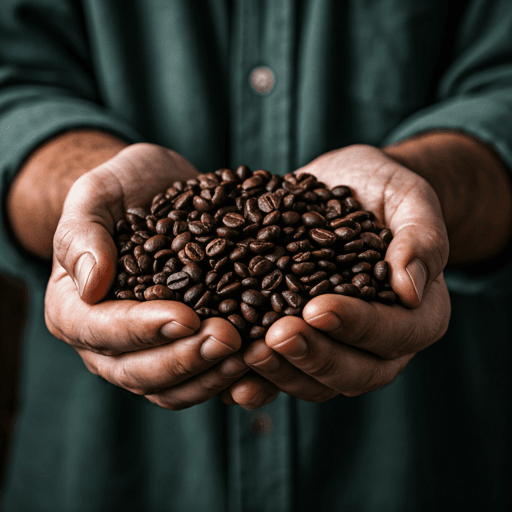
Set in the warm waters of the Indian Ocean off the southeast coast of Africa, Madagascar is one of the most singular places in the coffee world, and one of the least understood. The world's fourth-largest island broke away from the African mainland well over a hundred million years ago, and its long isolation produced an extraordinary storehouse of plants and animals found nowhere else. Coffee is part of that story. Alongside a commercial crop that is overwhelmingly robusta and a small, ambitious highland arabica scene, Madagascar shelters the richest concentration of wild Coffea species on Earth, many of them naturally low in caffeine or caffeine-free. It is a place where the coffee in your cup and the coffee in the forest tell two very different tales.
An island apart in the coffee world
Madagascar sits squarely within the tropics, which makes it well suited to growing coffee, but the island's terrain does most of the sorting. A humid coastal lowland belt rings the island, while a spine of central highlands runs down its length, cooler and higher. That split maps almost perfectly onto the two commercial coffee species. The hot, wet lowlands favor robusta, and the temperate highlands offer the altitude that arabica prefers. Today Madagascar's harvest is roughly 90 percent robusta and around 10 percent arabica, a split that has broadly held for decades and shapes everything about how the origin is perceived abroad.
That balance also explains why Madagascar rarely appears on a specialty menu. The global specialty trade is built around washed and natural arabica, and an origin dominated by robusta simply has fewer entry points into those channels. Yet the island's robusta has long enjoyed a quiet reputation for quality, and a handful of growers are now betting that both its robusta and its emerging arabica have more to offer than the market assumes.
From Réunion cuttings to a coffee economy
Coffee is not native to Madagascar in cultivated form; it arrived, as it did across much of the western Indian Ocean, by way of the neighboring island of Réunion in the mid-to-late nineteenth century, when planters from that island struck deals to grow and export it. Under French colonial administration from the late 1890s, coffee planting spread quickly and became a cornerstone of the island's agricultural export economy. Through much of the twentieth century Madagascar was a significant robusta supplier, and production reached its high-water mark in the 1980s and early 1990s. At that peak, coffee is often said to have involved a large share of the population and to have made up something close to half of agricultural exports.
Then came the reckoning that has haunted many single-commodity economies. When global coffee prices collapsed in the late 1990s, the shock rippled through Malagasy farming communities, and much of the country's coffee infrastructure fell into disrepair. Aging trees, thinning investment, and unpredictable logistics meant that exports through the main port of Toamasina dwindled. A great deal of what Madagascar grows today is consumed domestically, brewed strong and drunk daily, rather than shipped abroad.
Robusta country: the lowland backbone
Robusta is the workhorse of Malagasy coffee, and it grows where robusta likes to grow: in the humid tropical lowlands, typically at altitudes somewhere around 100 to 300 meters above sea level. The east coast is the heartland, from the Vatovavy region in the southeast up through the areas around Toamasina (formerly Tamatave) and into the SAVA zone in the northeast, near towns such as Antalaha and Andapa. There is also meaningful production in the northwest, around Ambanja, along the Sambirano River, and on the island of Nosy Be, part of a valley system better known abroad for its vanilla and cocoa. Harvest generally gets underway around the middle of the year.
If you want to understand why robusta ended up here rather than arabica, it helps to know what sets the two species apart. Robusta, botanically Coffea canephora, is hardier, more disease-resistant, and more tolerant of heat and low elevation than arabica, and it carries markedly more caffeine. Our guide to what makes robusta coffee distinct unpacks those traits, and the head-to-head in arabica versus robusta explains why lowland origins so often lean robusta. What makes Madagascar's version interesting is its reputation: Malagasy robusta has historically been described as unusually smooth, with less of the rubbery, grain-forward bite many associate with the species, and at its best it can show gentle floral and fruit-tinged notes rather than pure bitterness.
Highland arabica and the specialty frontier
The other tenth or so of the crop climbs into the cooler central highlands. Arabica is grown at higher elevations around the capital, Antananarivo, and in areas near Lake Alaotra, the island's largest lake. The dominant varieties are the classics that traveled the colonial coffee routes: Bourbon and Typica, the two lineages from which a great many of the world's cultivated arabicas descend. A few growers have also experimented with Bourbon Pointu, also called Laurina, a naturally low-caffeine mutation of Bourbon named for its distinctive pointed bean and long associated with this corner of the Indian Ocean.
Specialty arabica in Madagascar is still very much in its infancy. Volumes are small and dedicated specialty farms are scarce; the effort has been led by a handful of pioneers, notably the family-run Zebu Coffee Estate in the Itasy region, often described as the country's only dedicated specialty arabica farm, working to prove that the island's highlands can produce clean, expressive arabica worth its own single-origin lot. Whether Madagascar can build a durable place in the specialty coffee market will depend as much on stable processing and reliable export logistics as it does on the quality of the beans themselves.
The wild Coffea species: half a genus in one island
Here is where Madagascar becomes genuinely extraordinary. Beyond the two farmed species, the island is home to the largest wild diversity of the coffee genus anywhere on the planet, with dozens of endemic Coffea species documented in its forests. Botanists commonly count close to sixty native species here, roughly half of all the coffee species known worldwide, and the tally keeps rising: in recent years researchers working in the forests of northern Madagascar formally described six new species previously unknown to science, part of a global total that now runs to well over a hundred.
What draws researchers most is a quirk of the island's coffees, historically grouped under the informal name Mascarocoffea: many of them contain little or no caffeine, a trait almost unheard of in the wider genus. Caffeine levels do vary from species to species — some Malagasy coffees are close to caffeine-free, while measured studies of others, such as Coffea kianjavatensis and Coffea lancifolia, have still found modest amounts — but as a group they make a natural laboratory for anyone interested in genetically low-caffeine coffee that is not achieved through industrial decaffeination. It is a striking contrast with the wild arabica populations of the Ethiopian forests, coffee's original genetic homeland, which our Ethiopian coffee guide explores; both places are irreplaceable seed banks for the crop's future, but Madagascar's diversity leans toward the caffeine-light.
That treasure is fragile. Many of Madagascar's wild coffee species are considered threatened, pressured by deforestation, habitat loss, and a changing climate, and a number are narrowly endemic to single patches of forest. They are not grown at any commercial scale and are unlikely ever to fill a bag on a shelf. Their value is genetic: the traits locked inside them, from caffeine content to heat and drought tolerance, could prove vital as breeders work to future-proof the coffees we do drink.
Flavor, processing and how the origin drinks
Malagasy coffee is processed by both washed and natural methods depending on the producer, and the choice shapes the cup as much as the species does. Washed lots aim for cleaner, more transparent character, while sun-dried natural lots push toward fruit and body; the trade-offs are covered in our notes on the washed process. As a rough guide, here is how the island's coffees tend to present.
| Type | Where it grows | Typical altitude | Character in the cup |
|---|---|---|---|
| Lowland robusta | East coast, SAVA, northwest / Sambirano | ~100–300 m | Full-bodied, earthy, low acidity; smoother than many robustas, with occasional floral, coconut or citrus hints |
| Highland arabica | Central highlands, near Antananarivo and Lake Alaotra | Higher elevations | Emerging specialty character: medium body, softer acidity, fruit and floral sweetness in the best lots |
| Wild endemic species | Northern and western forests | Varied, mostly wild | Not commercially brewed; prized for genetics, and often naturally low in or free of caffeine |
For brewing, the robusta rewards being treated as what it is. Its low acidity, heavy body, and earthy depth suit espresso, moka pot, and strong milk-based drinks, where its intensity carries rather than overwhelms. Slightly lower brew temperatures and a touch more dilution tame any harshness. The scarce highland arabica, by contrast, is worth treating gently as a pour-over or filter coffee, where its softer acidity and fruit sweetness have room to show.
Why Madagascar coffee is so hard to find
If you have never seen a bag labeled Madagascar, you are not alone. Several forces keep it off the map. The crop is mostly robusta, which sits outside the specialty spotlight; the specialty arabica sector is tiny and young; and much of what is grown stays on the island as a domestic staple rather than an export. Add unpredictable infrastructure and the seasonality of the small single-origin lots that do escape, and you have an origin that surfaces only occasionally, usually through curious roasters or green buyers with a taste for the unusual. That rarity is part of the appeal. Madagascar is less a reliable everyday origin than a window into coffee's deep past and possible future — an island where a smooth cup of robusta shares the map with a forest full of coffees the rest of the world has barely tasted.