
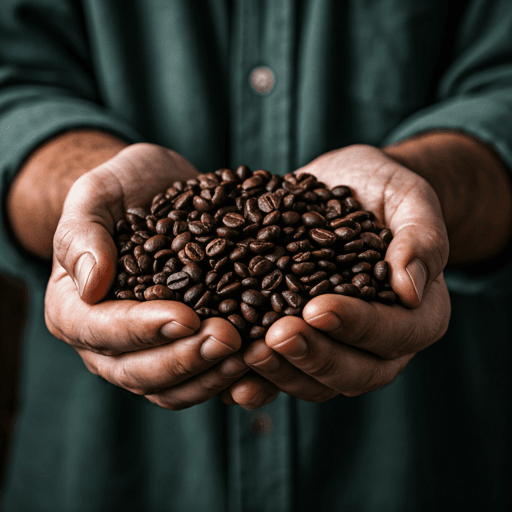
Robusta coffee is coffee made from Coffea canephora, the hardier of the two species that supply almost all of the world's cups. Set beside arabica, robusta coffee pours a bolder, more bitter, earthy and full-bodied brew, carries close to double the caffeine, and builds a thicker crema — which is exactly why roasters reach for it in espresso blends and instant coffee.
If you have ever typed "robust coffee" into a search bar and landed here, that near-miss spelling is almost always chasing the same thing: robusta, the workhorse bean behind a great deal of the strong, punchy coffee people drink every day. Here is what the bean actually is, how it tastes, why it packs the caffeine it does, and where it earns its place.
What is robusta coffee?
Robusta coffee comes from Coffea canephora, one of the few species in the Coffea genus grown at commercial scale. Arabica (Coffea arabica) is the other giant and still accounts for the majority of the world's harvest; robusta is the clear number two, making up roughly a third to two-fifths of global production depending on the season. A distant third species, liberica, fills a small niche — you can read more about it in our guide to liberica coffee.
What sets Coffea canephora apart is toughness. The plant thrives at lower, hotter altitudes — often from near sea level up to around 800 metres — where arabica would struggle. It tolerates heat and humidity, shrugs off many pests, and resists coffee leaf rust far better than arabica does. Part of that resilience comes from the bean's own chemistry: its higher caffeine and chlorogenic-acid content act as a built-in defence against insects and fungus. Add in higher yields per tree, and robusta becomes a dependable, lower-cost crop for farmers in demanding climates. For a wider look at how the species fit together, see our overview of coffee bean varieties and types.
What robusta coffee tastes like
The classic robusta cup leans bold and blunt: pronounced bitterness, a woody or earthy backbone, and grainy, nutty or grain-toast notes rather than the bright fruit and florals arabica is prized for. Body is heavy, acidity is low, and sweetness is modest, so the drink often reads as "strong" and a little rough on its own. In lower grades you may catch a rubbery or burnt edge.
That said, it is worth hedging the reputation. A growing tier of carefully grown and processed "fine" or specialty-grade robusta beans exists, and at its best it can be surprisingly smooth, with chocolate, dark-cocoa and roasted-grain character and none of the harsh rubber note. Robusta is not automatically "worse" than arabica — it is a different tool with different strengths, and quality still comes down to how the cherries are grown, picked and processed. The full side-by-side belongs in our dedicated arabica vs robusta comparison; here we are just profiling the bean itself.
Robusta coffee and caffeine
The single fact people repeat most about robusta is the caffeine, and it holds up: Coffea canephora beans carry roughly twice the caffeine of arabica by dry weight. Robusta typically lands somewhere around 2.2 to 2.7 percent caffeine, while arabica sits closer to 1.2 to 1.5 percent. The exact figures shift with variety, growing conditions and how the coffee is brewed, so treat "about double" as a useful rule of thumb rather than a precise measurement.
That caffeine is not just a talking point for drinkers — for the plant it works as a natural pesticide, which is one reason robusta shrugs off pests that trouble arabica. It also contributes to the bean's bitterness. (This is a flavour and botany fact, not health advice; how much caffeine suits any individual is a personal matter.)
Robusta vs arabica at a glance
Here is a quick decoder for the two species that dominate your cup. This is the short version; for arabica on its own terms, see our arabica coffee beans guide.
| Trait | Robusta | Arabica |
|---|---|---|
| Species | Coffea canephora | Coffea arabica |
| Caffeine | Higher — roughly 2x | Lower |
| Flavour | Bitter, earthy, woody, grainy | Sweeter, fruity, floral, bright |
| Acidity | Low | Higher, livelier |
| Body and crema | Heavy body, thick crema | Lighter body, thinner crema |
| Growing | Low altitude, hardy, high yield | Higher altitude, delicate |
| Common use | Espresso blends, instant, ready-to-drink | Single origins, filter, specialty |
Where robusta coffee shines
Robusta's bold body and thick crema make it a natural blending partner in espresso. A measured percentage of robusta beans in an espresso blend adds crema, heft and a satisfying "kick" that pure-arabica blends can lack — a trick long associated with traditional Italian-style espresso, where a splash of robusta gives the shot its signature crema-topped intensity. If you enjoy a moka pot or a home espresso, some of that punch may well be robusta at work.
The species is also the backbone of most instant coffee, thanks to its higher yield, lower cost and bold flavour that survives freeze-drying and spray-drying. It shows up in plenty of canned and ready-to-drink coffees for the same reasons, and it is the muscle behind the strong, sweetened iced coffees of Southeast Asia. Increasingly, a slice of robusta in a blend is a deliberate flavour decision rather than a purely economic one — roasters use it to build body, boost crema and add a caffeine lift by design. In short, robusta earns its keep wherever bold flavour, dependable supply and a hard-working, no-fuss bean matter more than delicate nuance.
Where robusta coffee grows
Robusta is a tropical crop of the warm lowlands. Vietnam is by far the world's largest producer, with vast plantations in its Central Highlands around Đắk Lắk, and it supplies a huge share of the robusta in global blends and instant coffee. Coffea canephora is native to central and western Africa — the Congo basin region — and Africa remains an important origin, with Uganda and Côte d'Ivoire among the notable growers.
Beyond those, Brazil produces a large volume of robusta it calls Conilon, mostly in the state of Espírito Santo, and pockets of South and Southeast Asia — Indonesia especially — round out the picture. Wherever the climate is hot, humid and lower in altitude, robusta tends to be the practical choice.
How to tell if your coffee has robusta
The clearest signal is the label. A bag marked "100% arabica" is telling you there is no robusta inside; an espresso blend that lists an arabica-to-robusta ratio (say 80/20 or 70/30) is telling you the opposite. Most instant coffee is robusta-heavy even when it does not spell it out, and inexpensive supermarket blends often lean on it too.
Your palate offers clues as well. A cup that tastes assertively bitter, feels heavy and grainy, and throws a thick, stubborn crema likely has robusta in the mix. A brighter, sweeter, more delicate coffee is probably arabica-dominant. Value is a rough guide too — robusta is generally more economical to grow than arabica, so a strikingly cheap "strong" blend is often robusta-forward.
The bottom line on robusta coffee
Robusta coffee is not a lesser cousin so much as a different animal — a hardy, high-caffeine, full-bodied species that keeps the world's espresso crema thick and its instant coffee dependable. Dismissed for years as merely the cheap filler, it is being reappraised as growers prove that thoughtful, fine-grade Coffea canephora can stand on its own. The next time a coffee tastes especially bold, earthy and bracing, there is a good chance you are meeting robusta — and now you know exactly what that means.