
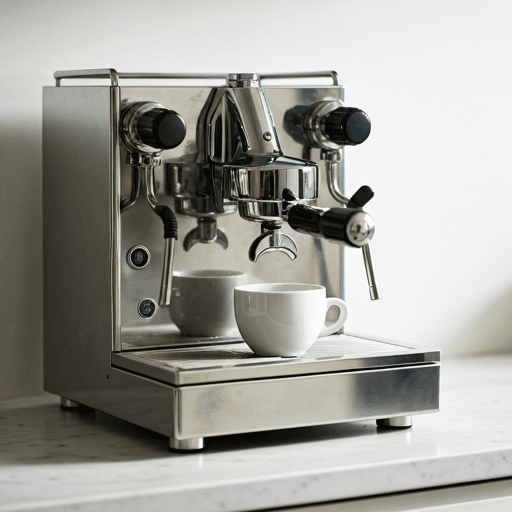
Jura coffee machines are Swiss-made, fully automatic bean-to-cup espresso makers that grind whole beans, brew the shot, and (on most models) froth milk at the touch of a button. The company, based in Niederbuchsiten, Switzerland, focuses almost entirely on this one category: premium super-automatic machines for the home and workplace. If you want fresh-ground coffee and cafe-style milk drinks without touching a portafilter, a Jura sits firmly at the higher end of that market. This guide walks through the model families, the signature technology, and what actually matters when you are choosing between them.
What Jura coffee machines are
A Jura coffee machine is a super-automatic, or bean-to-cup, appliance. You fill a hopper with whole beans and a tank with water, then press a drink. The machine doses and grinds the beans, tamps and brews the coffee, and steams milk through an internal system, all in one sequence. That is a very different experience from a manual espresso setup, where you grind, dose, tamp, and steam yourself. For a broader look at how this whole category works, and how it compares with pod and manual machines, see our fully automatic coffee machines guide.
Two things define Jura within that category. First, it is a specialist: rather than making toasters and kettles on the side, the brand has built its reputation almost entirely on automatic coffee machines, and that focus shows in the engineering and the software. Second, it sits at the premium tier. Jura rarely competes on price; it competes on grind quality, milk texture, and the polish of the touchscreen and app. If you are cross-shopping against another well-known automatic brand, our De'Longhi bean-to-cup machines guide is a useful counterpoint.
The Jura model families at a glance
Jura organizes its home lineup into a handful of lines that climb in size, drink range, and features. The names shift over time as models are refreshed, so treat these as the current shape of the range rather than a fixed catalog. Here is how the families broadly compare.
| Line | Best suited to | Notable traits |
|---|---|---|
| ENA (compact) | Small kitchens, one or two drinkers | Slim footprint; ENA 4 is espresso/black only, ENA 8 adds milk drinks and a touchscreen |
| E line | Everyday households wanting milk specialties | Mid-size, fine-foam milk system, wide one-touch drink menu |
| S line | Users who want more control and specialty range | Similar footprint to E, often adds an adjustable milk dial and extra drinks |
| Z (flagship) | Enthusiasts wanting the full spectrum, including cold brew | Dual spout, hot and cold specialties, top-tier grinder and frothing |
| GIGA | Offices and heavy daily volume | Two grinders and two heating systems for back-to-back drinks |
Compact ENA line (ENA 4, ENA 8)
The ENA machines are Jura's smallest, built for tight counters and one or two coffee drinkers. The Jura ENA 4 is deliberately simple: it makes black coffee and espresso only, with no built-in milk system, which keeps the body narrow and the operation straightforward. If your household drinks mostly espresso, ristretto, and long black coffee, that focus is a feature rather than a limitation. Step up to the ENA 8 and you gain a color touchscreen, a two-cup function, and an integrated fine-foam frother, so cappuccino and latte macchiato come from the same compact shell. The ENA line is the natural entry point to the brand for anyone who values a small footprint.
Mid-range E and S lines (E8, S8)
The E and S lines are Jura's core household machines, offering a wide one-touch drink menu with an internal milk system. The E8 is one of the brand's most popular models, delivering espresso, cappuccino, flat white, latte macchiato and more with a straightforward menu. The Jura S8 typically sits a small step above, adding a rotary dial that lets you fine-tune milk froth and steam density, plus a slightly broader specialty range on many versions. In practice, choosing between an E-line and an S-line machine often comes down to whether you want that extra manual control over milk texture and a few more drink presets. Both are true one-touch machines for milk-based coffee, which is where much of Jura's appeal lies. For help weighing an automatic against a manual setup in general, see how to choose an espresso machine.
Flagship Z and GIGA lines
At the top sit the Z and GIGA lines. The Z models are the home flagships, with a dual spout, the widest drink range, and, on recent versions, cold brew specialties alongside the usual hot drinks. They pair Jura's best grinder and frothing hardware with a large, guided touchscreen. The GIGA line is aimed at offices and other high-throughput settings: it uses two separate grinders (so you can keep, say, a regular and a decaf bean loaded at once) and dual heating systems to pour two drinks in parallel. If you are buying for a single household, a Z or a mid-range machine will usually make more sense than a GIGA, which is really built for volume.
Signature Jura technology
Several features recur across the Jura espresso machine range and help explain the premium positioning.
- Integrated precision grinder. Every Jura grinds fresh for each cup using a built-in burr grinder (the current "Professional Aroma Grinder" on many models). Grinding to order is one of the biggest levers on cup quality, which is a large part of why a fresh bean-to-cup machine can outperform working from pre-ground coffee.
- Pulse Extraction Process (P.E.P.). Jura's brew unit pushes water through the coffee in short pulses rather than one steady flow. The stated aim is to optimize contact time and extraction, especially for short drinks like ristretto and espresso, where a very short brew can otherwise taste thin.
- Fine-foam frother. The milk system on milk-capable models is designed to produce a dense, fine microfoam, and higher machines add a dial so you can shift between the airier foam of a cappuccino and the silkier milk of a flat white.
- CLEARYL water filter. Jura machines accept a CLEARYL cartridge that sits in the tank to reduce limescale and impurities. On machines with the intelligent water system, a Smart+ filter uses RFID so the machine recognizes it and tracks its life (each cartridge is rated for a set volume of water before replacement).
- App control (J.O.E. and Smart Connect). With a Smart Connect or Wi-Fi module, Jura's J.O.E. app lets you start and customize drinks from a phone, save favorites, and get maintenance prompts. It is a genuine convenience, though not essential to good coffee.
What to look for when choosing a Jura
Because the machines share a design language, the right choice comes down to matching features to how you actually drink coffee. A few questions cut through the range quickly.
Do you want milk drinks?
This is the single biggest fork. If you drink only espresso and black coffee, a milk-free machine like the Jura ENA 4 keeps things compact and simple. If cappuccino, latte, or flat white are non-negotiable, you need a model with the integrated milk system, which rules the ENA 4 out and points you to the ENA 8, E, S, Z, or GIGA lines.
How wide a drink menu do you need?
Entry machines cover the core drinks; mid-range and flagship models add more one-touch specialties and, at the top, cold brew. If your household orders the same two or three drinks, paying for dozens of presets adds little. If everyone wants something different, the broader menus earn their keep.
Milk control, screen, and capacity
Look at whether the milk system has a dial for adjusting froth density (handy if you switch between cappuccino and flat white), the size and clarity of the display, and the water-tank and bean-hopper capacity. Larger tanks and hoppers mean fewer refills, which matters more the more cups you pull per day. A slim ENA is happy serving a couple of people; a busy kitchen or office benefits from bigger reservoirs.
One grinder or two?
Nearly all home Jura machines use a single grinder. The dual-grinder GIGA line exists specifically so a high-traffic setting can keep two bean types loaded and pour drinks back to back. For most homes, one grinder is plenty; two is a workplace feature.
Where Jura sits on cost
Jura is a premium brand, and it is honest to say so plainly. Even the compact ENA models sit above entry-level automatics, and the S, Z, and GIGA lines climb well into premium territory. We do not quote prices here (they vary by model, region, and retailer), but the pattern is consistent: you are paying for build quality, grind and milk performance, software, and the brand's single-minded focus on automatic coffee. Whether that premium is worth it depends on how much you value one-touch convenience and how many drinks you make a week. A heavy daily drinker gets more from the investment than someone who brews once on weekends, for whom a simpler machine, a pod system, or even a good manual setup may make more sense.
Is a Jura right for you?
A Jura coffee maker suits someone who wants freshly ground, cafe-style coffee, including milk drinks, with as little hands-on effort as possible, and who is comfortable paying a premium for that ease. If you enjoy the ritual of dialing in a manual espresso machine, or you are on a tight budget, the value equation shifts. If not, the appeal is obvious: quietly reliable, well-engineered, one-touch coffee. Start by deciding whether you need milk drinks and how wide a menu you want, then match those answers to the ENA, E, S, Z, or GIGA line. From there, compare against the wider field using our bean-to-cup coffee machine guide so you can see exactly where a Swiss super-automatic fits your kitchen and your coffee habits.