
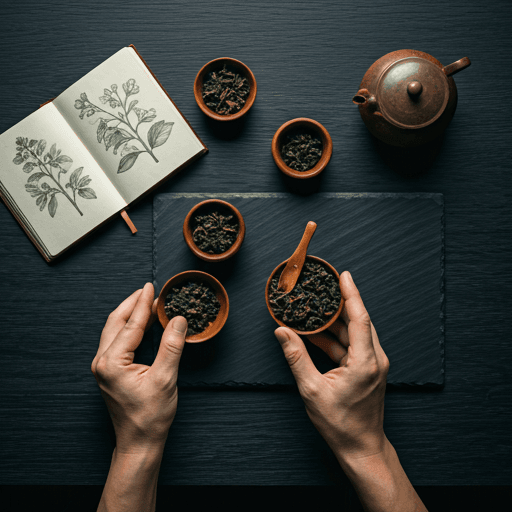
Guangdong Da Ye Qing (大叶青, "big-leaf green") is a classic yellow tea from Guangdong Province, China — and its name is a small puzzle. Despite the qing, or "green," in the title, da ye qing is finished with the men huang yellowing step that defines yellow tea, not green tea. Made from large-leaf tea plants, it pours a deep golden cup that is mellow, sweet, and unusually thick and hearty for a yellow tea, with a toasted-grain aroma that sets it apart from the delicate bud-style yellows most drinkers meet first.
What is Da Ye Qing yellow tea?
Da Ye Qing (大叶青) is a Chinese yellow tea, one of the six classic tea types alongside green, white, oolong, black, and dark (hei cha). If you are sorting out how those families relate, our overview of the main types of tea lays out the map. Yellow tea is the smallest and least familiar of the six, and it is defined by a single warm resting stage called men huang, or "sealing the yellow" — the step that separates it from green tea and gives the category its name. For the full mechanics of that stage, see our guide to yellow tea.
The important thing to fix in your mind up front: despite the word "green" sitting inside its name, da ye qing is a genuine yellow tea. The leaves are fired to halt oxidation, as with a green tea, but then they are piled and smothered so they turn from green toward gold before the final roast. That men huang step is applied, and it is what makes the cup mellow rather than grassy.
The naming puzzle: green in name, yellow in the cup
So why "qing" at all? In Chinese tea names, qing (青) is a slippery color word that can mean green, blue-green, or simply "unoxidized leaf," and it turns up in several teas that are not green at all — Wuyi rock oolongs are grouped as qing cha, for instance. In Da Ye Qing the word is historical and descriptive of the raw big-leaf material rather than a claim about the finished style. The name breaks down as da ye (big leaf) plus qing (the green, unoxidized leaf it starts from). What arrives in the pot, after men huang, is a yellow tea.
The second half of the name is the more telling one. Da Ye Qing is made from large-leaf tea plants — the big-leaf, or da ye zhong, material, an assamica-type varietal with broad, thick leaves — rather than the small, tender single buds used for the famous yellow "needle" teas. That single choice of raw material is what makes this tea distinctive, and it is worth its own section.
Huang Da Cha: the big-leaf branch of yellow tea
Yellow tea is usually split into three sub-styles by how tender the pluck is, and Da Ye Qing sits firmly in the boldest of the three:
- Huang ya cha (yellow bud tea) — single buds only, the most rarefied grade. This is the home of pure-bud classics such as Junshan Yinzhen from Hunan and Sichuan's Meng Ding Huang Ya.
- Huang xiao cha (yellow small-leaf tea) — a bud with one or two tender leaves, giving a fuller cup; Weishan Maojian from Hunan is a well-known example.
- Huang da cha (yellow big-leaf tea) — a bud with several mature leaves and stems attached, the heartiest tier. Guangdong Da Ye Qing is the headline tea here.
This ladder is the key to understanding Da Ye Qing. Where a bud-style yellow tea is prized for silky delicacy, a huang da cha is built for body and roast. The mature leaves and stems carry more structure and more of the sugars that caramelize under fire, so the finished tea reads as robust, sweet, and toasty rather than fragile. It is, in effect, the everyday, full-bodied cousin at the far end of the yellow-tea family — and one of the reasons drinkers who find bud-style yellows too subtle often warm to this one quickly.
Where Guangdong Da Ye Qing grows
Guangdong Da Ye Qing is a specialty of Guangdong Province in southern China, traditionally associated with the growing districts around Shaoguan in the north, Zhaoqing in the west, and Zhanjiang on the Leizhou Peninsula in the far southwest. Guangdong's warm, humid, subtropical climate suits vigorous large-leaf tea plants, which push out the broad, thick leaves the style depends on.
Those plants set a distinctive quality standard. Both the leaves and their stems are meant to be genuinely large — often cited in the region of 10 to 13 cm long — and, unusually for a Chinese specialty tea, the finished product openly includes stem. The pluck is a bud with several leaves (accounts range from one bud and two or three leaves up to one bud and four or five), a far cry from the tweezed single buds of a yellow-needle tea. Local histories trace the tea back several centuries, often to the Ming dynasty, but firm early dates are hard to pin down, so that pedigree is best treated as tradition rather than documented fact.
Da Ye Qing is not a mass-market tea. Guangdong is far better known commercially for its Phoenix Mountain dancong oolongs, and the labour-heavy, low-yield craft of a big-leaf yellow tea has fallen out of favour over the decades. Today only a handful of gardens, chiefly around Zhaoqing, still make it in any quantity, which makes authentic Da Ye Qing genuinely scarce and something of a connoisseur's curiosity rather than a supermarket staple.
Men huang and the roast: how it is made
Da Ye Qing begins like a green tea — the leaves are withered and then pan-fired (sha qing, or "kill-green") to stop oxidation — before the yellow-tea signature takes over. In the men huang stage, the warm, rolled leaves are piled and wrapped, often in cloth or paper, and left to rest in a dark, still, humid spot. Descriptions of the traditional method keep the pile temperature around 35°C for several hours (commonly cited at roughly three to five), during which chlorophyll softens and the leaf turns from green toward gold, shedding its grassy edge.
What gives this particular tea its signature is the finish. Traditional Da Ye Qing is fired the old way, over firewood in large iron woks, and that roast layered on top of the men huang is where its most quoted note comes from: a strong "rice crust" or toasted-grain aroma, like the crisp scorched rice at the bottom of the pot. Because the men huang here can be relatively light, Da Ye Qing is sometimes called the "least yellow" of China's yellow teas — the fired, roasted character can read as loudly as the yellowing does.
| Aspect | Detail |
|---|---|
| Also written | Da Ye Qing; Guangdong Da Ye Qing; 大叶青 ("big-leaf green") |
| Tea type | Yellow tea (huang cha) — huang da cha, the big-leaf sub-style |
| Origin | Guangdong Province, China (Shaoguan, Zhaoqing, Zhanjiang) |
| Plant | Large-leaf (da ye zhong), assamica-type varietal |
| Pluck | A bud with several mature leaves and stems; leaves ~10–13 cm |
| Defining step | Men huang (sealed yellowing) plus a firewood roast |
| Liquor | Deep, clear golden-yellow |
| Flavor | Toasted rice, roasted grain, nutty; mellow, sweet, thick |
| Brew temperature | About 90–95°C (195–205°F) |
| Caffeine | Contains caffeine; varies widely with leaf and brew |
What Da Ye Qing tastes like
Brewed, Da Ye Qing pours a deep, clear golden-yellow liquor — noticeably richer in color than the pale gold of a bud-style yellow tea. The aroma leads with that trademark toasted-rice or roasted-grain character, often joined by nutty, cereal-like, and gently baked-bread notes from the firewood roast. On the palate it is mellow, sweet, and thick, with a rounded, comforting body and a smooth, warming finish. It is the yellow tea for people who like a cup with some heft.
Because it is a big-leaf tea carrying mature leaf and stem, a well-made Da Ye Qing is smooth rather than sharp, though a coarser lot can show a faint vegetal or lightly bitter edge if it is over-brewed. It also re-steeps generously — the sturdy leaf keeps giving across several infusions, opening from a toasty, grain-sweet first cup into rounder, softer later rounds. This is an unfussy, everyday-pleasure kind of tea rather than a rarefied sipping ceremony.
Da Ye Qing vs its yellow-tea siblings
The clearest way to place Da Ye Qing is next to the bud-style yellows it is so often contrasted with. The three below span the full pluck ladder, from single buds to big leaf and stem.
| Tea | Origin | Sub-style | Pluck | Signature note |
|---|---|---|---|---|
| Da Ye Qing | Guangdong | Yellow big-leaf | Bud + mature leaves & stem | Toasted rice, roasted, thick and mellow |
| Meng Ding Huang Ya | Mengshan, Sichuan | Yellow bud | Single buds | Roasted chestnut, delicate sweetness |
| Weishan Maojian | Ningxiang, Hunan | Yellow small-leaf | Bud + tender leaves | Lightly smoky, sweet, softer body |
Set side by side, the family split is obvious. Meng Ding Huang Ya is all finesse — tweezed buds, a pale golden cup, quiet chestnut sweetness. Weishan Maojian sits in the middle, fuller and often faintly smoky. Da Ye Qing is the bold outlier: the deepest liquor, the loudest roast, and the thickest body, thanks entirely to its big-leaf raw material and firewood finish. Same men huang idea, three very different outcomes — which is exactly why tasting a big-leaf yellow next to a bud-style one is such a good lesson in how much the pluck shapes the cup.
How to brew Da Ye Qing
Unlike fragile yellow buds, Da Ye Qing is a sturdy big-leaf tea that stands up to hotter water and a firmer hand. A reliable starting point:
- Use roughly 4–5 grams of leaf per 150 ml of water, or a generous heaped teaspoon per cup.
- Heat water to about 90–95°C (195–205°F); the mature leaf and stem can take near-boiling water without turning harsh.
- Steep the first infusion for one to two minutes, then taste and adjust.
- Re-steep several times, adding a little time with each round — the leaf keeps giving.
A gaiwan, a sturdy teapot, or even a simple mug all work; this is not a tea that demands ceremony. If a cup turns bitter, shorten the steep or pour off more completely between rounds rather than cutting the leaf.
Caffeine and everyday notes
Like every true tea from the Camellia sinensis plant, Da Ye Qing contains caffeine. Because it is made from mature leaf rather than caffeine-dense buds, it is not necessarily high in caffeine, but the exact amount varies widely with how much leaf you use, water temperature, and steep time, so treat any single figure as an approximation rather than a fixed number. As a lightly processed tea it is a source of the plant compounds found across the tea family, and many people simply enjoy a mellow, toasty cup as an unhurried moment in the day. Responses vary from person to person, and this is general information, not medical advice — if you are sensitive to caffeine, pregnant, or managing a health condition, check with a qualified professional about what is right for you.
Understood on its own terms — a big-leaf, firewood-roasted Guangdong yellow tea whose "green" name is a historical quirk — Da Ye Qing is one of the more characterful corners of an already tiny category. It trades the hushed delicacy of the yellow-needle teas for warmth, body, and a toasted-grain sweetness you will not find anywhere else in the yellow family, and that is exactly what makes it worth seeking out.