
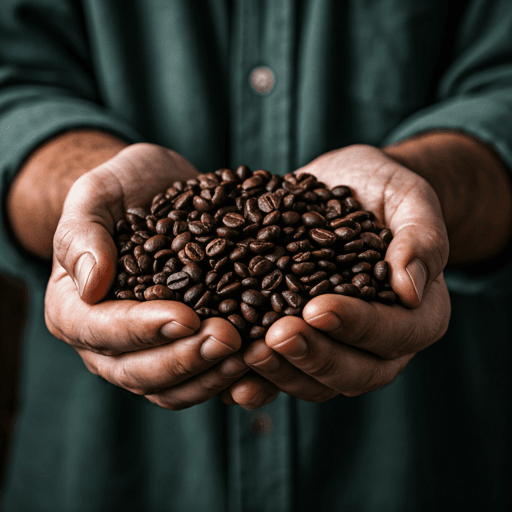
Costa Rican coffee is clean, bright, balanced washed arabica grown on volcanic soil across eight officially defined regions, from the high ridges of Tarrazu down to the dry Pacific slopes of Guanacaste. It is the origin much of the specialty world treats as its reference point for a textbook cup, and for about thirty years it was the only significant producing country where the law effectively banned anything but arabica.
This guide covers the eight regions and what each is known for, the arabica-only rule and what actually happened to it, the altitude grading behind the letters SHB, the honey process the country did more than anywhere to popularise, and what the cup tastes like.
What Costa Rican coffee is
Costa Rican coffee is not a variety or a roast. It is a country's worth of arabica, grown mostly on volcanic mountain soil between roughly 600 and 1,900 m, harvested by hand, and overwhelmingly processed by the washed method, the route that strips the fruit off the seed before drying and gives the clean, transparent, acidity-forward cup the country is known for. If you want the mechanics of washed, natural and honey, our guide to coffee processing methods covers them properly; here, the point is simply that Costa Rica leaned hard into clean processing and built a reputation on it.
The plants are dominated by Caturra and Catuai, two compact, high-yielding arabicas that ICAFE, the national coffee institute, has put at roughly 90% of the country's production between them. Around them sit smaller plantings of Villa Sarchi (a spontaneous Bourbon mutation first selected in the West Valley), Villalobos, Typica, Bourbon, Geisha and a growing set of F1 hybrids and leaf-rust-tolerant selections.
Scale matters to the story. Costa Rica supplies under 1% of the world's coffee and sits well outside the top ten producers; it is a small origin that competes on quality rather than volume. It is also a shrinking one. Registered growers now number somewhere around 25,000 to 26,000, roughly half the figure of a decade earlier, and the sector is overwhelmingly smallholder: the large majority farm plots under 10 hectares and deliver only a modest number of bags each. That structure is the reason the country became a natural home for microlots and traceable single origins; if you are new to that idea, see single-origin coffee explained.
Why the land matters
Costa Rica sits on a volcanic spine. The central highlands are built from young, mineral-rich volcanic soils that drain freely while holding nutrients, close to ideal for coffee roots. Stack four things on top of that and you get the country's signature cup:
- Altitude. Most of the crop grows between about 800 and 1,700 m, with the best-known farms higher still. Cooler air at elevation slows cherry ripening, which tends to build denser seeds, more sugar and more acidity.
- Volcanic soil. Ash and weathered basalt give the mineral base that growers across the Central Valley and Tarrazu credit for the country's sweetness and structure.
- A real dry season. Distinct wet and dry seasons give the trees a clean flowering trigger and a mostly-dry picking window.
- Microclimates. The country is small, but ridges, valleys and two coasts chop it into pockets with their own rainfall and temperature. That is exactly why eight regions exist rather than one.
The harvest reflects that patchwork rather than a single national date. Picking runs broadly from November into February or March across most of the highlands, peaking around November in the higher zones, but it starts considerably earlier, in some years around midyear, in lower and wetter areas such as Turrialba and Perez Zeledon. Exact windows shift with altitude and weather.
The eight growing regions
ICAFE recognises eight coffee regions. Altitude bands vary between sources and shift as farms creep uphill, so treat these as approximate.
- Tarrazu — the famous one. Sitting in the Los Santos zone south of the capital, Tarrazu coffee grows on steep, high ground, much of it above 1,200 m and some approaching 1,900 m. Dense beans, vivid citric acidity, honeyed sweetness. If a bag says Costa Rica and gives no region, this is the profile buyers expect.
- Central Valley (Valle Central) — the historic heartland, where the country's coffee industry first took root, on the slopes of the Poas, Barva and Irazu volcanoes. Lively acidity, medium to full body, chocolate and fruit.
- West Valley (Valle Occidental) — home of Villa Sarchi and a hotbed of honey processing. Stone fruit, caramel, orange, honey.
- Tres Rios — a small, squeezed region on the flank of Irazu, sometimes nicknamed the country's Bordeaux. Refined acidity, balance and a long finish; urban sprawl from the capital has cut into its planted area, and it is now one of the smallest regions by volume.
- Orosi — a wetter valley south-east of Cartago, with rich topsoil and a track record in national quality competitions. Chocolatey, elegant, moderate acidity.
- Turrialba — lower, rainier, on the Caribbean side, and one of the first regions to pick each year. Gentler acidity, lighter body, softer aromatics; often blended.
- Brunca — the southern zone, taking in Coto Brus and Perez Zeledon. Broad altitude spread, so the cup ranges from smooth and mild low down to citrus and floral complexity up high.
- Guanacaste — the north-west, drier and hotter under a Pacific climate, with much of the crop grown under shade. Softer acidity, moderate body, a bittersweet finish.
The arabica-only law, and why 100% arabica by law is now dated
Here is the fact everybody repeats about Costa Rica, and the fact everybody now gets slightly wrong.
In the late 1980s (sources variously date it to 1988 or 1989) Costa Rica prohibited the planting of robusta. The reasoning was partly phytosanitary and partly commercial: hold down pest and disease pressure, and protect the country's name as an arabica origin rather than let lower-scoring coffee dilute it. For three decades that made Costa Rica genuinely singular, the one significant producer where growing the other species was simply not allowed.
That ban was lifted in 2018. Lowland growers were struggling, robusta's tolerance of heat and disease looked increasingly useful against a shifting climate, and the government moved to allow robusta to be planted again, but under conditions. Planting is restricted to areas designated by ICAFE, in practice lower, hotter ground unsuited to fine arabica; only approved robusta varieties are permitted; and robusta must be kept separate from arabica right through harvest and processing so the country's arabica reputation is not muddied. Not everyone welcomed it, and specialty buyers argued at the time that the move risked diluting the national brand.
So the accurate version is this: Costa Rica is still an overwhelmingly arabica origin, and commercial robusta remains a marginal presence in what the country actually exports. But the flat claim that it is 100% arabica by law has been out of date since 2018. If a bag or a blog still says it, the writer is quoting a fact that expired.
SHB: grading by altitude, not by cup
Costa Rican green coffee is classified by the elevation it grew at, on the reasoning that higher-grown beans mature slower and end up denser and harder. Thresholds are quoted slightly differently from source to source, but the letters you will see on a bag are:
- SHB — Strictly Hard Bean: grown above roughly 1,200 m. The most prized band, and the one Tarrazu trades in.
- GHB — Good Hard Bean: roughly 1,000 to 1,200 m.
- MHB — Medium Hard Bean: below about 1,000 m.
Neighbouring origins use SHG (Strictly High Grown) for much the same idea. Read the label honestly: SHB is a statement about elevation and density, not a cupping score. It tells you the bean grew where good coffee tends to grow. It does not certify that the lot was picked, fermented or dried well, and a carelessly handled SHB will lose to a carefully handled lot from lower down. For what actually defines quality, see what is specialty coffee.
Honey process: Costa Rica's contribution
If Costa Rica owns one processing idea, it is honey. The name comes from miel, Spanish for the sticky mucilage that coats the seed inside the cherry, not from any added honey. In a honey process the skin is removed but some of that mucilage is left on during drying, landing the cup between washed cleanliness and natural fruitiness. Producers describe lots by colour, loosely according to how much mucilage stays on and how the lot is dried:
- White / yellow honey — least mucilage, faster drying. Brightest, and closest to washed.
- Red honey — more mucilage, slower drying. Fuller sweetness and body.
- Black honey — most mucilage, longest and shadiest drying. Deepest sweetness and fruit.
Costa Rica did not invent leaving mucilage on the seed, but it named the style, refined it and pushed it into the specialty mainstream in the 2000s. Two things accelerated it. Honey lots began placing well in the country's national specialty competitions from the mid-2000s, which put the style in front of buyers; and pressure to use less water made a low-water process look practical as well as fashionable, since honey processing skips the washing step that a fully washed lot depends on. The colour terms are conventions, not a regulated scale, and one mill's red is another's black.
The micromill revolution
None of that would have happened under the old system. For most of the twentieth century, smallholders sold cherry to large cooperative mills, where it was pooled with everyone else's: a reliable outlet, but no identity and no control. From the early 2000s, families began installing their own small wet mills and drying their own coffee. Counts vary by source, but the number of these micromills grew from a handful to well over a hundred within about a decade.
The consequences were immediate. A grower who controls their own mill can separate a single plot, try a black honey against a washed lot from the same trees, and sell the result under their own name. Traceability, varietal experimentation and honey processing all arrived together, and they arrived because processing moved onto the farm. It is arguably the most consequential thing to happen to Costa Rican coffee in the last fifty years.
What Costa Rican coffee tastes like
The classic profile is clean and bright: citric acidity in the orange-to-lemon range, medium body, and sweetness that reads as cocoa, almond, brown sugar or stone fruit. It is frequently described as the balanced cup, where nothing dominates and everything is legible. Higher-grown lots from Tarrazu and Tres Rios push acidity and clarity; lower Turrialba and Guanacaste lots are milder and rounder. Honey and natural lots swing sweeter and fruitier, sometimes into berry and tropical territory.
It suits light-to-medium roasts, where the acidity survives, and it is a common choice for people learning to taste, precisely because the cup is so readable.
Costa Rican coffee at a glance
| Region | Approx. altitude | Typical flavour |
|---|---|---|
| Tarrazu | 1,200-1,900 m | Bright citric acidity, honeyed sweetness, dense and complex |
| Central Valley | 1,000-1,700 m | Lively acidity, medium-full body, chocolate and fruit |
| West Valley | 700-1,600 m | Stone fruit, caramel, orange; strong honey-process tradition |
| Tres Rios | 1,200-1,650 m | Refined acidity, balance, long clean finish |
| Orosi | 1,000-1,400 m | Chocolatey, elegant, moderate acidity |
| Turrialba | 500-1,400 m | Gentle acidity, light body, delicate aromatics |
| Brunca | 600-1,700 m | Smooth and mild low down; citrus and floral up high |
| Guanacaste | 600-1,350 m | Soft acidity, moderate body, bittersweet finish |
How it compares to its neighbours
Set against Colombian coffee, Costa Rica tends to read drier and more citric where Colombia leans juicier and rounder, and Colombia grows on a vastly larger scale across three Andean ranges. Guatemala, working similar volcanic ground, often gives more body and cocoa weight. Panama, next door, is defined in the public mind by Geisha and its floral extremes rather than by balance.
Costa Rica's real edge is not one flavour note. It is consistency and infrastructure: a small country, dense with micromills, with a national institute, a defined region map, an altitude grading system and a processing vocabulary it exported to everyone else.
The bottom line
Costa Rican coffee is the balanced, high-grown, cleanly processed arabica that much of the specialty world uses as its reference point. Start with an SHB lot from Tarrazu if you want the archetype, a West Valley honey if you want to taste what the country popularised, or a Turrialba or Guanacaste lot if you want something gentler. And when you read that Costa Rica is 100% arabica by law, remember that the law changed in 2018, even if the coffee in the bag, in practice, mostly has not.