
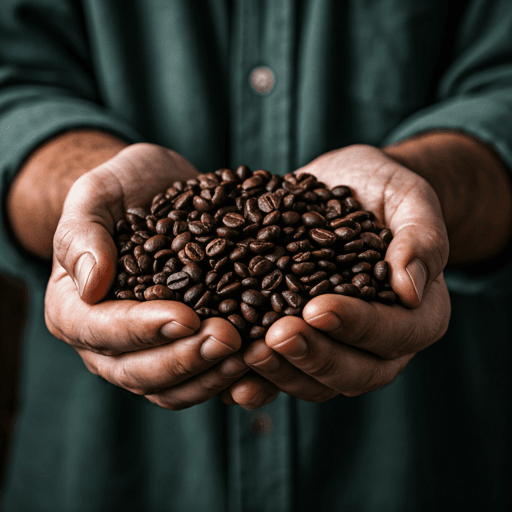
Coffee blending is the practice of combining two or more coffees to a repeatable recipe so that the finished cup does something none of the components does on its own. On the roaster's side it is less an act of inspiration than a design job: set a target, give every component a role, test ratios by tasting, then defend that profile as the crops underneath it quietly change.
Whether a drinker should reach for a blend or a single lot is a separate question, and one that single origin vs blend already answers. This page is about the build — how a blend is designed, assembled, and kept tasting like itself through a whole year of shifting harvests.
Where coffee blending starts: a target, not a bean
The most common beginner error is to start from the shelf. A roaster has three lots on hand, likes all of them, and starts mixing to see what happens. That can produce a pleasant accident, but it cannot produce a product, because there is no definition of success to measure the next version against.
Experienced blenders start from a written target instead, and the target has two halves:
- What should it taste like? Stated in cup terms, not origin terms — sweet, cocoa-leaning, soft citrus acidity, heavy body, long finish, rather than Brazil plus Ethiopia. Defining the goal by flavor is what later allows components to be swapped without the blend losing its identity.
- What is it for? A filter blend, an espresso blend meant to hold up in milk, and a blend meant to be drunk black as a straight shot are three different design problems. Milk flattens acidity and rewards sweetness, body and a deep roasty backbone; black espresso exposes every rough edge; filter brewing gives delicate aromatics room that espresso does not.
Write the target down before touching a scale. Everything downstream — component choice, ratio, roast approach — is just a series of attempts to hit it.
Component roles: base, structure, accent
A useful way to think about how to blend coffee is to assign each component a job rather than a percentage. Most working roasters describe three roles, though a blend does not need all three, and none of the proportions below is a rule — they are the shapes that recur in published roaster guidance, not fixed quantities.
The base
The largest share, commonly somewhere from about half to three-quarters of the recipe. Its job is body, sweetness and a stable, agreeable background — the thing that stays constant while the rest moves. Washed and pulped-natural coffees from lower-acid growing regions are frequently used here; a soft, nutty, chocolatey Brazilian lot is the textbook example, but any clean, sweet, low-drama coffee can play the part. The base should be something you would happily drink alone and never find distracting. Many roasters also note the other end of that range: once a single component climbs much past roughly three-quarters, it is worth asking whether the coffee should simply be sold as itself.
The structural component
The second-largest share, often a fifth to a third. Its job is to give the blend a spine — acidity, brightness, clarity, a sense of lift. Washed Central and South American coffees are common choices, as are washed East African lots when a sharper, more fruit-forward lift is wanted. Without this, blends built on a soft base go flat and read as one-note.
The accent
A small share, often around a tenth. Its job is aroma or a distinctive top note — florals, stone fruit, berry, spice. Accents are the most fun and the least reliable part of a recipe. Below a certain proportion, a component contributes little except complication; published guidance tends to put the practical floor for an audible component somewhere in the region of five to ten percent, and where exactly it falls depends heavily on how loud the coffee is. A powerfully aromatic natural can be legible at the bottom of that band; a gentle washed lot may vanish at the top of it.
A fourth role sometimes appears in espresso blend building: a small proportion of fine robusta added for crema stability and a heavier, more bitter bite. It is a deliberate stylistic choice with a long history in traditional espresso culture, not a defect, but it changes the character of the shot substantially and is easy to overdo.
The honest note here is that most commercial blends are two to four components, and more components almost never means better. Every addition makes the recipe harder to weigh accurately, harder to diagnose when something drifts, and harder to replace when a lot runs out. Beyond four components there is also a real dosing argument: at typical espresso dose weights, a five- or six-part blend means each individual dose contains a slightly different mix than the last, which quietly widens shot-to-shot variation. Three components, each with a clear job, is a sweet spot many roasters keep returning to.
Ratios, and how to actually test them
There is no formula that yields a coffee blend recipe. Ratios are found by tasting, and the discipline of the tasting matters more than the arithmetic. A workable sequence looks like this:
- Taste every component alone, first. You cannot reason about what a coffee contributes to a mixture until you know what it is. Roast each candidate on its own and evaluate it in isolation — the standard method for doing that is covered in what is coffee cupping.
- Build two or three candidate ratios, not ten. Widely used starting grids for a three-part blend look like 60/30/10, 50/30/20 or 70/20/10. Weigh them accurately; small errors at small percentages are proportionally large.
- Taste them side by side, blind if you can. Comparative tasting is far more informative than sequential tasting, and knowing which cup is which reliably biases the result.
- Evaluate in the brew method the blend is for. A mixture that cups beautifully can fall apart as espresso, because espresso concentrates body and bitterness and compresses aromatics. If it is an espresso blend, pull shots — and if it is meant for milk drinks, taste it in milk too.
- Change one thing at a time. Move the ratio by something like ten percent per iteration — a step size many roasters use as a default rather than a law — or change one component, but never both at once. This is the single most-broken rule in blend development, and it is the reason so many roasters end up with a recipe they cannot explain.
- Document what each component contributes. Not just the percentage — the reason. Component two is here for the malic acidity and the finish. That note is what makes a future substitution possible.
One practical shortcut for early screening: brew components separately and combine the liquids at candidate ratios. It is not identical to blending the grounds, since it sidesteps how differently the beans grind and extract together, but it lets you scan many proportions quickly before committing to roasting real batches.
Pre-roast vs post-roast blending
This is the fork every blending roaster has to take a position on, and the pre-roast versus post-roast debate is genuinely unsettled — both approaches are used at every scale, and experienced roasters argue for each.
Pre-roast blending means weighing the green coffees together and roasting the mixture as one batch. It is simpler, faster and produces one product from one roast, which is why high-volume operations lean on it. The trade-off is real, though: green coffees differ in density, moisture content and screen size, and beans with different physical properties do not absorb heat at the same rate. One profile must serve all of them, so the mixture is a compromise — some components may end up slightly underdeveloped while others sit a touch dark. Roasters who pre-blend therefore select components partly on green metrics, matching density, moisture and bean size, and generally avoid pairing extremes such as a peaberry with a very large-screen bean.
Post-roast blending means roasting each component to its own profile and combining the roasted coffees afterwards. Each bean gets the treatment it deserves, and the recipe can be revised on the spot without re-roasting anything. The penalties are operational: more batches, more inventory of roasted single components, more weighing steps, and more opportunity for a weighing or labeling error. There is also a solubility caution — combining components roasted to very different degrees tends to extract unevenly, so a wide spread of roast levels within one blend usually disappoints.
A middle path is common in practice and worth naming: pre-blend the components that are genuinely compatible in the drum — similar density, similar size, similar processing — and add the one awkward component post-roast, after giving it the profile it needed. That hybrid keeps most of the production simplicity of green blending without forcing a single curve onto a bean that clearly wanted a different one.
At a glance
| Factor | Pre-roast blending (green blending) | Post-roast blending |
|---|---|---|
| What is combined | Green coffees, before roasting | Roasted coffees, after roasting |
| Batches per production run | One | One per component |
| Roast quality per bean | One compromise profile for all | Each component optimized individually |
| Component matching required | High — similar density, moisture, screen size | Lower — mismatched greens are fine |
| Speed of iteration | Slow; every change needs a new roast | Fast; re-weigh and taste |
| Inventory complexity | Low | Higher — roasted stock of each component |
| Main error risk | Uneven development within the batch | Weighing and mixing error; uneven mixing |
| Equipment sensitivity | High — drum, airflow and batch size all change how mixed greens develop | Lower for the roast, higher for mixing hardware |
| Typically favored by | Higher-volume production, settled recipes | Smaller batches, recipe development, quality-led roasting |
Neither is correct in the abstract, and a great deal of the answer is machine-dependent. A drum roaster and a fluid-bed roaster do not treat a mixed-density charge the same way; a small batch in a large drum behaves differently from a full one; airflow, charge weight and the roaster's own profiling habits all shift how forgiving a green blend turns out to be. A small operation running small batches can post-blend with almost no penalty, while a larger one combining heavy batches by hand faces a genuine mixing-homogeneity problem that a proper blending drum or auger solves and a shovel does not. And a pre-roast blend whose components were chosen for compatible green metrics can be excellent. The trap is treating either as doctrine, or assuming that what works on someone else's machine will transfer unchanged to yours.
Seasonality: why the recipe is a moving target
Here is the part that explains why blends exist commercially at all. A single lot is a finite thing — see single origin coffee explained — and when it runs out, it is gone, and next year's crop from the same farm will not taste identical. Harvests arrive on different calendars in different hemispheres, quality varies with weather, and green coffee changes in the warehouse as it ages.
A blend absorbs that. Because the target is defined by flavor rather than by origin, a component can be retired and a replacement slotted into the same role. The blend keeps its name and its character while its contents rotate underneath. That continuity is the product.
Holding it steady takes ongoing work:
- Cup the components on a schedule, not just on arrival. Coffees flatten and change as they age in green form; a component that carried the acidity in a blend six months ago may not be doing it now.
- Re-cup the finished blend against a reference. Some roasters freeze retained samples of each month's roasts and cup them together periodically, so drift shows up as a trend rather than as a customer complaint.
- Re-tune after every swap. A replacement component almost never enters at the same percentage as the one it replaces, and it may need a different roast approach to sit correctly in the blend.
- Expect the roast to move too. As new-crop coffees give way to older stock, moisture and density shift, and a profile that was correct in one season will usually need adjusting in the next.
- Keep a written recipe history. Percentages, component names and the date of each change. Without it, a blend that has drifted over four substitutions is impossible to walk back to the version customers liked.
How blending goes wrong
- Using a blend to hide a bad lot. Blending can dilute a flaw, and this is the oldest use of the practice. It rarely works well at the specialty end: a phenolic, over-fermented or otherwise faulty component tends to be more detectable than expected, especially concentrated as espresso, and the flaw becomes the blend's signature.
- Over-complication. Five, six or eight components is usually a sign that nobody knows which coffee is doing what. Complexity is a property of the cup, not of the ingredient list.
- Changing two things at once. Adjust the ratio and swap a component in the same iteration and you have learned nothing about either.
- Not re-cupping after a substitution. The most common way a well-loved blend quietly degrades is a like-for-like component swap that was never tasted in the finished recipe.
- Designing on the cupping table only. A blend developed purely by cupping and then sold for espresso is a coin flip; test in the format it will be served in.
- Ignoring green compatibility when pre-blending. Mismatched density and moisture in one drum is the standard route to a batch that is simultaneously underdeveloped and scorched.
- Trusting a percentage you never verified on a scale. Recipes drift most easily at the small end, where a scoop-and-guess habit turns a ten percent accent into something between five and fifteen.
Blending versus profiling a single lot
The nearest neighbor to blending, as a craft, is profile development on a single coffee — and the two solve different problems. Profiling asks what one coffee can be persuaded to do; the ceiling is whatever that lot contains. Blending asks what several coffees can do together; the ceiling is higher in some directions, particularly body, the balance of sweetness against acidity, and year-round stability, and lower in others, particularly the transparent, unrepeatable specificity that makes an exceptional single lot worth drinking on its own. Most roasters do both, for different reasons, and the good ones do not pretend either is a substitute for the other.
The bottom line
A blend is a recipe with a purpose, not a mixture. Define the target in flavor terms and name what it is for; give every component a job and keep the count to two to four; find ratios by comparative tasting in the brew method you will actually serve; choose pre-roast or post-roast blending on the honest logic of your batch sizes, your machine and your green metrics rather than on doctrine; and accept that the recipe is permanently provisional, because the coffees underneath it are. Done properly, coffee blending is not a way of using up lots — it is the discipline of making the same good cup available in a year when nothing else stays the same.