
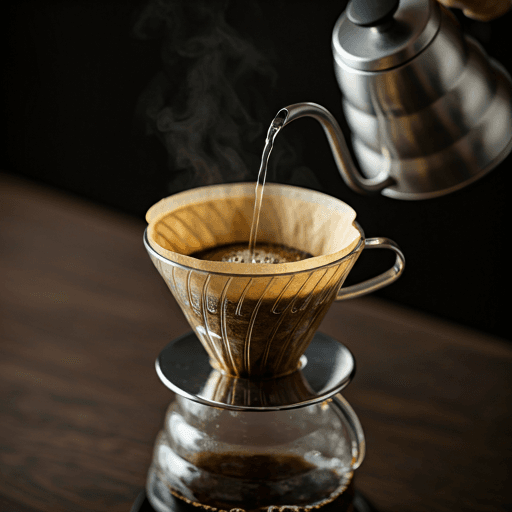
Brew a cup and you are mostly drinking water. A cup of coffee is roughly 98% water, which is why the best water for coffee matters almost as much as the beans, the grind or the recipe. The short version: the best water for coffee is clean, fresh, odour-free and moderately mineralised — often nothing fancier than well-filtered tap water. Very hard, heavily chlorinated, softened, or fully distilled water all tend to pull a cup in the wrong direction.
This guide is about water type and mineral content, not how hot the water should be. Temperature is its own separate lever, and we cover it in best water temperature for coffee.
The short answer: what the best water for coffee looks like
If you want one rule of thumb, it is this: what water is best for coffee comes down to water that tastes clean and pleasant to drink on its own, carries a little mineral content, and has no chlorine smell or stale off-notes. In practice that usually means filtered tap water. A basic carbon filter strips chlorine and odours while leaving behind the modest amount of calcium and magnesium that actually helps flavour along.
What to avoid sits at the extremes: water with so many minerals that it tastes chalky and furs up your kettle, and water with none at all — distilled or heavily purified — that tastes flat and washed out. The sweet spot is comfortably in the middle, and most drinkable tap water is already close to it.
Why water quality matters so much
Does water quality affect coffee? Yes, and more than most people expect. Water is not a neutral carrier — it is an active ingredient. A small amount of dissolved mineral content, especially magnesium and calcium, helps the water grab and hold the flavour compounds locked inside the grounds. Think of those minerals as tiny hooks: with a few of them present, water pulls sweetness and aroma out of the coffee more readily. Strip them all away and the water has less to work with, so the cup can taste thin and hollow.
But the relationship is not simply "more is better." Push the mineral content too high and two things go wrong. The cup starts to read as dull, flat and slightly chalky, because there is already so much dissolved in the water that it struggles to take on much more from the coffee. And that same mineral load leaves scale — the crusty limescale that builds up inside kettles, espresso machines and moka pots over time.
Then there is everything you do not want carried into the cup at all: chlorine, and the musty or metallic off-odours some tap supplies pick up. Coffee is startlingly good at broadcasting these. If your water smells faintly of a swimming pool, that note will ride straight into your mug. This is exactly why filtered water for coffee is often the easy win — the filter removes the bad stuff and keeps the good stuff. Flavour is subjective and taste responses vary, so treat all of this as a helpful starting point rather than a verdict on your particular tap.
Tap vs filtered vs bottled vs distilled
Here is how the common options tend to stack up.
Tap water
Often perfectly good, sometimes not. Municipal supplies vary enormously from one place to the next. If your tap water tastes clean and you enjoy drinking it plain, it will usually make decent coffee. If it is noticeably hard, or you can smell chlorine, it is worth filtering.
Filtered tap water
For most people this is the practical sweet spot. A jug filter, an under-sink cartridge or a filter built into the machine removes chlorine and odours and takes the edge off very hard water, without stripping out all the helpful minerals. It is cheap, low-effort and repeatable — the reason filtered tap tends to be the default recommendation.
Bottled water
A mixed bag, because "bottled" covers everything from near-distilled purified water to intensely mineralised spring water. A moderately mineralised spring water can make lovely coffee; a very high-mineral one can taste flat, and a purified zero-mineral one can taste hollow. If you go bottled, a middling mineral content is the target — read the label rather than assuming.
Distilled and zero-mineral water
Distilled, deionised and reverse-osmosis water have had almost everything removed. On its own, this tends to make flat, under-extracted coffee, because the water has no minerals to help pull flavour out. Some dedicated home brewers start from zero-mineral water and add a measured mineral blend back in, but that is a hobby in itself. For everyday brewing, plain distilled water is not the answer.
| Water type | Effect on coffee | Verdict |
|---|---|---|
| Filtered tap | Chlorine and odours removed, helpful minerals kept | Usually the sweet spot |
| Hard tap | Can taste dull and chalky; scales your kettle and machine | Workable, but filter it |
| Softened (ion-exchange) | Minerals swapped for sodium; tends to taste flat or faintly salty | Best avoided for brewing |
| Distilled / zero-mineral | No minerals to pull flavour; tastes flat and under-extracts | Avoid on its own |
| Bottled spring | Varies by brand; a moderately mineralised one brews well | Fine if mineral content is moderate |
Hard vs soft water: taste and scale
Hardness simply describes how much dissolved mineral — mainly calcium and magnesium — the water carries. It matters for coffee in two ways: taste and equipment.
On taste, water that is very hard often makes coffee that reads as dull, heavy or chalky, because so much is already dissolved that extraction is muted. Water that is very soft — naturally soft, or softened by an ion-exchange system — swings the other way and can taste flat and a little sharp. Household softeners deserve a special mention: they typically swap calcium and magnesium for sodium, which does little to help extraction and can leave coffee tasting oddly flat or faintly salty. If you have a whole-house softener, brewing from an unsoftened tap or a filter jug is usually the better call. The sodium in softened water is a taste consideration here, not a health verdict — if you follow a low-sodium diet, that is a question for your own healthcare provider, and this is not medical advice.
On equipment, hard water is the main reason kettles fur up and espresso machines need descaling. You will sometimes see figures for an ideal range — very roughly somewhere around 50 to 150 parts per million of total dissolved solids is often quoted as a comfortable window — but treat any single number as a loose guide, not a hard target. The gear you own, the beans you brew and your own palate all move the goalposts.
Practical takeaways
- Trust your tongue first. If your tap water tastes good to drink straight, it usually makes good coffee. Fix it only if it needs fixing.
- Filter if it is chlorinated or hard. A simple carbon filter is the highest-value, lowest-effort upgrade for most kitchens.
- Use fresh, cold water, heated once. Freshly drawn cold water brought to temperature a single time tastes brighter than water that has been sitting or reboiled many times, which can go flat.
- Skip the extremes. Neither rock-hard tap nor zero-mineral distilled water is doing you any favours.
- Descale on a schedule if your water is hard, so scale never gets the chance to dull your machine or your cup.
Good water is the quiet partner to everything else you do. Once it is clean and moderately mineralised, the other variables can actually do their job: the right grind and dose control how much flavour you pull, which is the whole story of coffee extraction, while your coffee-to-water proportions set the strength — see coffee brewing ratios. Sort the water, dial in the grind and ratio, mind the temperature, and a plain cup of coffee made at home starts to taste like the beans deserve.