
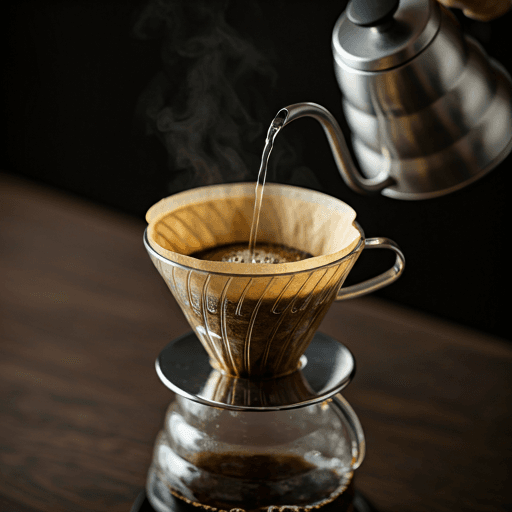
Coffee brewing ratios are simply how much coffee you use compared with how much water, measured by weight in grams. Get this one number right and most of the guesswork disappears. For everyday filter and pour-over coffee, the so-called golden ratio is about 1:15 to 1:18 - that is 15 to 18 grams of water for every 1 gram of coffee, or roughly 55 to 60 grams of coffee per litre. This guide explains what a coffee to water ratio means, why it matters more than any gadget, and the typical ratios for every common brew method.
What coffee brewing ratios actually mean
A brewing ratio is just a comparison: grams of dry coffee to grams of water. We write it like 1:16, which reads as "one part coffee to sixteen parts water." Because water weighs almost exactly 1 gram per millilitre, you can treat grams and millilitres of water as the same thing - 500 g of water is 500 ml. That small fact is why a kitchen scale beats a measuring jug and a coffee scoop every time.
The reason ratios coffee drinkers swear by work so well is that they are portable. A 1:16 ratio tastes the same whether you are making one mug or a full carafe, so once you find a coffee water ratio you like you can repeat it forever and scale it to any batch size. Scoops cannot do that, because a "scoop" of light, fluffy beans weighs less than the same scoop of dense, dark-roasted ones.
The golden ratio explained
The golden ratio is the industry shorthand for a balanced brewed coffee. The Specialty Coffee Association's long-standing guidance lands near 55 grams of coffee per litre of water, which works out to roughly 1:18. In practice most home brewers sit anywhere from 1:15 (stronger, fuller) to 1:18 (lighter, cleaner) and adjust from there. A common, easy-to-remember starting point is 60 grams of coffee per litre, or about 1:16 to 1:17.
There is no single "correct" number inside that band - it is a taste window, not a law. Start in the middle, brew a cup, and let your own palate move you toward stronger or lighter. The point of the golden ratio is to give you a reliable place to begin instead of a blank page.
Strength versus extraction: two different things
This is the idea that unlocks everything. Your ratio controls strength - how concentrated the cup is, how much dissolved coffee is in each sip. Your grind size and brew time control extraction - how much flavour you actually pull out of the grounds.
They are easy to confuse because both affect taste, but they are separate dials:
- Ratio (strength): more coffee per unit of water makes a stronger, denser cup; less makes a weaker, more tea-like one.
- Grind and time (extraction): a finer grind or longer contact pulls out more; too far and you get bitter, harsh, over-extracted coffee. Too coarse or too fast and you get sour, thin, under-extracted coffee.
The skill is keeping the ratio fixed while you adjust grind, so you change one variable at a time. If your coffee is strong but bitter, do not just add water - that dilutes strength but leaves the bitterness. Coarsen the grind instead. For a deeper dive on grind, see our guide to how to grind coffee beans.
Use a scale, not scoops
A cheap digital kitchen scale that reads in 1-gram steps is the most useful coffee tool most people do not own. Weighing both the coffee and the water removes the biggest source of inconsistency and lets you hit the same coffee to water ratio every single morning. Tare the empty brewer, add your dose of grounds, tare again, then pour water until the scale shows your target weight. Once you brew by weight for a week, scoops feel like guessing in the dark. For the full beginner walkthrough, our broad guide to how to make coffee covers the whole process from bean to cup.
Coffee brewing ratios by method
Different brewers want slightly different ratios because of how they extract. Full-immersion methods sit the grounds in water the whole time, so they can run a touch leaner; percolation methods like pour-over run a little richer. Espresso and cold brew are measured differently again. Use this as a starting chart, then adjust to taste.
| Method | Typical ratio | Example weights | Notes |
|---|---|---|---|
| Drip / pour-over | 1:16 to 1:17 | 30 g coffee : ~500 g water | Clean and bright; the classic golden-ratio zone |
| French press | ~1:15 | 30 g : 450 g | Full immersion, coarse grind, heavier body |
| AeroPress | 1:14 to 1:16 (or concentrate) | 15 g : 220 g | Very flexible; many recipes go stronger and dilute |
| Espresso | ~1:2 (by output) | 18 g in : ~36 g out | Measured by liquid yield, not water added |
| Moka pot | Fill-based | Basket level-full; water below the valve | Ratio is set by the pot size, not weighed |
| Cold brew concentrate | 1:4 to 1:8 | 100 g : 500-800 g water | Brew strong, then dilute to taste before serving |
A few notes on the outliers. Espresso is a "brew ratio" measured by what comes out of the machine: a standard double pulls about 18 g of grounds into roughly 36 g of liquid, a 1:2 ratio. A tighter 1:1 gives a ristretto; a looser 1:3 gives a lungo. Moka pots ignore the scale entirely - you fill the funnel basket level (never tamped) and fill the bottom chamber with water to just under the safety valve. Cold brew is usually made as a concentrate at 1:4 to 1:8, then cut with water, milk or ice to drinking strength before serving. The French press guide and V60 pour-over guide cover those methods in full. This page is the cross-method ratio reference; those pages own the step-by-step technique.
How to dial in to taste
Brew a cup at the chart ratio, taste it, and adjust one thing at a time. The two most common fixes:
- Too weak or watery? Use more coffee (drop the ratio toward 1:15) or grind a little finer to extract more.
- Too strong or bitter? Use less coffee (raise the ratio toward 1:17 to 1:18) or grind a little coarser to extract less.
Change strength with the ratio; change harshness or sourness with the grind. If you keep notes - dose, water, grind setting, how it tasted - you will zero in on your ideal cup within a few brews and be able to reproduce it on demand.
How to scale a recipe up or down
Because a ratio is proportional, scaling is just multiplication. Pick your water amount, divide by the ratio, and that is your coffee dose. Want 750 ml of pour-over at 1:16? That is 750 divided by 16, about 47 g of coffee. Making a single 250 ml mug at the same ratio? 250 divided by 16 is roughly 16 g. The ratio stays put while the absolute weights move together, which is exactly why brewing by weight is so forgiving - one tidy formula covers a tasting flight or a dinner-party carafe.
The takeaway
Coffee brewing ratios are the quiet foundation under every good cup. Start near the golden 1:15 to 1:18 for filter, use the chart for other methods, weigh your coffee and water, and adjust grind for bitterness and ratio for strength. Master that and you will get a consistent, repeatable brew anywhere in the world. From here, dial in your grind for clarity or pick a single method to perfect - the ratio you have learned here travels with you to all of them.