
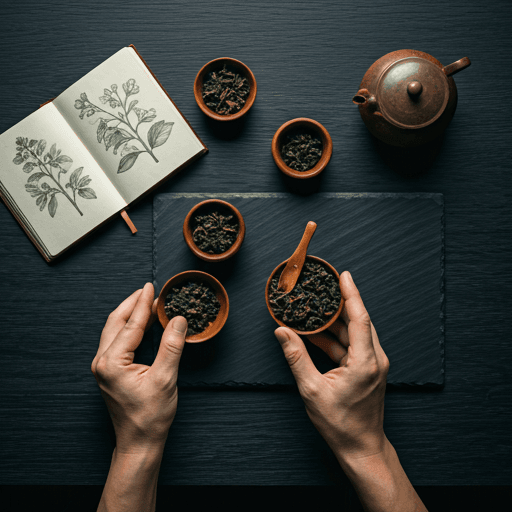
Ben Shan oolong tea is a lightly oxidized, ball-rolled oolong from Anxi County in southern Fujian, China — one of the region's "four famous cultivars" and a close botanical cousin of the celebrated Tie Guan Yin. It looks and smells strikingly like Tie Guan Yin, yet it grows on a distinct tea plant with reddish stems, thinner leaves, and a softer, honey-orchid character all its own.
What is Ben Shan oolong tea?
Ben Shan oolong tea (本山, roughly "source mountain" or "home mountain") is made from the Ben Shan cultivar of Camellia sinensis, an oolong-type tea bush native to Anxi County in the Min Nan (southern Fujian) tea country. It sits within the same family of teas as Tie Guan Yin, sharing the modern jade-green processing style: a light oxidation of roughly 20–30% followed by the tight, semi-ball rolling that Anxi is famous for. The result is a fresh, fragrant, floral-and-fruity oolong that many drinkers mistake for Tie Guan Yin at a glance.
That resemblance is the whole story of Ben Shan. Because it is aromatic, forgiving to grow, and productive even in less-than-ideal soil, Ben Shan is frequently used as an affordable, Tie Guan Yin–style oolong — sometimes blended with genuine Tie Guan Yin and, less honestly, sometimes sold outright under the Tie Guan Yin name. Understanding Ben Shan on its own terms is the best defense against that confusion, and it rewards you with a genuinely likeable tea. To place it in the wider picture, it helps to know how the broad categories of oolong tea and the six types of tea are organized.
Anxi County: the terroir behind the cup
Anxi County lies in the mountainous interior of southeastern Fujian Province. It is widely regarded as a cradle of oolong craftsmanship and the birthplace of the Tie Guan Yin tea plant, with organized tea culture in the county often dated to the eighteenth century. The Anxi tea landscape is so distinctive that it has been recognized internationally as an agricultural heritage system, built around a layered pattern of headwater forests, terraced tea gardens, villages, and rivers.
The growing conditions matter for flavor. Anxi's tea gardens climb hilly, sometimes rocky slopes under a warm, humid subtropical climate with frequent cloud and mist. Cooler nights and mineral-rich soils slow leaf growth and concentrate the aromatic compounds that give Anxi oolongs their signature high-toned florals. Anxi maintains more than a hundred tea varieties, with dozens of indigenous cultivars; the principal ones include Tie Guan Yin, Huang Jin Gui (Huangdan), Ben Shan, Mao Xie, Meizhan, and Da Ye Oolong. For a wider look at the province's teas, see our guide to Fujian tea.
The Four Famous Cultivars of Anxi
Anxi tea people traditionally group four cultivars together as the county's most celebrated oolong bushes. Each is processed in a broadly similar way, but each carries its own leaf shape, aroma, and reputation.
| Cultivar | Character in the cup | Notable trait |
|---|---|---|
| Tie Guan Yin | Deep orchid florals, creamy body, long "yin yun" aftertaste | The benchmark Anxi oolong; most prized |
| Huang Jin Gui | Bright, high florals with juicy, osmanthus-like fruit | Earliest to flush each spring; very fragrant |
| Ben Shan | Lighter honey-orchid, snappy and floral, gently fruity | Reddish stems, thinner leaves; TGY's close cousin |
| Mao Xie | Savory, buttery, pastry-like when traditionally finished | Downy hairs on the leaf ("hairy crab") |
Ben Shan is the one most often confused with Tie Guan Yin. Its siblings each have distinguishing tells: read more in our guides to Huang Jin Gui oolong and Mao Xie oolong.
Ben Shan versus Tie Guan Yin: cousins, not twins
The most important thing to understand is that Ben Shan is not Tie Guan Yin. It is a distinct, officially recognized oolong cultivar in its own right, traditionally said to have been selected in Anxi's Xiping area and often dated to around 1870. Genetic and phytochemical studies confirm what tasters have long said: the two plants are closely related and produce very similar aromas and flavors, yet Ben Shan carries measurably different chemistry.
Researchers comparing the two cultivars found that Ben Shan leaf holds lower catechins (around 87 mg/g versus roughly 115–118 mg/g in Tie Guan Yin), lower caffeine, and less of certain aroma compounds such as limonene. In their words, the aroma and taste of Ben Shan are "very similar" to Tie Guan Yin, "but it lacks the 'yin yun'" — the deep, lingering, mineral-floral resonance (often translated "iron goddess rhyme" or "yin rhyme") that connoisseurs treasure in top Tie Guan Yin. Ben Shan gives you the perfume up front, but not that echoing finish.
You can also tell the plants apart in the leaf. Ben Shan is known for its slender, bright-red stalks and thinner, more elliptical leaves with a slightly ridged edge that unfurl quickly in the pot. Tie Guan Yin tends toward a heavier, glossier, thicker leaf. In the dry, tightly rolled ball, the differences are subtle — which is exactly why Ben Shan is so easy to pass off as its more famous relative.
Is Ben Shan just a cheaper Tie Guan Yin substitute?
Partly, and honestly, yes — but that framing sells it short. Because Ben Shan is hardy and reliably aromatic, it is one of the most common cultivars used as an affordable, TGY-style oolong, and it is regularly blended into commercial Tie Guan Yin or marketed as the real thing. Within the same quality tier, the "other" Anxi oolongs — Huang Jin Gui, Ben Shan, and Mao Xie — tend to sit below Tie Guan Yin in market demand rather than in intrinsic quality.
The fairer view is that a well-made, high-elevation Ben Shan from old bushes deserves to be judged as its own tea, not as a discount imitation. Bought and labeled honestly, single-cultivar Ben Shan is a lovely, everyday floral oolong with a lightness and snap that some drinkers actually prefer to the richer Tie Guan Yin.
How Ben Shan is made: rolled ball-shape processing
Modern Ben Shan is almost always made in the light, jade-green Anxi style, which keeps oxidation low to preserve bright florals. The processing follows the classic Anxi oolong sequence:
- Plucking: young shoots are gathered, typically as a small cluster of leaves.
- Sun withering: leaves wilt briefly outdoors to lose surface moisture and soften.
- Cooling and tossing (yao qing): the leaves are rested and repeatedly shaken or tumbled, bruising the edges to start controlled, partial oxidation and build aroma.
- Fixation (kill-green): heat halts oxidation early, locking in the fresh, green-floral profile at roughly 20–30% oxidation.
- Rolling and shaping: the tea is repeatedly wrapped in cloth and kneaded, tightening each leaf into the compact, semi-ball nugget that defines Anxi oolong.
- Drying: a gentle, low firing sets the shape and finishes the tea, keeping aromatics intact.
The finished leaf is a tight, yellowish-green to jade ball flecked with those telltale reddish stems. Ben Shan can also be given a heavier traditional roast, which pushes it toward warmer, toasted, nuttier notes; but the fragrant green style is by far the most common today.
Flavor profile: lighter, honey-orchid, floral
Ben Shan brews to a pale gold-to-greenish liquor with a clean, high fragrance. Expect an orchid-forward florality wrapped in a soft honey sweetness, with gentle stone-fruit and orchard notes — think pear, apricot, or peach — and a cooling, faintly mineral finish. Compared with Tie Guan Yin, Ben Shan reads as lighter, brighter, and snappier: less of the buttery, creamy weight and less of that long resonant aftertaste, but plenty of immediate perfume and easy drinkability.
That approachable, floral lightness makes Ben Shan an excellent introduction to Anxi oolong and a fine everyday cup. It also holds up to several infusions, releasing its aromatics generously across the first few steeps.
How to brew Ben Shan oolong
Like most rolled Anxi oolongs, Ben Shan performs beautifully with either a relaxed Western pour or a more intense gongfu session. A quick rinse — a few seconds with hot water, poured off — helps the tight balls begin to open and wakes up the aroma.
| Method | Leaf | Water | Temperature | Time |
|---|---|---|---|---|
| Western | 3 g | ~350 ml (12 oz) | 85–95°C (185–205°F) | 2–3 min, 2–3 steeps |
| Gongfu | 6–7 g | ~150 ml | 90–95°C (195–205°F) | Rinse, then 20–30 s, adding time each round for 6–8 steeps |
Because Ben Shan is delicate and lightly oxidized, avoid a hard rolling boil held for too long, which can pull out astringency and flatten the florals. Slightly cooler water and shorter, repeated steeps show off its best side. If you enjoy Ben Shan, the same rolled-ball technique carries over neatly to its Anxi siblings and to Taiwan's high-mountain oolongs.
Caffeine in Ben Shan oolong
As an oolong, Ben Shan sits in the moderate-caffeine range — generally lighter than a strong black tea and comparable to other green-style oolongs. Interestingly, laboratory analysis has found the Ben Shan cultivar to carry somewhat less caffeine in the leaf than Tie Guan Yin (around 19–20 mg per gram of dry leaf versus roughly 24–26 mg/g), so a cup of Ben Shan may deliver a slightly gentler lift than an equivalent Tie Guan Yin.
Actual caffeine in your cup depends on leaf quantity, water temperature, and steep time, and repeated gongfu infusions spread the caffeine across many small servings. Oolong is also associated in some research with the calming amino acid L-theanine, which many drinkers feel smooths the energy it provides. As with any caffeinated drink, moderation is sensible, and anyone who is pregnant, sensitive to caffeine, or managing a health condition should check with a qualified professional about what is right for them.
Choosing and enjoying Ben Shan
When selecting Ben Shan, look for tight, glossy jade-green balls with visible reddish stems, and a clean, fresh floral aroma in the dry leaf. Honest labeling matters most: a tea sold clearly as Ben Shan, ideally with a named growing area within Anxi, tells you the merchant respects the cultivar for what it is rather than dressing it up as Tie Guan Yin. Treated that way, Ben Shan earns its place among Anxi's four famous cultivars — not as a stand-in, but as a bright, honey-orchid oolong worth knowing on its own.