
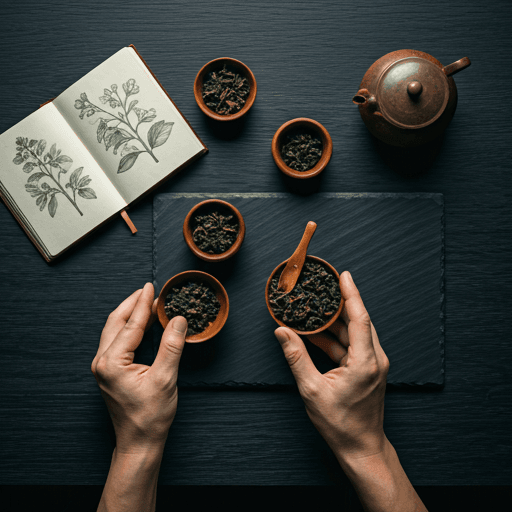
Oolong tea is a partially oxidised tea made from the leaves of Camellia sinensis — the same plant behind green, black and white tea. What makes it different is where the leaf is stopped: oolong sits in the wide middle ground between green tea (essentially unoxidised) and black tea (fully oxidised). That single decision, taken somewhere along an oxidation scale, is why "oolong tea" covers everything from a pale, orchid-floral cup to a dark, roasted, almost coffee-like brew.
If you have ever seen it written as "wulong tea" or "wulong" — that is the same drink. Wulong is simply a closer transliteration of the Chinese name; oolong is the spelling that became common in English. So the answer to "what is oolong tea" is: one tea category, defined by partial oxidation, with the broadest flavour range of any tea on earth.
What is oolong tea, exactly?
Every true tea — green, white, oolong, black and dark/pu-erh — comes from the leaves of one plant, Camellia sinensis. The differences come almost entirely from how the picked leaf is handled. The key step is oxidation: once a leaf is bruised or rolled, enzymes react with oxygen and the leaf chemistry changes, deepening colour and shifting flavour from grassy and fresh toward malty, fruity and rich.
Green tea is heated early to halt oxidation almost immediately. Black tea is allowed to oxidise fully. Oolong is the deliberate in-between: makers let the leaf oxidise partway — commonly cited as roughly 10% to 80% — then apply heat to lock it in at the point they want. Because that point can fall almost anywhere, oolong is not a single flavour but a spectrum. For the bigger picture of how one plant becomes so many drinks, see our guide to Camellia sinensis, the tea plant and the overview of the types of tea explained.
How oolong is made, step by step
The processing is what defines the cup. After picking, oolong leaves are usually withered in sun and air to soften them and begin losing moisture. They are then gently bruised — traditionally by shaking, tossing or tumbling in bamboo baskets — which breaks the leaf edges and starts controlled oxidation. The maker watches the leaf change colour and aroma, then "kills the green" with heat (a process called shaqing) to stop oxidation at the chosen point. Many oolongs are then rolled into tight balls or twisted strips, dried, and sometimes roasted. Each of those decisions — how long to wither, how hard to bruise, when to fire, how much to roast — shifts the final tea, which is why two oolongs from neighbouring gardens can taste worlds apart.
Oxidation versus roasting
These two are easy to confuse but they are not the same. Oxidation happens to the fresh leaf before it is fired, driven by the leaf's own enzymes. Roasting is heat applied to the finished tea afterwards, which adds toasty, caramelised, nutty notes through cooking rather than oxidation. Many of the darkest, most intense oolongs are both moderately oxidised and then roasted — that combination is what gives a Wuyi "rock" oolong its deep, mineral, almost burnt-sugar character.
The oolong flavour spectrum
Think of oolong as a dial rather than a fixed taste. Turn it one way and you get something close to green tea; turn it the other and you approach black tea.
- Light, green oolongs — lower oxidation, usually unroasted or lightly roasted. Pale gold liquor, floral and creamy, with notes of orchid, lilac, fresh butter and sometimes a vegetal edge. Jin Xuan (milk oolong) and many Taiwanese high-mountain teas live here.
- Medium oolongs — the classic middle. More body, honeyed and fruity, with a gentle toast. Traditional Tieguanyin and Dong Ding often sit in this zone.
- Dark, roasted oolongs — higher oxidation and/or heavier roast. Amber to chestnut liquor, rich and warming, with roasted-nut, woody, mineral and caramel notes. Da Hong Pao and other Wuyi rock teas are the flagships.
One pleasant feature of a good oolong is that it usually rewards several infusions. Quality leaf, especially the tightly rolled styles, slowly unfurls and gives a slightly different cup each time you re-steep it.
Famous types of oolong tea
Most celebrated oolongs come from two regions: the Wuyi and Anxi areas of Fujian in China, and the mountains of Taiwan (historically called Formosa). Here are the names you will meet most often.
| Oolong | Origin | Style | Typical flavour |
|---|---|---|---|
| Tieguanyin (Iron Goddess) | Anxi, Fujian, China | Rolled; light to medium oxidation | Orchid-floral, creamy, smooth |
| Da Hong Pao (Big Red Robe) | Wuyi Mountains, Fujian, China | Twisted; more oxidised and charcoal-roasted "rock tea" | Rich, mineral, woody, roasted |
| Jin Xuan (milk oolong) | Taiwan | Rolled; lightly oxidised, usually unroasted | Naturally creamy, buttery, floral |
| Dong Ding | Taiwan | Rolled; medium oxidation, often roasted | Honeyed, smooth, lightly toasty |
| Alishan / high-mountain (Gaoshan) | Taiwan | Rolled; light oxidation, grown at altitude | Sweet, floral, fresh, delicate |
| Oriental Beauty (Dongfang Meiren) | Taiwan | Heavily oxidised, leafhopper-bitten leaf | Honeyed, ripe-fruit, muscatel |
About "milk oolong"
Jin Xuan is a Taiwanese cultivar developed in the early 1980s (officially registered as cultivar #12 in 1981 by the Taiwan Tea Research and Extension Station), nicknamed milk oolong for its naturally smooth, buttery, slightly milky character. In genuine Jin Xuan that creaminess comes from the cultivar and processing alone — no milk is involved. Be aware, though, that some inexpensive "milk oolong" is artificially flavoured to push the milky scent harder, so a heavy, candy-like aroma is a sign the leaf may have been scented rather than naturally creamy.
How much caffeine is in oolong tea?
Oolong is a caffeinated tea — it is a real tea leaf, after all. A typical cup lands somewhere in the moderate range, broadly comparable to other true teas and generally below a cup of brewed coffee, though exact numbers vary with the leaf, the dose and how long you steep. A useful and slightly counter-intuitive point: a dark, roasted oolong is not automatically the most caffeinated. Colour comes mostly from oxidation and roast, which do not track caffeine, so a pale, lightly oxidised oolong can deliver as much caffeine as a darker one. If you brew gongfu style with lots of leaf, the first short infusion carries the most caffeine, and rinsing or pouring it off is one way to lighten the cup. If you want to understand caffeine across drinks generally, our caffeine explained guide covers the basics.
How to brew oolong tea
Oolong tea is loose-leaf at its best, and it forgives experimentation. There are two common approaches. For the general loose-leaf fundamentals — water, leaf and timing — see how to brew loose-leaf tea; below is the oolong-specific version.
Western style (one good cup)
- Use roughly a heaped teaspoon (about 2 to 3 grams) of leaf per cup.
- Heat water to about 85 to 95°C / 185 to 205°F. Lighter, greener oolongs prefer the cooler end; dark roasted oolongs can take it near-boiling.
- Steep for about 2 to 3 minutes, then taste.
- Re-steep the same leaf — good oolong gives two or three more rounds, each a little longer.
Gongfu style (many tiny steeps)
This traditional method uses a lot of leaf, very little water and very short infusions, drawing out a new layer of flavour each round.
- Use a small vessel (a gaiwan or little teapot), about 100 to 150 ml.
- Add a generous amount of leaf — roughly 5 to 7 grams.
- Pour on hot water and steep for only 15 to 40 seconds for the first infusion.
- Pour off completely, then re-steep, adding a few seconds each round. A quality oolong can give six or more satisfying infusions.
Oolong is best enjoyed plain, without milk or sugar, so its floral and roasted notes come through. Tightly rolled oolongs open up slowly, so do not judge the leaf on the first quick steep — the second and third rounds are often the best.
Oolong tea benefits: what the evidence actually says
Like other teas from Camellia sinensis, oolong contains polyphenol antioxidants and a moderate amount of caffeine, and is a calorie-free drink when taken without milk or sugar. It is worth being measured here: oolong is studied less than green or black tea, and a lot of the headline claims come from small trials or laboratory and animal work rather than large human studies.
- Antioxidants. Oolong is rich in tea polyphenols (including catechins and, in more oxidised types, theaflavins). These are the compounds researchers associate with tea's general benefits.
- Metabolism and weight. Some small human studies suggest oolong's caffeine-and-polyphenol combination may give a modest, short-lived bump to energy expenditure and fat oxidation. This is a "may help a little" effect, not a weight-loss solution.
- Blood sugar and heart health. There is early and mixed evidence that regular tea drinking may support healthy blood sugar and cardiovascular markers, but the oolong-specific picture is not settled and more research is needed.
- Calm focus. Like other true teas, oolong contains the amino acid L-theanine, which many drinkers feel pairs with caffeine for a smoother, steadier alertness than coffee.
None of this is medical advice. If you are pregnant, breastfeeding, sensitive to caffeine, or managing a health condition, treat oolong as the pleasant, moderate-caffeine drink it is and check with a doctor about how much suits you.
Where oolong fits among teas
The simplest way to place oolong is on the oxidation line: green tea at one end, black at the other, oolong occupying the broad, varied middle. That is also why it is such a good tea to explore — once you taste a light, floral high-mountain oolong next to a dark, roasted rock oolong, the whole idea of "partial oxidation" stops being abstract and becomes something you can taste in the cup. Start with a couple of contrasting styles, brew them side by side, and let your palate map the spectrum for itself. From there, the natural next step is to compare oolong with its neighbours on the line and keep tasting your way across the family.