
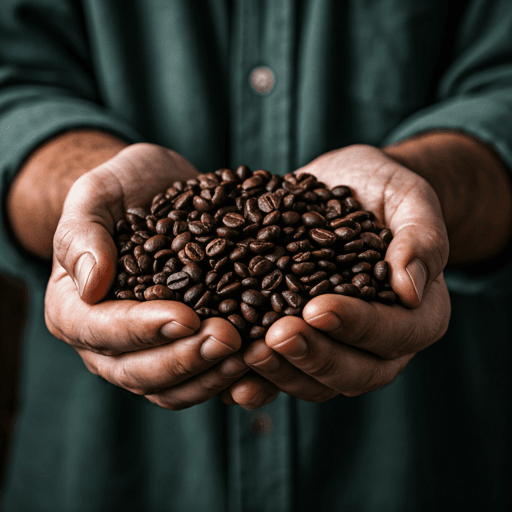
Yemeni coffee is where the coffee trade began. It is arabica grown on ancient stone terraces in dry mountains, dried whole in the sun because water is too scarce to do anything else, and grown from heirloom plants found nowhere else on earth. The cup is wild, winey, fruity and enormously complex — and this origin is the reason the word mocha exists at all.
That last point is where most writing about this origin goes wrong, so this guide starts with the port, tells the history precisely, and then gets to what is actually in the cup.
What Yemeni coffee is
Yemeni coffee comes from the highlands of southwestern Arabia, inland from the Red Sea. It is almost entirely Coffea arabica, grown between roughly 1,500 and 2,400 m (about 4,900–7,900 ft), with some plots higher still. The farms are small — frequently a fraction of a hectare — and they sit on dry-stone terraces cut into near-vertical mountainsides, many of them built centuries ago and some by long tradition far older than that. The terracing is among the oldest working agricultural infrastructure still in use anywhere.
Two things follow from the land. The climate is arid, so the plants grow slowly and yield little, which tends to concentrate what ends up in the seed. And because the terraces are steep, narrow and hand-worked, almost nothing here is mechanized. Yemeni coffee beans are typically small, irregular and often visibly misshapen — graders elsewhere would call them defective on looks alone. In this origin, small and lumpy is simply what the heirloom plants produce. If you want the groundwork on what the bean actually is, our guide to what coffee beans are covers it.
Output is tiny. Yemen accounts for a very small fraction of world coffee — well under one percent of global production. This is a genuinely scarce origin, not a marketed one.
The Mokha story: how a Red Sea port named a coffee
This is the heart of the page, and it is worth getting exactly right.
Mokha — also spelled Mocha, and rendered from Arabic as al-Makha — is a real port town on Yemen's Red Sea coast. From roughly the sixteenth century onward it was the harbour through which coffee reached the wider world, and its zenith came in the first quarter of the eighteenth century. Beans came down from the highlands by caravan, were sorted and traded at the port, and sailed on to Cairo, Istanbul, Venice, Amsterdam and London. For a long stretch, if you drank coffee at all, it had very likely passed through Mokha.
Trade names are blunt. When one port handles essentially all of a commodity, the port's name becomes the product's name — and so coffee shipped from Mokha was simply called mocha.
One honest footnote, because it is usually left out: the coffee did not grow at Mokha. It was carried there from inland Yemen, and a substantial share of what shipped out had crossed the Red Sea from the Horn of Africa first — by some accounts a majority of the port's volume in its later years. The port was the funnel, not the farm.
Then the word drifted. Because coffee from this origin often carried a natural cocoa-like note, "mocha" gradually stopped meaning coffee from that port and came to mean a coffee-and-chocolate drink — two different senses of one word, separated by a few hundred years. This page is about the first sense: the origin and the harbour. The drink is a different subject entirely.
Mokha's dominance did not last, and no single cause explains it. Coffee plants were taken out of Arabia and established elsewhere in the early 1700s, which ended the monopoly. A plague in the eighteenth century killed roughly half the town's population, and it never fully recovered. Nearby harbours took over the trade — al-Hudaydah, and then Aden, which came under British control in 1839. The name outlived the working harbour by a long way.
The history: Ethiopia grew it, Yemen farmed it
These two origins get conflated constantly, and the distinction is clean.
Coffea arabica the plant is native to the highland forests of southwestern Ethiopia, where it still grows wild. Yemen is where coffee was first cultivated as a deliberate crop and traded at scale, from around the fifteenth century. Ethiopia is the botanical homeland; Yemen is the place that turned a wild forest plant into agriculture and an export commodity. Our Ethiopian coffee guide covers the plant's side of that story.
Yemen's role in early coffee drinking is documented rather than folkloric. The earliest credible evidence of coffee drinking appears in the middle of the fifteenth century, in Sufi communities in Yemen, where it was drunk to stay awake through long night devotions. That is a real, dated thread in coffee's history, and it belongs to this origin.
There is a modern coda that makes the point better than any legend. Genetic work on cultivated arabica indicates that nearly all of the coffee cultivated over the past few centuries descends from a very small number of plants out of Yemen — and that the diversity still held in Yemen dwarfs what exists on the world's plantations. Yemen is not merely an old coffee country. It is arabica's domestication centre, and much of the world's coffee is descended from what was farmed on these terraces.
Mocha-Java: coffee's oldest named blend
Dutch shipping established arabica on Java at the very end of the seventeenth century — seedlings reached Batavia in 1696 and again in 1699, and the first Java coffee sailed for Europe in 1711. Yemen's long monopoly was over. But something else began: ships bound for Europe were now carrying both coffees, and the two were combined into Mocha-Java, widely described as the oldest coffee blend still known by name.
The logic still holds up. Yemen brought fruit, wine-like acidity and spice; Java brought earthy, heavy, low-toned depth. Bright and wild against dark and grounded — a contrast blenders still reach for three centuries later. The Java half of that pairing is its own story, with its own island, its own estates and its own processing tradition; this page stays on the Yemeni half.
What makes the cup: aridity, terraces and the natural process
Yemeni coffee is almost universally natural (dry) processed — the whole cherry is dried with the fruit still on the seed, rather than washed off. Our guide to coffee processing methods explains how that differs from washed and honey.
Here is the part that matters, though: in Yemen this is not a stylistic choice. It is a constraint. Yemen is one of the most water-stressed countries on earth, and washed processing needs water the region does not have. Natural processing is what the land permits. Cherries are commonly spread to dry on the flat stone rooftops of highland houses, turned by hand over weeks while the fruit sugars concentrate and break down around the seed.
That distinction is worth being honest about. Elsewhere, "natural process" is a deliberate flourish chosen for effect. In Yemen it is the method that has been used for centuries because there was no alternative — and the wild, fermented, fruit-forward character everyone praises is the direct result of an environmental limit, not a trend.
Farmers here also work against real agronomic pressure: qat, a competing cash crop, draws land and scarce water away from coffee in many highland areas.
The heirloom landraces
Most of the world's arabica grows from a handful of catalogued cultivars descended from Typica and Bourbon lines. Yemen is different. Its plants are vernacular landraces, named locally and largely never formally catalogued by modern botany: Udaini, Tuffahi, Dawairi, Ismaili, and others such as Jaadi and Khulani.
Treat the names loosely. Several are regional labels as much as botanical ones — Ismaili and Udaini both point at places — and the same name can mean different things in different valleys. Broadly, and with hedges intact: Tuffahi is associated with rounded sweetness and softer acidity; Dawairi with wine-like, dark-fruited complexity and a long finish; Udaini with a deeper, heavier, earthier profile. Genetic fingerprinting of these landraces is ongoing, and the picture is still being filled in, so treat any tidy variety-to-flavour chart with suspicion.
This is the origin's real distinction: uncatalogued heirlooms producing a character absent from the commercial cultivars behind most of the world's coffee. Because the plants are unique to the origin, this is a case where buying single origin genuinely tells you something the label alone cannot.
What Yemeni coffee tastes like
Yemeni coffee is often called the wildest cup in coffee, and the description is fair. Expect:
- Winey, fermented fruit — the signature; think red wine, dried dates, raisin and prune
- Blueberry and dark berry — the natural process pushing hard
- Spice — a warm, cardamom-like aromatic note many tasters pick out
- Chocolate and tobacco — the deep, savoury base under the fruit
- Low-to-medium acidity and a syrupy, heavy body
The through-line is complexity and layering rather than clarity. A good Yemeni cup does several things at once and keeps shifting as it cools. It is also, by nature, less uniform than a modern washed coffee — the same variability that makes it thrilling makes it inconsistent. That is the deal.
Yemeni coffee at a glance
| Fact | Detail |
|---|---|
| Origin | Highlands of southwestern Arabia, inland from the Red Sea |
| Species | Coffea arabica, heirloom landraces |
| Altitude | Roughly 1,500–2,400 m (about 4,900–7,900 ft); some plots higher |
| Key regions | Haraz, Bani Matar, Raymah, Yafa, Bura'a, Udain |
| Varieties | Udaini, Tuffahi, Dawairi, Ismaili, Jaadi, Khulani (vernacular, largely uncatalogued) |
| Processing | Almost universally natural (dry), often on stone rooftops |
| Why natural | Water scarcity — a constraint, not a style choice |
| Farm structure | Very small hand-worked plots on ancient dry-stone terraces |
| Harvest | Roughly October into December, varying by altitude and region |
| Bean appearance | Small, irregular, frequently misshapen |
| Flavour | Winey, dried fruit, blueberry, spice, chocolate, tobacco |
| Acidity / body | Low-to-medium acidity; syrupy, heavy body |
| Historic port | Mokha (Mocha / al-Makha), Red Sea coast |
| Share of world output | A very small fraction — well under 1% |
| Caffeine | Present; arabica typically carries less than robusta |
Yemeni coffee vs Ethiopian coffee
They are the two halves of coffee's origin story, and they taste related but distinct.
| Yemen | Ethiopia | |
|---|---|---|
| Role in history | First cultivated as a crop; first traded at scale | Botanical homeland; arabica still grows wild |
| Plants | Vernacular landraces unique to the origin | Vast wild and heirloom diversity |
| Processing | Almost all natural, by necessity | Both washed and natural, widely |
| Typical cup | Winey, spiced, syrupy, dried fruit, heavy | Floral, citrus, tea-like; berry-driven when natural |
| Acidity | Low to medium | Often bright and high |
| Volume | Very small | Among the world's larger arabica producers |
Simplified: a natural Ethiopian and a Yemeni coffee both give you fruit, but Ethiopia's tends to arrive lifted, floral and bright, while Yemen's arrives darker, denser, more fermented and more savoury underneath.
A note on conditions
Yemeni coffee is produced under extremely difficult circumstances, and volumes are very small. That is the plain fact, and it is not this page's place to say more about it or to take any side. It is worth stating only so that the scarcity of this origin is understood as a reality rather than a marketing angle.
The bottom line
Yemeni coffee is the origin the whole trade grew out of. Ethiopia gave the world the plant; Yemen made it a crop, put it in a cup, shipped it out of Mokha, and handed the word mocha to every language that drinks it. What survives is a coffee grown on old stone terraces from heirloom plants that exist nowhere else, dried whole in the sun because the water was never there for anything else — wild, winey, spiced and unmistakable. It is not a clean cup or a consistent one. It is the most historically loaded coffee you can drink, and it still tastes like nothing else.