
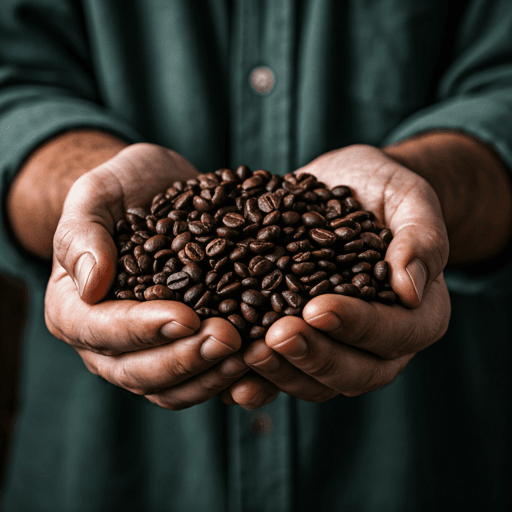
Coffea is the genus of tropical, evergreen shrubs and small trees whose seeds we roast, grind and brew as coffee. Of its roughly 120-plus species, only three matter commercially: Coffea arabica, Coffea canephora (better known as robusta) and Coffea liberica. Everything in your cup — from a delicate floral pour-over to a punchy espresso blend — traces back to a berry-bearing plant in this one botanical family.
Below is what the Coffea plant is, the three species that dominate the world's coffee, how the plant lives from blossom to fruit, and where on the map it can actually grow.
What the Coffea plant actually is
Coffea is a genus in the Rubiaceae, or madder family — the same broad plant family that includes the ornamental gardenia and the cinchona tree once tapped for quinine. Members are woody evergreens with glossy, dark-green, waxy leaves and clusters of small white, star-shaped flowers that smell intensely of jasmine. Left unpruned in the wild, some species grow into trees several meters tall; on farms they are usually kept low and bushy so the fruit stays within reach.
The genus is native to tropical Africa, with wild diversity reaching Madagascar and the Mascarene islands. Botanists count roughly 125 species of Coffea in total, and new ones are still being described. Yet almost all of that diversity never reaches a cup: the overwhelming majority of species have never been farmed at scale. When people say "the coffee plant," they nearly always mean one of just three domesticated species — and in practice, mostly two of them.
The three Coffea species that matter
Coffea arabica
Coffea arabica supplies most of the world's coffee — commonly cited figures put it somewhere between about 60 and 70 percent of global production. It originated in the highlands of Ethiopia and neighboring parts of the Horn of Africa, and it is prized for a finer, more nuanced cup: brighter acidity, more aromatic complexity and sweetness. The trade-off is that arabica is fussy. It prefers cooler high-altitude climates, ripens slowly, yields less per tree and is more vulnerable to pests and to coffee leaf rust. Botanically it is unusual too — a tetraploid that largely self-pollinates, which is part of why its wild genetic base is comparatively narrow.
Coffea canephora (robusta)
Coffea canephora, almost always sold under the name robusta, is the hardy workhorse. Native to central and western sub-Saharan Africa, it tolerates heat, lower altitudes and disease far better than arabica, and it yields heavily. The cup is bolder, more bitter and earthier, with a thick crema prized in espresso. Its defining number is caffeine: robusta typically carries close to twice as much as arabica, which is one reason it shows up in strong espresso blends and in a great deal of instant coffee. We keep the full head-to-head brief here — for the deep comparison, see arabica vs robusta coffee beans explained.
Coffea liberica (and the wild rest)
Coffea liberica is the rare third wheel — a small share of world production, but a distinctive one. Native to West and Central Africa, it grows into a larger tree with bigger, oddly asymmetric fruit and a flavor often described as smoky, woody and floral, sometimes almost jackfruit-like. It has a devoted following in parts of Southeast Asia. Beyond these three lie the many wild Coffea species that plant scientists increasingly study as a genetic reservoir — potential sources of heat tolerance and disease resistance as growing conditions shift.
Coffea arabica vs canephora vs liberica at a glance
| Species | Caffeine | Flavor | Hardiness | Share of world coffee |
|---|---|---|---|---|
| Coffea arabica | Lower (roughly ~1.2%) | Finer, sweeter, aromatic, brighter acidity | Fussy; needs altitude and cooler air; rust-prone | Most of it (about 60–70%) |
| Coffea canephora (robusta) | Higher (roughly 2x arabica) | Bold, bitter, earthy, heavy crema | Very hardy; heat- and disease-tolerant; high yield | Nearly all the rest |
| Coffea liberica | Varies; generally moderate | Smoky, woody, floral, distinctive | Robust, large tree; regionally grown | A small niche |
Treat the caffeine and share figures as ballpark: they drift with variety, growing region, harvest year and how the numbers are measured.
The life of a coffee plant: blossom to cherry
A coffee plant grown from seed does not rush. It typically takes around three to four years before a tree produces its first meaningful harvest, after which a healthy plant can keep bearing for decades. The cycle each season runs roughly like this:
- Flowering. Clusters of fragrant white blossoms open along the branches, often triggered by rain. The scent is famously jasmine-like, but individual flowers are short-lived, lasting only a few days.
- Fruit set. Pollinated flowers develop into small green fruits called drupes, or "cherries."
- Ripening. Over several months the cherries swell and color up — most turn deep red, though some varieties ripen to yellow or orange.
- Harvest. Ripe cherries are picked, and inside most of them sit two seeds pressed flat against each other. Those seeds are what get processed and roasted.
We are deliberately keeping the fruit and the seed brief here. For what the fruit itself is — pulp, mucilage, the "cherry" and even cascara — see the coffee cherry fruit guide; for how those two inner seeds become the green beans that get roasted, see what are coffee beans.
Where Coffea grows: the bean belt
Coffea is a tropical genus, and commercial coffee is grown almost entirely in a band circling the globe near the equator — roughly between the Tropic of Cancer and the Tropic of Capricorn. This zone is often called the "bean belt" or coffee belt. Within it, a few conditions do the heavy lifting:
- Temperature. The plant dislikes frost and extreme heat alike. Arabica favors cooler, mild ranges; robusta shrugs off warmer, lower-lying ground.
- Altitude. Higher elevations slow ripening and tend to concentrate flavor, which is why celebrated arabica so often comes from mountain slopes, while robusta thrives at lower altitudes.
- Rainfall and shade. Coffee wants steady moisture and a distinct dry spell to trigger flowering. Many farms grow it under a canopy of taller trees, echoing its origins as a forest-understory plant.
Those same requirements make Coffea sensitive to a changing climate. Rising temperatures, shifting rainfall and the spread of pests and diseases such as coffee leaf rust are pushing suitable growing zones uphill and prompting real interest in hardier species and varieties — a pressure worth noting without overstating the picture.
From cherry to bean, in one line
The short version: ripe cherries are picked, the fruit is stripped away, the seeds are dried, and only later are they roasted into the brown beans you recognize. Each of those stages is its own craft. To see how growers actually manage the trees, the harvest and processing on the ground, read how coffee farms work.
The plant behind the ritual
Strip away the roastery, the grinder and the barista, and coffee begins as a single genus of glossy-leaved, white-flowered tropical plants — Coffea — most of whose species you will never taste. It is a small botanical footprint for such an outsized daily ritual: two workhorse species doing nearly all the labor, a distinctive third holding a niche, and a long tail of wild relatives quietly holding options for the future of the cup.