
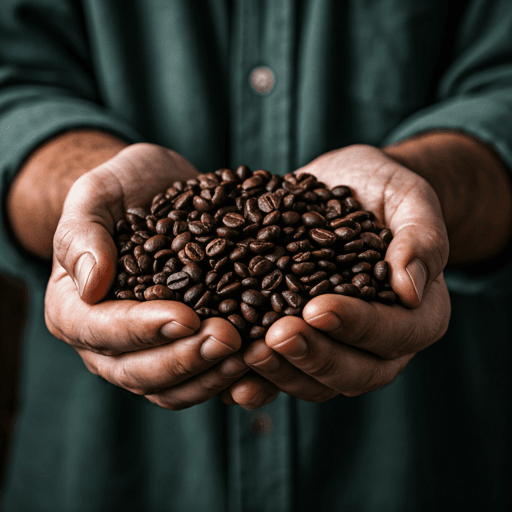
A coffee farm grows the fruit of the Coffea plant — the bright “coffee cherry” — and turns years of patient cultivation into the green beans that later get roasted. It is slow, seasonal work: a newly planted coffee tree takes roughly three to four years to bear its first real crop. Every cup you drink starts here, long before a roaster or barista is involved.
This guide walks the whole journey from seed to harvest — where coffee grows, the two species that matter, the lifecycle of a coffee tree, and how a farm turns ripe cherries into the unroasted green beans it ships out. We will keep the roasting story for later, because roasting happens off the farm entirely.
What a coffee farm is and where coffee grows
A coffee farm is agricultural land planted with coffee trees and managed to produce a harvest of cherries each season. Farms range from a family-run coffee garden of a few hundred trees to a large estate or coffee plantation covering many hectares. Whatever the size, the goal is the same: healthy trees, ripe fruit, and clean processing.
Coffee is fussy about climate, so almost all of it is grown in a band around the equator often called the “Bean Belt,” roughly between the Tropics of Cancer and Capricorn. This zone offers the warmth, rainfall, and altitude coffee needs. Within it, growing regions span Latin America, Africa, the Middle East, and Asia — each with its own soils, weather, and flavor signature. How coffee is grown varies a lot from place to place, but the core biology is shared everywhere.
Two species: arabica and robusta
Nearly all farmed coffee comes from two species, and knowing the difference explains a lot about a farm's location and choices.
- Arabica is prized for its sweeter, more aromatic, more acidic cup. It is fussy: it prefers cooler, high-altitude slopes (often above 1,000 meters) with average temperatures around 15–24°C, and it is more vulnerable to heat, frost, and disease. Most specialty coffee is arabica. For more on the bean itself, see our guide to arabica coffee beans.
- Robusta is hardier and higher-yielding. It tolerates lower altitudes and warmer weather (around 24–30°C), resists pests better, and carries more caffeine, with a bolder, more bitter cup. It is common in blends, instant coffee, and espresso bases.
Many farms grow one species suited to their altitude and climate; some grow both. Elevation, shade, and weather all shape the final flavor as much as the species does.
From seed to first harvest: the coffee tree's lifecycle
Coffee farming is a patience game. A tree planted today will not pay its way for years. Here is the lifecycle a farm manages, season after season.
Seed and nursery
A coffee “bean” is really a seed, so farms start by germinating selected seeds (or rooting cuttings) in a shaded nursery. Seedlings are nursed in bags or beds for several months until they are strong enough to survive outdoors. Good nursery work — healthy stock, disease-free plants, the right variety — sets the ceiling for everything that follows.
Planting out and the growing years
Young trees are transplanted into the field, often on sloped land, and sometimes under taller “shade” trees. For the first three to four years the tree grows leaves and roots but little fruit. Farmers spend this time pruning, weeding, feeding the soil, and protecting trees from pests and disease. Only after this stretch does a tree reach productive maturity — and a well-kept coffee tree can keep bearing for a few decades.
Flowering
Mature trees burst into fragrant white blossoms, usually triggered by rain after a dry spell. The flowers are short-lived, and once pollinated they set the fruit. Flowering is a hopeful, nerve-wracking moment on any farm: a badly timed drought or storm here can dent the whole year's crop.
Cherries ripen
Each pollinated flower becomes a coffee cherry that ripens slowly, shifting from hard green to yellow to a deep red (some varieties ripen yellow or orange). For arabica this takes roughly nine months from flower to ripe fruit; robusta usually takes a little longer. Inside most cherries sit two seeds — the future coffee beans. To learn how the fruit itself is built, see our explainer on the coffee cherry fruit.
Harvest
Because cherries on one branch ripen unevenly, harvest is the make-or-break moment for quality. There are two broad approaches:
- Selective handpicking: workers pass through the trees repeatedly, picking only the ripe red cherries. It is labor-intensive and expensive, but it is how most high-quality and specialty coffee is picked.
- Strip-picking or machine harvesting: a whole branch (or a whole row, by machine) is stripped at once, ripe and unripe together. It is faster and cheaper, better suited to flat land, and common where volume matters more than top-tier flavor.
The farm at a glance: stage by stage
| Stage | What happens on the farm |
|---|---|
| Seed & nursery | Selected seeds germinated and raised as shaded seedlings for months. |
| Planting out | Young trees set into the field, often on slopes and under shade. |
| Growing (years 1–3) | Pruning, weeding, feeding, pest control; little to no fruit yet. |
| Flowering | Fragrant white blossoms appear, usually after rain, then set fruit. |
| Cherry development | Fruit ripens green → yellow → red over several months. |
| Harvest | Ripe cherries handpicked selectively, or strip-/machine-picked. |
| Processing | Fruit removed by washed, natural, or honey method. |
| Drying | Beans dried on raised beds or patios to a stable moisture level. |
| Milling & sorting | Dry parchment hulled off; beans graded and bagged as green coffee. |
How the farm turns cherries into green beans
Freshly picked cherries are perishable, so processing starts fast — often the same day. The aim is to remove the fruit and dry the seeds to a stable moisture level without spoiling them. There are three main methods, and the choice strongly shapes flavor.
- Washed (wet) process: the skin and pulp are removed, the sticky mucilage is fermented and rinsed away in water, then the beans are dried. This tends to give a cleaner, brighter, more acidic cup.
- Natural (dry) process: whole cherries are laid out to dry intact, so the seed absorbs sweetness from the fruit as it dries over weeks. This gives a heavier body and fruitier, wilder flavors. It is the oldest method and uses little water.
- Honey (pulped natural) process: the skin is removed but some sticky mucilage is left on the bean during drying. It sits between washed and natural, adding sweetness and body while keeping some clarity.
Whatever the method, the beans are then dried — traditionally on raised beds or open patios, raked regularly so they dry evenly to roughly 10–12% moisture. Finally comes milling: machines hull off the dry parchment layer, and workers or optical sorters grade the beans by size, density, and defects. What comes out the far end is green coffee beans — unroasted, stable, and ready to ship.
From here the beans leave the farm. The transformation into the brown, aromatic beans you buy happens elsewhere; that is a separate craft covered in our guide to what coffee roasting is.
The people and economics behind the farm
Coffee is one of the world's most traded agricultural products, and a large share of it is grown by smallholders — families working small plots rather than vast estates. Harvest season draws seasonal labor for the intense weeks of picking. Because so much value is added after the farm (in roasting, branding, and retail), the price a grower receives can be a small fraction of what a finished cup sells for, and it swings with volatile global markets.
That reality has shaped how coffee is bought. Fair-trade and direct-trade models aim to pay growers more predictably and reward quality, while certifications for organic, shade-grown, and bird-friendly farming push toward more sustainable practices. Shade-grown coffee, for instance, keeps trees under a canopy that supports biodiversity and can improve cup quality on some farms. None of this is a magic fix, but it explains a lot of the language you see on a bag of coffee.
What shapes quality on the farm
- Altitude and climate: higher, cooler slopes tend to grow denser, more complex arabica.
- Variety: the specific cultivar planted sets flavor potential and disease resistance.
- Ripeness at harvest: picking only ripe cherries is the single biggest quality lever.
- Processing and drying: clean, careful, even drying protects everything the farm worked for.
- Freshness and storage: green beans stored well hold their quality until they are roasted.
The bottom line
A coffee farm is where patience, climate, and careful hands turn a seed into the green beans behind every cup — years of growing, one nerve-wracking flowering, a slow ripening, and a fast, skilled harvest and processing season. Once those green beans leave the farm, the roaster takes over and the flavor you know finally emerges. Learning the farm's side of the story makes the next cup taste a little different.