
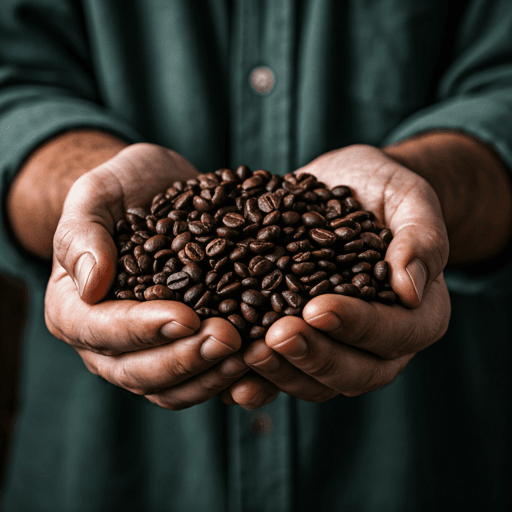
Santos coffee — often written as "Brazil Santos" — is not a single farm, estate or coffee variety. It is a classic trade name for Brazilian arabica shipped through the port of Santos, and for well over a century it has been a benchmark for smooth, mild, nutty, low-acid coffee. When you see "Santos" on a bag or a green-coffee contract, it is describing where the coffee left the country and roughly how it was graded, not a specific place it was grown.
That distinction matters, because a lot of shoppers assume "Santos" is a region or a bean type the way "Geisha" or "Bourbon" is. It isn't. Below we decode what the name actually signals, where the term "Bourbon Santos" comes from, how the coffee tends to taste, how it is graded, and whether it is genuinely "good" coffee.
What Santos coffee actually is: a port and a grade, not a variety
The clearest way to understand Santos coffee is to picture the map. Santos is a major seaport in the state of São Paulo, on Brazil's southeast coast. For generations it has been the main gateway through which Brazil — the world's largest coffee producer — ships its harvest to the rest of the planet. Coffee grown across huge inland growing zones such as Sul de Minas, the Cerrado and parts of São Paulo state is trucked down to Santos, classified, and exported. Because so much of it passed through that one port, buyers simply started calling it "Santos."
So "Brazil Santos" is best read as an export classification — a trade shorthand — rather than a terroir. It tells you the coffee is Brazilian arabica of a broadly recognizable, dependable character, sorted to a certain grade before it was loaded. It does not, on its own, tell you the specific farm, altitude or micro-lot. That is why two bags both labelled "Santos" can taste noticeably different: the label is a category, not a fingerprint. For the bigger picture of the country's growing regions and styles, see our overview of Brazilian coffee.
Why the name stuck
Trade names like this are common in coffee history. Ports and shipping routes were how the wider world first encountered and named coffees, long before single-farm traceability existed. "Santos" endured because Brazil's volume is so large and so consistent that the term became a reliable, if broad, promise: a clean, balanced, unfussy cup that behaves predictably in a blend. Roasters kept using it, and the name outlived the era when it was purely a logistics term.
"Bourbon Santos": what the term means
You will very often see the fuller phrase "Bourbon Santos." This adds a variety reference to the trade name. Bourbon is one of the historic arabica varieties — the strain traces back to trees brought to Brazil generations ago from the island then called Bourbon (today Réunion). Bourbon plants are prized for a rounder, sweeter cup.
Classically, "Bourbon Santos" referred specifically to the small, curly beans that Bourbon trees produce in their first few years of bearing — roughly the first three or four harvests. Those younger-tree beans were considered the more flavorful, more desirable lots. As the same trees age, the beans they yield grow larger and flatter, and that later coffee was traditionally sold as the plainer "Flat Bean Santos," generally regarded as a step down. Today the term is used more loosely by many roasters, often just to flag a Bourbon-variety Brazilian coffee shipped as Santos, so treat it as a quality signal rather than a strict guarantee. If you want to dig into the variety itself, our guide to arabica coffee beans explains where Bourbon sits in the family.
How Santos coffee tastes
The reason Santos became a global staple is that its flavor is easy to like and easy to work with. Expect a cup that is:
- Mild and smooth — gentle, rounded, without sharp edges.
- Low in acidity — soft rather than bright or citrusy.
- Nutty and chocolatey — think toasted nuts, caramel and mild cocoa, sometimes a whisper of orange sweetness.
- Medium-bodied and clean — a tidy finish that doesn't overstay.
That profile makes Santos a natural crowd-pleaser and an outstanding team player. Its mildness is exactly why roasters reach for it: it adds body, sweetness and balance to an espresso blend without fighting the other components, and it makes an approachable everyday drip or filter cup for people who dislike anything too acidic or aggressive. Compared with a bright washed African coffee, Santos leans mellow and comforting rather than vivid. To see how it contrasts with the other side of the species divide, our comparison of coffee bean varieties and types is a useful next step.
How Santos coffee is graded
Brazilian green coffee is classified along a few axes, and a full Santos description usually stacks them together — which is why you might see a label like "Brazil Santos NY 2/3, Screen 17/18, fine cup." Here is what those pieces mean, kept general:
- Defect count (the "NY" number). Brazilian arabica is graded by counting physical defects — black beans, broken bits, stones and other imperfections — in a fixed green-coffee sample. Fewer defects earns a better grade number, so a cleaner lot (say NY 2) sits above a more defect-heavy one.
- Screen size. Beans are sieved by size, with larger screens (like 17/18) associated with more premium lots and smaller screens used in more commercial blends. Bigger is not automatically tastier, but size uniformity helps an even roast.
- Cup quality. Tasters also rate the liquor for cleanliness and character, using traditional descriptors from "strictly soft" and "soft" down to harsher notes. Santos at its best is prized for that soft, sweet, clean cup.
None of this makes Santos a single-quality product. The grading ladder is exactly what lets one origin span a wide range, from workaday commodity coffee up to genuinely refined lots. If the idea of traceable, farm-specific coffee appeals to you, that is a different framework — our piece on single-origin coffee explains how it contrasts with a broad trade grade like Santos.
Santos coffee at a glance
| Aspect | What it means |
|---|---|
| What the name is | A trade/export grade for Brazilian arabica shipped through the port of Santos — not a farm, region or variety |
| "Bourbon Santos" | Bourbon-variety lots, classically the smaller beans from younger trees; a quality signal, not a strict guarantee |
| Typical flavor | Mild, smooth, sweet, nutty-chocolatey, low acidity, clean and medium-bodied |
| Common use | Espresso-blend base and approachable everyday drip/filter coffee |
| How it's graded | By defect count (NY number), screen size and cup quality |
Why you see Santos everywhere
Two forces put Santos in so many bags and cafés. First is sheer scale: Brazil produces a vast share of the world's arabica, and a large slice of it exports as Santos, so it is abundant and steadily supplied. Second is its temperament. Because the cup is mild, sweet and low-acid, it blends beautifully and offends almost no one, which is precisely what a roaster wants as the backbone of a house espresso or a supermarket blend. When a label just says "100% arabica" or "smooth medium roast," Brazilian Santos-style coffee is very often part of what's inside — and in espresso blends it is frequently paired with a touch of robusta for extra crema and body.
Is Santos "good" coffee?
Honestly, it depends what you want from it, and the fair answer is hedged. Santos is not trying to be a dramatic, floral, acidic showpiece — it is the dependable, comforting middle of the road, and it does that job as well as any coffee on earth. As a category it spans a genuine range, from plain commodity lots that are fine but forgettable up to carefully sorted, higher-screen, low-defect Bourbon Santos that can be a lovely, sweet, chocolatey cup in its own right.
If you crave brightness and complexity, a mild Brazilian may feel a little quiet. If you want a smooth, easy, everyday coffee — or a reliable base that makes milk drinks and espresso taste rounded and sweet — Santos is a classic for good reason. It is less a "best or worst" question than a "right tool for the mood" one. Judge the specific lot in front of you, notice whether it says Bourbon Santos and how it was graded, and let the cup, not the port name, have the final word.