
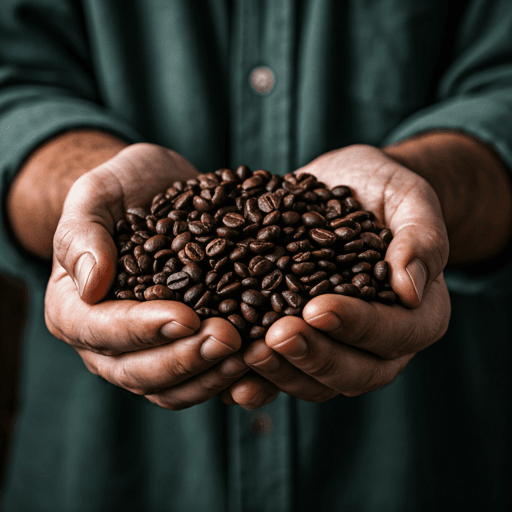
A peaberry is a natural quirk of the coffee cherry: instead of the usual two flat-sided beans growing side by side inside the fruit, a single small, round, whole bean forms on its own. Roasters sort these out and sell them separately as peaberry coffee, and they make up only about 5 percent of any given harvest. Because the shape is genuinely different, peaberries are prized by some drinkers and marketed as a premium lot, but the flavor question is more debated than the label suggests.
This guide explains what a peaberry is, why it forms, whether it actually tastes better, and why a bag of it usually carries a higher price than the rest of the same crop. For the basics of how an ordinary coffee seed grows, see our overview of what coffee beans are; here we focus on the round exception to that rule.
What a peaberry actually is
Inside a normal coffee cherry, two seeds develop facing each other. Each one grows a flat side where it presses against its neighbor, which is why standard coffee beans have that familiar half-moon profile with a crease down the middle. A peaberry is what you get when only one seed forms instead of two. With no neighbor to flatten against, that lone seed rounds out on all sides and grows into a small, dense, oval or pea-shaped bean, sometimes described as looking more like a caraway seed or a tiny egg than a coffee bean.
The name follows the shape: it looks like a single pea in the pod. In Spanish-speaking origins it is often called caracol, meaning snail, or perla (pearl); you may also see the older English term "pea berry." All of these point to the same thing: one rounded whole seed rather than two flat halves. It is not a separate species, variety, or grade of quality on its own. A peaberry can occur in any coffee, whether the plant is arabica or robusta, and it tells you about how that particular cherry developed, not about where the coffee sits among the broader coffee bean varieties and types.
Why peaberries form
The short answer is a developmental hiccup inside the cherry. A coffee flower is set up to produce two ovules, and normally both are fertilized and mature into two seeds. In a peaberry, only one of those two ovules is fertilized or continues to develop, so a single seed absorbs the space and nutrients that would ordinarily be shared. Instead of splitting the cherry's resources two ways, the one surviving seed takes it all and grows round.
Several things nudge this along. Peaberries turn up more often at the tips and outer edges of branches, where pollination and nutrient flow can be less even. Growing conditions play a part too: weather stress, plant health, soil, and the age of the tree can all raise or lower how many peaberries a crop throws. Because it is essentially a natural variation rather than a defect or a bred trait, no farm can grow only peaberries; they simply appear, scattered through an otherwise normal harvest, and have to be pulled out afterward.
Is peaberry coffee better? The honest answer
This is where marketing and evidence part ways, so it is worth being straight about it. The case in favor goes like this: because a peaberry is a single rounded seed, it may have received a concentrated share of the cherry's sugars and compounds, and its even shape lets it tumble and heat more uniformly during roasting. Fans argue this can translate into a brighter, cleaner, more lively cup. Many roasters who sell peaberry lots describe them exactly that way.
The more skeptical view is that peaberry is mostly a size and sorting distinction, not a guarantee of superior flavor. A peaberry lot is really just the round seeds separated from the same trees as the regular beans, so its ceiling is set by the quality of that origin to begin with. Any coffee, peaberry or flat, still depends far more on the variety, the growing altitude, the processing, the roast, and how fresh it is when you brew it. Blind tastings pitting peaberry against the flat beans of the same coffee do not reliably crown a winner. The fair conclusion: peaberry can be lovely, and it is a fun, distinctive lot to try, but the round shape by itself is not proof that the cup will be better. Treat "peaberry" as an interesting attribute, not a quality badge.
Famous peaberries: Tanzania and Kona
A couple of origins have made peaberry part of their identity. Tanzania peaberry is probably the best known, to the point where "Tanzanian peaberry" is a recognized specialty offering in its own right, often sold as a distinct grade and associated with a bright, wine-like, medium-bodied character. Because Tanzania markets so much of its coffee this way, the country is closely linked with the style even though peaberries occur everywhere coffee grows.
Hawaii is the other famous name. Kona peaberry is the small round fraction sorted out of Hawaii's prized crop, and it carries the same reputation for smoothness that the region is known for. If you want the full story on that origin, see our guide to Kona coffee. Beyond these two, you will also find celebrated peaberry lots from origins across Africa and Central America, but Tanzania and Kona are the names most drinkers meet first.
How peaberry roasts and tastes
The rounded shape has a real, practical effect in the roaster. Flat-sided beans can lie against the drum and each other unevenly, while peaberries, being more spherical, tend to roll and tumble freely and expose all their surfaces to the heat. Many roasters find this makes for a more even roast across the batch, with fewer scorched or underdone edges. Peaberries are also usually a bit smaller and denser than the flat beans from the same lot, so roasters often adjust slightly to account for that.
On flavor, keep expectations honest and hedged. Peaberry coffees are frequently described as bright, lively, and clean, sometimes with a concentrated sweetness, and that is a common thread in tasting notes. But the actual cup you get is driven by the origin and roast at least as much as by the peaberry shape, so descriptors vary a lot from one lot to the next. The safest way to think about it: a peaberry from a good coffee will usually taste like a good version of that coffee, presented in a slightly more uniform, often vivid way.
Peaberry vs regular flat beans at a glance
| Trait | Peaberry bean | Regular "flat" bean |
|---|---|---|
| Shape | Single small, round, whole seed (no flat side) | Two seeds with one flat side each, creased down the middle |
| Share of crop | Roughly 5 percent, scattered through the harvest | The large majority of every crop |
| Roasting | Rolls and heats evenly thanks to the rounded shape | Can sit unevenly; flat sides heat differently |
| The claim | Sometimes said to be brighter and more concentrated (debated) | The baseline the origin is known for |
| Sorting | Must be separated out by hand or machine | Ships as the standard lot |
Why peaberry coffee costs more
The premium comes down to scarcity plus labor. Since peaberries are only a small slice of any harvest and appear mixed in with the normal beans, someone has to pull them out. That separation happens through size and shape sorting, using screens and gravity or density sorters, and often a final pass of careful hand-picking to catch the rounds the machines miss. That is extra work applied to a small volume, and the round beans that come out the other end are sold as a distinct, limited lot. Lower supply and higher handling naturally push the price up relative to the flat beans from the very same trees. That is a fact of how the lot is produced, not evidence that the coffee inside is automatically finer.
The bottom line
Peaberry coffee is one of the small wonders of the coffee cherry: a single round seed where two flat ones usually grow, sorted out and sold on its own. It roasts evenly, often cups bright, and comes with a good story attached, and origins like Tanzania and Kona have built real reputations around it. Just keep the marketing in perspective. The round shape is a genuine, charming quirk worth seeking out and tasting for yourself, but the quality of the cup still rides on the origin, the roast, and the freshness, exactly as it does for every other bean in the bag.