
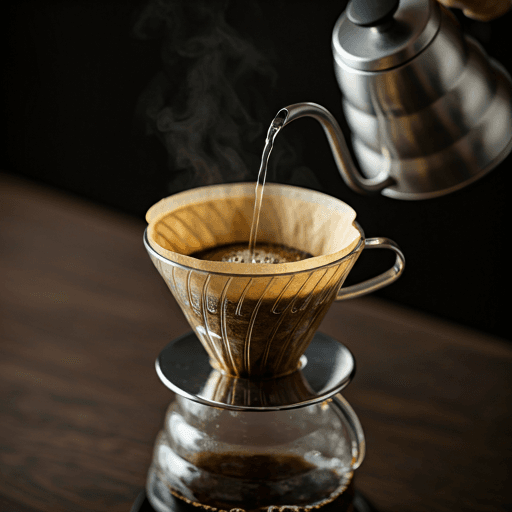
Drip coffee is made by pouring hot water over ground coffee held in a filter, so the water passes through the grounds by gravity and drips down into a pot or cup. It is the everyday default in much of the world, brewed either by an automatic drip machine or by hand as a pour-over. The result is a clean, easy-drinking cup with a light-to-medium body and none of the intense concentration of espresso.
That single idea, water meeting coffee and falling through a filter, covers a huge share of the coffee people drink at home and at work. Below we break down how drip works, the difference between automatic machines and manual pour-over, the grind and ratio that make a good cup, and how drip compares to espresso, the French press and the percolator.
How drip coffee works
Every drip brew has the same four parts: ground coffee, a filter, hot water and gravity. You place a filter (paper, metal or cloth) in a holder, add ground coffee, and pour hot water over it. The water soaks the grounds, dissolves the flavour compounds, and then drains through the filter into the vessel below. What is left behind in the filter is the spent grounds; what drips through is your coffee.
Two things make drip distinctive. First, it is driven by gravity and time rather than force. Water is in contact with the grounds for a few minutes as it slowly seeps through. Second, it is a filtered brew. A paper filter in particular traps most of the oils and fine sediment, which is why a cup of drip coffee tastes clean and clear rather than heavy.
The modern paper filter that made all of this convenient was invented by Melitta Bentz in 1908. Frustrated by gritty, bitter coffee, she lined a perforated brass pot with blotting paper torn from her son's school notebook, and the clean, sediment-free cup that resulted became the template for drip brewing worldwide.
What you taste in a drip cup
Because the paper traps oils and fines, drip coffee highlights clarity and the brighter, more aromatic notes of the beans. A well-made drip cup can taste sweet, balanced and easy to drink black. It will feel lighter on the tongue than a French press or espresso. If you want to understand where those flavour notes come from in the first place, our guide to what coffee beans are is a good companion read.
Automatic drip vs manual pour-over
Drip coffee splits into two broad camps. Both pour water through grounds in a filter, but they differ in who controls the pour.
Automatic drip machines
An automatic drip coffee maker does the work for you. You add water to a reservoir and ground coffee to a basket, press a button, and a heating element warms the water and showers it over the bed of grounds. It is the classic countertop and office brewer, prized for convenience and for making several cups at once. The trade-off is less control: the machine decides the water temperature and the pour pattern, and cheaper models can run too cool or wet the grounds unevenly. If you are shopping for one, our drip coffee maker guide walks through the machines and what to look for.
Manual pour-over
Pour-over is the hands-on version of the same method. You pour hot water yourself, in stages, over grounds in a cone-shaped dripper. Popular pour-over devices include the Hario V60 with its spiral ribs and single large hole, the Chemex with its thick bonded paper and elegant glass body, and the original Melitta wedge-shaped dripper with two small holes that naturally slow the flow. Pour-over rewards attention: by controlling the speed and pattern of your pour, you can dial in a remarkably clean, expressive cup. Our how to brew with a V60 guide is a great place to start if you want to try it.
| Aspect | Automatic drip | Manual pour-over |
|---|---|---|
| Who controls the pour | The machine | You |
| Convenience | High, hands-off | Lower, hands-on |
| Volume | Several cups at once | Usually one to two cups |
| Control over the cup | Limited | Very high |
| Typical devices | Countertop drip makers | V60, Chemex, Melitta |
Grind, ratio and water: the basics of a good cup
Drip coffee is forgiving, but a few fundamentals make the difference between a flat cup and a great one.
- Grind: Aim for a medium grind, roughly the texture of coarse sand or kosher salt. Too fine and the water trickles through slowly and over-extracts into bitterness; too coarse and it rushes through, leaving the coffee thin and sour. Pour-over generally takes a slightly finer medium grind than an automatic machine.
- Ratio: A good starting point is roughly 1 part coffee to 15-17 parts water by weight (for example, 30g of coffee to about 500g of water). Strength comes from this ratio, not from the method, so adjust to taste.
- Water: Use fresh, filtered water just off the boil, around 92-96°C (just below boiling). Boiling-hot water can scorch the grounds; lukewarm water under-extracts and tastes weak.
- Freshness: Grind just before brewing if you can. Coffee goes stale quickly once ground.
For a full step-by-step walkthrough across methods, see our how to make coffee guide. If you want to get the grind right specifically, our how to grind coffee beans guide covers the textures method by method.
How drip differs from espresso
The clearest way to understand drip coffee is to compare it with espresso, its opposite in almost every way. Drip relies on gravity and time: water passes slowly through a wide bed of grounds over several minutes. Espresso relies on pressure: a machine forces hot water through a tightly packed, finely ground puck in around 25-30 seconds at roughly nine bar, about nine times atmospheric pressure. The result is a small, intense, syrupy shot with crema on top, rather than a tall, clean cup.
| Feature | Drip coffee | Espresso |
|---|---|---|
| Driving force | Gravity | High pressure (about 9 bar) |
| Brew time | A few minutes | About 25-30 seconds |
| Grind | Medium | Very fine |
| Result | Tall, clean cup | Small, concentrated shot |
| Body | Light to medium | Thick, with crema |
Neither is "better"; they are different drinks for different moments. To go deeper on the pressurised side, read espresso explained.
Drip vs French press and percolator
Drip is one of several ways to brew, and it helps to know where it sits among the others.
French press is an immersion method, not a drip one. The grounds steep fully in hot water for about four minutes, then a metal mesh plunger separates them. Because a metal screen lets oils and fine particles through, French press coffee is heavier and more textured than the clean cup you get from a paper drip filter.
Percolator works differently again: it cycles boiling water up a tube and repeatedly back down through the grounds. This recirculation can over-extract and produce a strong, sometimes bitter brew. It is a classic camping and stovetop method, but it offers less finesse than modern drip.
So drip occupies a clean, balanced middle ground: lighter and clearer than French press or percolator, gentler and longer than espresso.
Why drip coffee is the everyday default
Drip coffee earned its place as the everyday brew for simple reasons. It is easy: load, pour or press a button, and walk away. It scales: a single brew can fill a carafe for a household or an office. It is consistent and forgiving, so even a casual brewer can make a decent cup. And the equipment, from a basic machine to a single paper cone, is among the most accessible in all of coffee. Filter coffee in this broad sense is the cup most people around the world reach for first thing in the morning.
That accessibility is exactly why it is worth doing well. A little attention to grind, ratio and water temperature turns an ordinary cup into a genuinely good one. From there you can branch out, into the hands-on craft of pour-over, the gear choices for a machine, or the intense world of espresso. Wherever you go next, it usually starts with the humble, reliable drip.