
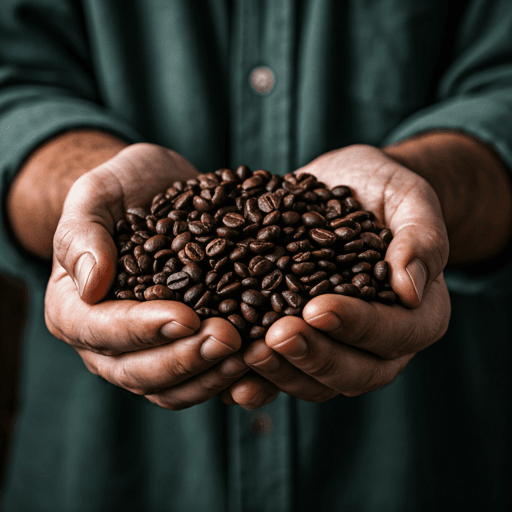
Dark roast coffee is coffee whose beans have been roasted longer and hotter — pushed to a deep, glossy brown that often shows a sheen of oil on the surface. That extra time in the roaster is what gives a dark roast its signature bold, smoky, low-acid character, in which bittersweet, roast-driven flavours overshadow the delicate origin notes of the bean itself. In plain terms, dark roast coffee trades bright fruit and floral nuance for depth, body and an almost chocolatey intensity.
It sits at one end of a spectrum every coffee travels along — from pale, tea-like light roasts, through balanced mediums, to the deep, roast-forward darks. Below we unpack what "dark roast" actually means, how it tastes, the stubborn caffeine myth that clings to it, where it shines and how to brew it well.
What "Dark Roast" Means on the Roast Spectrum
Every coffee begins as a green, grassy-tasting seed. Roasting applies heat that drives out moisture and sets off the chemical reactions — Maillard browning and the caramelisation of natural sugars — that build a bean's colour, aroma and flavour. As beans heat up they pop audibly: first crack arrives at roughly 196°C (385°F), and a quieter second crack follows near 224–230°C (435–446°F).
A dark roast is coffee taken to or beyond that second crack — very roughly 225–245°C — until the beans turn deep brown to almost black. At those temperatures, oils that were locked inside migrate to the surface, which is why dark roasted coffee beans so often look glossy or feel a little greasy. Where "medium" ends and "dark" begins is not rigidly fixed; a roaster reads colour, sound, aroma and time together rather than a single number. For the complete light-to-dark ladder, see our guide to coffee roast levels; for what is actually happening inside the drum, read what coffee roasting is; and for the raw material itself, see what coffee beans are.
| Roast | Colour | Surface | Acidity | Body | Typical notes |
|---|---|---|---|---|---|
| Light | Light brown | Dry | High, bright | Lighter | Floral, fruity, tea-like; origin-forward |
| Medium | Medium brown | Mostly dry | Balanced | Medium | Caramel, nutty, rounded sweetness |
| Dark | Deep brown to near-black | Often oily | Low | Heavy | Smoky, chocolatey, bittersweet; roast-forward |
What Dark Roast Coffee Tastes Like
The defining trait of a dark roast is that the roast becomes the dominant flavour. Expect a bold, full-bodied cup that leans smoky and toasty, with notes of dark chocolate, roasted nuts, caramelised sugar and a pleasant bittersweetness — think of the difference between lightly toasted bread and a deeply browned crust. Acidity is low, so there is little of the bright, citrus-or-berry snap you get from a light roast, and the finish is heavy and lingering rather than clean and delicate.
Because so much of the flavour is created by the roast, a dark roast tends to flatten the differences between origins. Two beans that taste distinct when roasted light — one floral, one fruity — will taste far more alike once pushed dark, as their subtle origin character gives way to shared roast notes. That is the essential trade-off, and the opposite of a pale "blonde" or light roast, which is prized precisely for showcasing where a coffee comes from. Some drinkers love the comforting consistency of a dark cup; others miss the nuance. Neither is wrong — it is a matter of taste.
The Dark Roast Caffeine Myth
Here is the most persistent misconception in coffee: that a bold, intense dark roast must be loaded with caffeine — or, in the opposite camp, that roasting "burns the caffeine off," so a dark roast has less. Both are largely wrong. Caffeine is remarkably heat-stable and survives roasting almost intact, so roast level changes the total only slightly.
The real wrinkle is how you measure your coffee. As beans roast darker they lose moisture and mass and puff up, so they become larger and less dense. Measure by scoop (by volume) and a light roast edges ahead, because its denser beans pack more mass — and more caffeine — into the same scoop. Measure by weight (grams) and the dark roast nudges ahead instead, because you need a few more of those lighter beans to hit the same weight. Either way the gap is small, and it varies with the beans and how they are ground and brewed. If caffeine matters to you, the dose you use, the coffee species (robusta carries far more than arabica) and the brew method all move the needle much more than roast colour does. The bottom line: choose a dark roast for its flavour, not for a caffeine boost that is not really there.
Where Dark Roast Coffee Shines
Dark roast has long been the backbone of espresso. Its low acidity, heavy body and forgiving nature give a syrupy shot with thick crema, and that intensity is exactly what lets coffee stand up to milk — which is why so many espresso blends aimed at cappuccinos, lattes and flat whites lean dark. It is also a natural fit for immersion methods like the French press and the stovetop moka pot, where full body is welcome, and for the classic, no-nonsense "diner" drip and the Italian-style espresso bar.
On a personal level, dark roast tends to please anyone who takes coffee with milk and sugar, who finds bright modern light roasts too sour or tea-like, or who simply wants a strong, satisfying, familiar cup. If your ideal cup is a deep, chocolatey dark coffee rather than a fruity, floral one, dark roast is your lane.
How to Brew Dark Roast Coffee Well
Dark roasts are more brittle and soluble than lighter beans, so they give up their flavour fast — which makes over-extraction and harsh bitterness the main risk. A few adjustments keep a dark roast smooth:
- Grind a touch coarser than you would for a lighter coffee, to slow extraction and avoid bitterness.
- Use slightly cooler water — around 90–93°C (195–200°F) rather than a rolling boil — which tames the sharp, ashy edges.
- Watch your time and ratio. Don't over-steep in a French press, and ease back the dose or lengthen the water a little if the cup tastes acrid.
- Use it fresh. The oils on a dark roast oxidise and stale faster than a dry light roast, so buy in smaller amounts, seal it well and drink it sooner.
Named Dark Roast Degrees You'll See
"Dark roast" is really a family of named degrees, each a little deeper than the last. Roughly from lighter to darkest, you'll meet:
- Full City+ — right at the start of second crack, with the first faint spots of oil; deep and rounded but still holding some origin character.
- Vienna — a moderately dark roast with a light sheen of oil, bittersweet and smooth.
- French roast — very dark, oily and openly smoky, with origin flavour mostly gone.
- Italian roast — the darkest common level, near-charred and intensely bittersweet.
A crucial point: these are roast styles and degrees, not places of origin — a French roast is not coffee from France, and an Italian roast is not grown in Italy; the names simply describe how dark the beans are taken. Because it is the most talked-about of the group, French roast gets its own deep dive — see what French roast coffee is for exactly how far it goes and how it differs from the category as a whole.
Dark roast coffee is not "burnt" coffee or a lesser choice — it is a deliberate style built for boldness, body and comfort rather than bright, delicate nuance. Understand what the roast is doing, brew it with a slightly gentler hand, and buy it fresh, and a good dark roast rewards you with one of coffee's most reliable, deeply satisfying cups.