
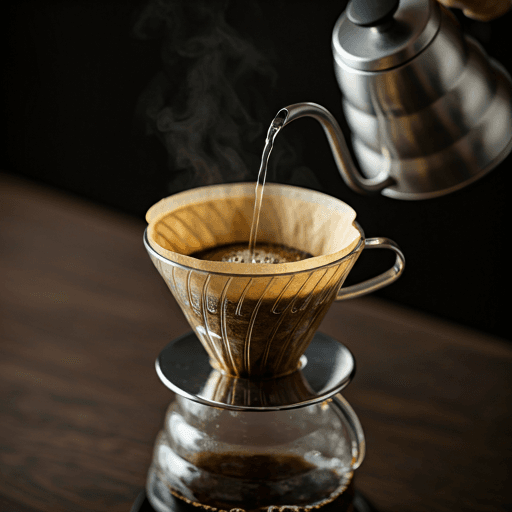
Coffee TDS — total dissolved solids — is a measure of how strong a brewed coffee is: the percentage of the finished drink that is actually dissolved coffee rather than plain water. A cup of filter coffee often lands somewhere around 1.2 to 1.5% TDS, while espresso is far more concentrated. TDS is usually paired with extraction yield, the share of the coffee grounds that dissolved into your cup, and specialty brewers read both with a refractometer to make a good result repeatable rather than lucky.
If that already sounds like a wall of jargon, here is the short version: TDS tells you how concentrated the coffee in your mug is, extraction yield tells you how much flavour you pulled out of the grounds, and the two are not the same thing. Below is what each number means, the rough targets people aim for, how they are measured, and why most of us never actually need a device to enjoy a good cup.
What coffee TDS actually measures
"TDS" is short for total dissolved solids, a term borrowed from water science, where it describes everything dissolved in a liquid. In coffee it means the same thing: out of the whole cup, what fraction is dissolved coffee solids — oils, acids, sugars, melanoidins and the rest — versus water. So when someone asks what is TDS in coffee, the plain answer is "a strength reading." A brew at 1.4% TDS carries more dissolved coffee per sip than one at 1.2%, so it will taste bolder, heavier and more mouth-filling, all else being equal.
Strength is a real, physical quantity, but it is not a quality score. A very strong cup can still taste bad, and a lighter cup can taste wonderful. Total dissolved solids in coffee simply puts a number on concentration so you can talk about it precisely, instead of arguing over what the word "strong" means to each person at the table.
Strength vs extraction: two different things
The single most common beginner mix-up is treating strength and extraction as one dial. They are not.
- Strength (TDS) is how concentrated the drink is — how much dissolved coffee sits in a given amount of liquid. You control it mostly with the coffee-to-water ratio: more coffee, or less water, makes a stronger, higher-TDS cup.
- Coffee extraction yield is how much of the ground coffee actually dissolved — the percentage of the dry grounds that ended up in the cup. You control it mostly with grind size, time and temperature: a finer grind or a longer contact time pulls more out.
Here is the part that trips people up: you can be weak or strong at almost any extraction. A big dose ground coarse might give you a strong-tasting but under-extracted cup; a small dose ground fine might give you a weak but over-extracted one. Because strength and extraction move independently, brewers like to track both rather than lump them together. For the flavour side of that story — why under-extraction reads sour and over-extraction reads bitter — see our deeper piece on coffee extraction explained.
Typical TDS and extraction targets
There are rough, widely-cited guidelines — and they really are only guidelines. For filter or pour-over coffee, many people aim for something in the region of 1.15 to 1.45% TDS and an extraction yield of about 18 to 22%, a band often described as a "sweet spot." Espresso is a different animal: it is far more concentrated, frequently landing somewhere around 8 to 12% TDS depending on the shot and the recipe.
Treat every one of those numbers as a starting compass, not a law. They shift with the coffee, the roast, the water and — most of all — your own taste. Plenty of excellent cups sit outside the "textbook" window, and some roasts sing a little brighter or darker than the averages suggest. Your palate is the final judge; the numbers just help you find your way back to a cup you already liked.
| Term | What it measures | Rough target (guideline) |
|---|---|---|
| TDS (total dissolved solids) | How concentrated — "strong" — the drink is: the % of the cup that is dissolved coffee | Filter roughly 1.15-1.45%; espresso much higher (around 8-12%) |
| Extraction yield | How much of the dry grounds dissolved into the finished cup | About 18-22% is a common "sweet spot" |
| Brew ratio | Weight of coffee vs weight of water — the main strength lever | Filter often starts near 1:15-1:17 (taste rules) |
How coffee TDS is measured
Strength is read with a coffee refractometer, a small device that shines light through a drop of brewed, filtered coffee and measures how much the light bends. That bend correlates with dissolved solids, so the refractometer reports a TDS percentage directly. You let the sample cool and filter out any grounds first, because stray particles scatter the light and throw the reading off.
Extraction yield is not measured directly — it is calculated. Conceptually, if you know how much dry coffee you started with, how much liquid you ended up with, and the TDS of that liquid, a simple formula tells you what percentage of the grounds dissolved. You do not need to memorise the math; brewing apps and printed charts do it for you the moment you type in your weights. The point to hold onto is this: TDS is the thing you read off the device, and coffee extraction yield is the thing you work out from that reading plus your brew weights.
Using the numbers to steer a brew
Once you can see both figures, tasting problems get easier to diagnose. A cup can be strong-but-sour (often under-extracted), strong-but-bitter (often over-extracted), or simply too weak or too strong regardless of how well it extracted. Because strength and extraction sit on separate axes, a number nudges you toward the right fix instead of guessing in the dark. Say a brew tastes thin and sharp: the refractometer might show it is both low in TDS and low in extraction, pointing you to a finer grind rather than just "more coffee." The full sour-versus-bitter decoding lives in the extraction guide, and the ratio side lives in our guide to coffee brewing ratios.
Do you actually need to measure TDS?
Honestly, no. The vast majority of people — including plenty of café professionals — dial in a brew entirely by taste, and that is completely valid. Measuring does not make coffee taste better on its own; a refractometer cannot drink the cup for you or tell you what you enjoy. What it buys you is repeatability: when you land a cup you love, the numbers let you reproduce it and share the recipe, and when something drifts, they help you see whether strength or extraction was the thing that moved.
That is why TDS lives mostly in the world of specialty coffee — competitions, roastery quality control, wholesale training — where consistency across hundreds of cups genuinely matters. For a single mug at home, your tongue is a superb instrument that needs no calibration. If you enjoy the data, measure; if you don't, brew, taste, adjust and repeat. Both roads lead to good coffee. Formal cup-scoring, where tasters rate a coffee on a shared scale, is its own separate discipline — we cover it in what coffee cupping is.
Adjusting strength and extraction separately
The practical payoff of splitting these two ideas apart is a clean, two-step way to fix a cup:
- To change strength: adjust the coffee-to-water ratio. Too weak? Add coffee or use a little less water. Too intense? Do the reverse. This barely touches how much you extracted.
- To change extraction: adjust grind size and contact time (and, to a lesser degree, water temperature). Tasting hollow or sour? Grind finer or brew a touch longer. Tasting harsh or bitter? Grind coarser or shorten the brew.
Change one variable at a time and re-taste before you touch the next. Because ratio moves strength and grind moves extraction, you can walk each toward where you want it without chasing your tail or undoing your last change. A good ratios guide will give you sensible starting points for different brewers, from a big batch pot to a single pour-over.
The bottom line
Coffee TDS is really just a strength gauge — the percentage of your cup that is dissolved coffee — and extraction yield is its partner number, the percentage of the grounds that made it into the drink. Filter coffee often hovers near 1.2 to 1.4% TDS and roughly 18 to 22% extraction, but treat those as loose signposts rather than targets you must hit. A refractometer turns "this tastes strong" into a number you can chase again tomorrow, which is genuinely useful if you care about consistency. For everyone else, the oldest instrument in the kitchen still works beautifully: brew it, taste it, and trust the cup.