
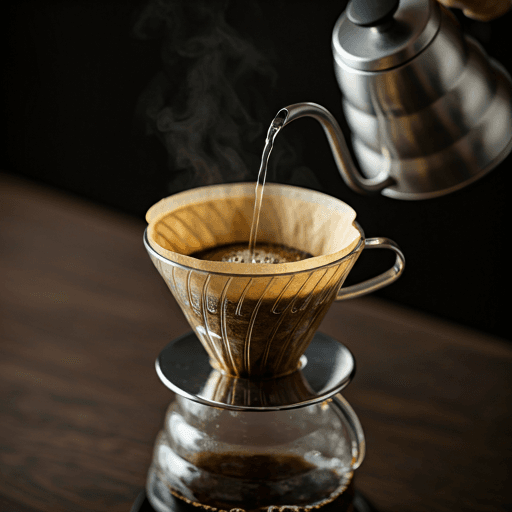
Typica mejorado is an Ecuadorian specialty coffee name for a tall, low-yielding, intensely floral Arabica that shows up on competition tables and on roasters' rarity shelves - and whose actual genetic identity is far less settled than its reputation. The name translates as "improved Typica." The most widely reported genetic work says it is probably not a Typica at all.
That gap between what the name promises and what the plant appears to be is the single most useful thing to understand about this coffee. It is not a scandal, and it does not make the coffee worse. But it changes what you should assume when a bag says "Typica Mejorado," and it is a clean illustration of how variety names work in specialty coffee generally: many of them are trade names first and botanical descriptions second.
What typica mejorado actually is
Typica mejorado is a name applied to selected Arabica material grown almost entirely in Ecuador, prized for a delicate, jasmine-forward, tea-like cup that buyers frequently place in the same sensory neighborhood as Geisha. It is grown in small volumes, on a modest number of farms, and it reaches the market mostly as named micro-lots rather than as a regional blend component.
Three things are reasonably well documented:
- The name is used commercially in Ecuador and, to a much smaller degree, on a handful of farms in Colombia and Costa Rica.
- Lots sold under the name perform strongly in cupping competitions. In the published results of Ecuador's inaugural Cup of Excellence in 2021, typica mejorado accounted for the largest single share of winning lots - reported at close to two in five - and a washed lot under that name took the top position.
- The plants are widely described by the people growing them as tall, delicate, and low-yielding.
Almost everything else - parentage, breeding institution, release date, whether "typica mejorado" even refers to one consistent population - sits somewhere between contested and undocumented. This page is written to keep those two categories apart.
The name-versus-genetics gap
Typica is the founding Arabica lineage behind an enormous share of the world's cultivated coffee, and it carries strong associations with clean, elegant, low-yield cups; if you want that background, our guide to the Typica coffee variety covers it properly. "Mejorado" simply means "improved." The name therefore reads as a promise: a Typica, made better.
The genetic reporting points elsewhere. Green coffee importers who submitted leaf samples for analysis, and commentary attributed to coffee geneticist Christophe Montagnon, have both been reported as concluding that material sold as typica mejorado is not a descendant of the Typica lineage at all, and is better described as a hybrid involving Bourbon and Ethiopian landrace material. Some producer-side descriptions instead frame it as a cross between Typica and an unspecified Ethiopian landrace. Those two accounts are not compatible, and both are circulating from credible-sounding sources at the same time.
Two caveats matter enormously here, and most writing on this coffee skips them.
First, the analyses that have been publicized were run on particular samples from particular farms. They are not a survey of everything on the market under the name. Second - and this is the more important point - typica mejorado does not appear as an entry in World Coffee Research's Arabica variety catalog. That absence is itself informative: catalog entries require a reasonably stable, verifiable identity, and the widely offered explanation for the gap is that no such single identity has been established. It is entirely plausible that several genetically distinct populations are being sold under one name.
So the honest summary is: the name says Typica; the best-publicized genetic findings say Bourbon-plus-Ethiopian; producer accounts sometimes say Typica-plus-Ethiopian; no formal catalog entry adjudicates between them. Anyone who tells you the parentage with confidence is going further than the public record supports.
Where the name came from - and how thin that story is
The origin account you will find repeated almost everywhere runs like this. A multinational food company operated a coffee breeding facility in Ecuador's Pichincha province, and researchers there worked with imported Ethiopian material to develop hybrids balancing yield and cup quality. A field technician, usually named as Don Olger Rogel, is said to have identified two standout selections, named them Sidra and Typica Mejorado, and distributed seed to Ecuadorian farms. The station later closed, leaving both selections in circulation without a formal commercial release. Producers who were early adopters - Pepe Jijon of Finca Soledad is the most frequently quoted - describe planting their first seeds early in the 2010s and still taking seed from those original mother trees.
Treat that as oral history, not as a documented breeding record. It comes overwhelmingly from producer and trade interviews rather than from published research, breeding reports, or company records. There is no public release document, no published pedigree, and no stated year of registration, because there does not appear to have been a formal release at all. The story is coherent, it is told consistently by people with direct involvement, and it is still unverified in the way a variety's history would normally be verified. Where this article uses it, it is reported as a claim.
Typica mejorado and Sidra: twin names from one scene
The clearest way to understand typica mejorado is alongside its sibling name. Sidra and typica mejorado emerged from the same Ecuadorian specialty moment, are attributed to the same defunct breeding program in the same telling, are grown by many of the same producers on the same farms, are marketed for the same Geisha-adjacent floral cup, and share the same murky lineage problem - commonly described as some mix of Typica and Bourbon material, with Ethiopian ancestry indicated by the analyses that have been made public. When people report genetic results for one, the results for the other tend to land in the same territory: less Latin American cultivar, more Ethiopian.
They are not interchangeable in the cup, and the two names have travelled very differently in the market - Sidra became the better-known of the pair well beyond Ecuador, and our Sidra coffee variety guide covers its own story, its own disputed lineage and its own trajectory in detail. What is worth carrying away here is structural: these are two names born of the same scene, both functioning as quality signals in the trade before anyone settled what they botanically are. If you find one of them confusing, the confusion is not yours - it is in the record.
The Geisha comparison is worth stating precisely, because it is constantly overstated. Typica mejorado is compared to Geisha coffee for cup style - the floral, tea-like register - and, by some producers, for how fragile the plant is. There is no established genetic relationship between them, and nothing in the public record suggests one.
How the plant behaves in the field
Field descriptions of typica mejorado come mostly from the producers growing it, and they are consistent enough to report - with the caveat that they are observations rather than trial data.
Stature and architecture. Tall, with an open growth habit. Producers describe a weak root system and compare its overall fragility to Geisha. Plants of that shape need more space, more careful staking or pruning management, and are more exposed to wind.
Yield. Low. This is the single most consistent point across every account: it produces little cherry relative to commercial varieties, which is the main reason it stays rare regardless of how well it cups. Low yield is also why it is positioned as a micro-lot coffee rather than a regional staple.
Disease and stress. Say this plainly: typica mejorado is not a disease-resistant variety. Nothing in the public record indicates rust resistance, and it is not derived from the Timor-hybrid material that carries resistance in cultivars bred for that purpose. Growers report sensitivity to excess moisture and to strong direct sun, with some noting that long-established plantings have adapted somewhat to their sites over a decade-plus in place. Shade management and site selection do a lot of the work.
Altitude. Ecuadorian lots are commonly listed in the region of 1,500-2,100 m, with much of the highest-elevation material coming from the southern highlands. Producers emphasize that altitude and site strongly shape how the coffee expresses itself, which is another way of saying the name alone will not tell you what is in the bag.
Bean and cherry. Descriptions vary. Some lots show notably elongated beans of the kind associated with Geisha; others produce distinctly small or uneven beans, which growers generally attribute to site and elevation. That inconsistency also sits comfortably with the multiple-populations theory.
Ripening and harvest. Ecuador's harvest windows differ sharply between the northern Andean farms, the southern highlands and the eastern slopes, and no variety-specific ripening data for typica mejorado appears to have been published. Treat any precise claim about its ripening behavior with suspicion.
What typica mejorado coffee tastes like
In honest terms: at its best, a floral, high-clarity, comparatively light-bodied cup that reads more like a delicate tea than like a classic Latin American washed coffee. The most commonly reported descriptors are jasmine and floral top notes, stone fruit such as peach or apricot, clean red fruit, bright but integrated citric acidity, a syrupy or honeyed sweetness, and a long, sweet finish. Naturals and extended-fermentation lots push toward tropical and red fruit; carefully washed lots keep the florals cleanest.
Two caveats keep this useful rather than promotional. First, processing does an enormous amount of the work in Ecuadorian specialty coffee - producers here experiment heavily with fermentation, and a substantial part of what people attribute to the variety is attributable to the process. Second, a floral cup is not guaranteed by a name. Lots sold as typica mejorado span a real quality range, and a low-elevation, indifferently processed example will taste ordinary.
Practically, it rewards a lighter roast, a filter brew, and slightly cooler-than-default water. Aggressive dark roasting removes exactly the aromatics people buy it for.
Where it is actually planted
Ecuador, overwhelmingly. Within Ecuador, the name is associated with Pichincha in the north - where the breeding station is said to have operated - and with the southern highlands of Loja and neighboring Zamora Chinchipe, which have become the country's most visible specialty regions. Some of the oldest and most frequently cited plantings sit further north again, in the Intag valley of Imbabura province, and lots also appear from Azuay, including the Yunguilla valley. Beyond Ecuador, a small number of Colombian farms sell under the name, and it is also reported from Costa Rica; those plantings are recent and marginal in volume.
This is a very small origin overall, which is part of the story: Ecuador produces modest quantities and has an unusual geography for coffee. Our guide to Ecuadorian coffee covers the country's regions, altitudes and structural quirks.
Typica mejorado at a glance
| Attribute | What the record supports | Documented or claimed? |
|---|---|---|
| Species | Coffea arabica | Documented |
| Also written | Typica Mejorada; "Mejorado" | Documented (trade usage) |
| Name meaning | "Improved Typica" (Spanish) | Documented |
| Lineage | Reported analyses point to Bourbon crossed with an Ethiopian landrace; some producer accounts say Typica crossed with an Ethiopian landrace; accounts conflict | Disputed - no consensus |
| Breeder / release year | Attributed to a former corporate breeding station in Pichincha, Ecuador; no formal release known | Claimed, unverified |
| Formal catalog status | No entry in the World Coffee Research Arabica variety catalog | Documented absence |
| Main growing country | Ecuador (Pichincha, Imbabura, Loja, Zamora Chinchipe, Azuay); minor Colombian and Costa Rican plantings | Documented |
| Typical altitude | Commonly listed around 1,500-2,100 m | Trade-reported |
| Stature | Tall, open habit, weak root system | Producer-reported |
| Yield | Low | Producer-reported, consistent |
| Leaf rust resistance | None indicated; treat as susceptible | No resistance claimed anywhere |
| Cup signature | Jasmine florals, stone fruit, citric acidity, syrupy sweetness, long finish | Widely reported |
| Usual comparison | Sidra (sibling name); Geisha (cup style only) | Sensory comparison, not genetic |
What you are actually buying when a bag says typica mejorado
Here is the practical translation. A bag labelled typica mejorado tells you, reliably, that the coffee comes from a small Ecuadorian producer working in the specialty segment, that it was almost certainly harvested and processed with unusual care, and that the roaster expects it to taste floral and delicate. Those are real signals and they are worth something.
What the label does not tell you is the plant's genetics, because nobody has established them to a standard that would survive scrutiny. It also does not tell you the coffee is good. A variety name is not a quality grade. Elevation, farm practice, picking selectivity, processing and roast all move the cup more than the variety name does, and a name that carries prestige attracts loose labelling as a matter of course.
So read the rest of the bag. Region, producer or farm name, altitude, harvest year and processing method are all more predictive of what is in your cup than the word "mejorado." If a roaster can tell you which farm it came from and how it was processed, the variety name becomes useful supporting information. If the variety name is the only specific thing on the label, it is doing marketing work, not descriptive work.
A worked example makes the point. Put two bags side by side. The first says only "Ecuador, Typica Mejorado, natural." The second says "Ecuador, Loja, named farm, 1,900 m, typica mejorado, washed, harvested this past season, roasted three weeks ago." The second bag is not better because it says more words. It is better because every one of those extra fields is a variable that measurably moves the cup, and the first bag has left all of them unstated. The variety name is identical in both cases and is carrying almost none of the information.
The bottom line
Typica mejorado is a genuinely distinctive Ecuadorian coffee with a floral, tea-like cup, grown on tall, fragile, low-yielding, disease-susceptible plants at high elevation, in volumes small enough that it will always be a micro-lot proposition. It is also a name that outran its own documentation: it says "improved Typica," the publicized genetic work says it is not Typica, no catalog entry settles the matter, and the origin story is oral history from a breeding station that no longer operates. Both things are true at once. Enjoy it for the cup, ask about the farm and the process, and hold the lineage loosely - the people closest to it do.