
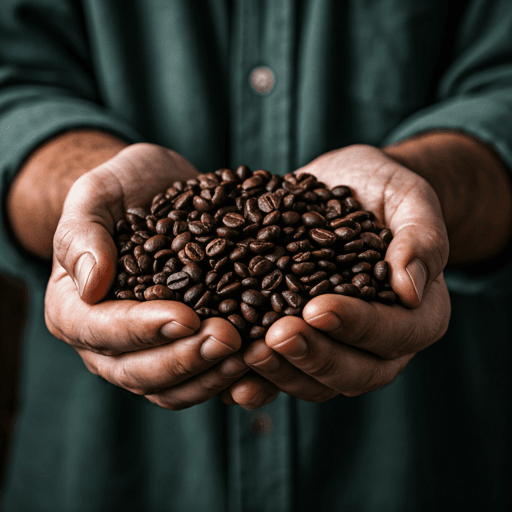
The pouches on a South Indian coffee shelf look interchangeable. They are not — but the difference that shows up in your tumbler is one number printed on the pack: the coffee-to-chicory ratio. Roast date, estate and packaging all matter less than whether you walked out with an 85:15 or a 53:47.
Since 1 July 2026 that number has to be on the front of the pouch. FSSAI's Labelling and Display amendment requires every coffee-chicory mixture sold in India to declare the split in capitals inside a rectangular box on the principal display panel — "COFFEE BLENDED WITH CHICORY: THIS BLEND CONTAINS COFFEE __%, CHICORY __%". Comparing brands got a great deal easier this year, so this guide is built around that number rather than around marketing names.
What chicory actually does to your decoction
Chicory is the roasted, ground root of Cichorium intybus. It contains no caffeine. In a metal filter it does three things: it slows the drip and thickens the decoction, it darkens the colour towards black, and it adds a bittersweet, faintly woody edge that most South Indian palates read as "kaapi". It is also far cheaper per kilo than coffee, which is why hotel and darshini blends lean on it so hard.
There is a legal ceiling. Under India's food product standards a coffee-chicory mixture must contain at least 51% coffee by mass, so chicory cannot exceed 49%. That single rule explains a pattern you can see across the whole market: the "strongest" blend every brand sells sits at 53:47, not 50:50 and not 40:60. Fifty-three is the commercial edge of the legal limit with a few points of headroom for batch variation. If a shop offers you a loose powder that tastes stronger than 53:47, you are buying something that could not legally be packaged and sold as coffee-chicory mixture.
Chicory percentage by brand and blend
Every ratio below is the figure the brand prints on its own pack or product page, checked in August 2026. Brands rename blends often; the ratio is the thing to match, not the name.
| Brand | Blend | Coffee : Chicory | Notes |
|---|---|---|---|
| Cothas | Nova Blend | 100 : 0 | No chicory; 200 g pack only |
| Cothas | Coffee Rich | 90 : 10 | Lightest chicory touch in the range |
| Cothas | Speciality Blend | 85 : 15 | The volume seller; Chikmagalur and Kodagu beans |
| Cothas | Premium Special (Home / Hotel) | 80 : 20 | The classic balanced kaapi profile |
| Cothas | Cotha Blend, Extra Strong | 60 : 40 | Deep colour, thick body |
| Cothas | Deccan Brew | 53 : 47 | At the legal chicory ceiling |
| Levista | Filter Coffee 80:20 | 80 : 20 | SLN Coffee, Kushalnagar, Coorg |
| Levista | Filter 60:40 | 60 : 40 | Bittersweet, hotel-style cup |
| Continental Malgudi | 80/20 Blend | 80 : 20 | CCL Products; dark roast, ground for metal filters |
| Continental Malgudi | 53/47 Blend | 53 : 47 | Strongest Malgudi; bitter edge by design |
| Bru | Green Label | 53 : 47 | HUL; billed as India's first packaged filter coffee |
| Narasu's | Delite | 53 : 47 | Salem, Tamil Nadu; company founded 1926 |
| Cafe Coffee Day | Unwind / Relish / Comfort / Refresh | 80:20 / 70:30 / 65:35 / 60:40 | Chikmagalur, medium-to-dark; mostly 200 g packs |
| Mysore Concerns | Kings Roast / Brindavan Bold / Legacy | 85:15 / 80:20 / 100:0 | Counter-ground in Matunga, Mumbai, since 1939 |
Two things stand out. First, only Cothas and the small counter roasters give you a real ladder — most national brands offer exactly two rungs, an 80:20 and something near 53:47. Second, nobody sells a 70:30 or 65:35 at national scale except Cafe Coffee Day, so if the middle is where your palate sits, CCD's Relish and Comfort are unusually useful and Cothas 80:20 is the nearest mainstream substitute.
What a 500 g pouch costs in August 2026
Prices below are listed prices for 500 g pouches checked in the first week of August 2026, with the source noted per row. The last column is the number that actually matters and that nobody prints: what you pay per 100 g of coffee, once you strip the chicory out of the pack weight.
| Blend (500 g) | Coffee : Chicory | Price | ₹ per 100 g pack | ₹ per 100 g of coffee | Price quoted at |
|---|---|---|---|---|---|
| Cothas Speciality Blend | 85 : 15 | ₹310 | ₹62 | ₹73 | BigBasket |
| Bru Green Label | 53 : 47 | ₹197 | ₹39 | ₹74 | BigBasket |
| Continental Malgudi 80/20 | 80 : 20 | ₹489 | ₹98 | ₹122 | shop.continental.coffee |
| Levista Filter 80:20 | 80 : 20 | ₹490 | ₹98 | ₹123 | levista.in (MRP) |
| Narasu's Delite | 53 : 47 | ₹345 | ₹69 | ₹130 | Amazon.in |
| Levista Filter 60:40 | 60 : 40 | ₹415 | ₹83 | ₹138 | levista.in |
| Cothas Extra Strong | 60 : 40 | ₹425 | ₹85 | ₹142 | BigBasket |
| Cotha Blend | 60 : 40 | ₹450 | ₹90 | ₹150 | cothas.com |
| Continental Malgudi 53/47 | 53 : 47 | ₹439 | ₹88 | ₹166 | shop.continental.coffee |
The method is deliberately blunt: pack price divided by the grams of coffee in the pack, treating chicory as filler. Chicory is not free, so the real spread is a little narrower than the column suggests. But the ranking holds, and it upends the usual assumption that high-chicory blends are the budget option. A 53:47 pouch is only good value if it is priced like one. Bru Green Label is; Continental Malgudi's 53/47 at ₹439 is not — you are paying ₹166 per 100 g of coffee, more than double Bru, for a blend with the same legal minimum of coffee in it.
One more trap worth knowing: buying direct from a brand's own site is often the worst price. The same 500 g Cothas Speciality pouch was ₹530 on cothas.com and ₹310 on BigBasket on the same day — a 71% premium for going direct. Check the marketplace before you check out on the D2C store.
The brands, one at a time
Cothas — the widest ratio ladder in India
Cothas Coffee has roasted in Bengaluru since 1949 and is the brand most South Indian households name first. It buys shade-grown beans from Chikmagalur and Kodagu and roasts on Probat equipment at its Bengaluru facility. What makes it worth recommending is not heritage, though: it is the range. Six rungs from 100% coffee down to 53:47 means you can move one step at a time until you find your ratio instead of jumping between two extremes. The 500 g Speciality pouch carries a one-way valve, which matters more than most people think for a powder that goes stale in weeks.
Bru Green Label — the price benchmark
Hindustan Unilever's Green Label is a 53:47 roast-and-ground powder that HUL bills as India's first packaged filter coffee, and its distribution reach is the widest here — it turns up in kirana stores that stock none of the specialist roasters. At roughly ₹197 for 500 g it sets the floor everyone else is priced against. Do not confuse it with the rest of the Bru range, which is instant — the Bru range guide covers where Green Label sits among them. This is a strong, dark, chicory-forward cup that behaves exactly as a hotel decoction should, and at this price the honest position is that it is very hard to argue against.
Continental Malgudi — good coffee, awkward pricing
Malgudi is the roast-and-ground line from CCL Products in Hyderabad, sold in 80:20 and 53:47. Both are dark-roasted and ground correctly for a metal filter, and the 80:20 at ₹489 is priced in line with Levista. The 53:47 is the odd one out: at ₹439 it costs almost as much as the 80:20 while containing a third less coffee. Note that Continental's better-known products are instants — if a spoon-in-hot-water cup is what you actually want, our Speciale vs Xtra comparison is the relevant page, not this one.
Levista — the Coorg roaster with clean packaging
Levista is SLN Coffee's consumer brand, roasting arabica and robusta from Coorg at Kushalnagar. The lineup is simple — 80:20 at ₹490 and 60:40 at ₹415 for 500 g — and the packaging and grind consistency are among the best in this group. It is also the most expensive mainstream 80:20 per gram of coffee. Buy it if you value consistency and a modern, aromatic cup; skip it if you are optimising rupees.
Narasu's — the Tamil Nadu institution
Narasu's Coffee has operated from Salem since 1926 and is the default kaapi brand across large parts of Tamil Nadu. The lineup is broader and more regionally distributed than the others here, spanning powders and roasted seeds, with Delite at 53:47 the easiest one to find online at about ₹345 for 500 g. Their brand guide goes through the full range, including the peaberry and pure-coffee packs that do not show up on national marketplaces.
The counter roasters — Mysore Concerns, Bayar's and your local shop
Packaged powder will never beat a pouch ground in front of you. Mysore Concerns has been roasting off King's Circle in Matunga, Mumbai since 1939 and publishes its ratios properly — Kings Roast 85:15, Brindavan Bold 80:20, Legacy at 100% coffee. Bayar's has run out of Basavanagudi, Bengaluru since 1974. Most cities have an equivalent: a shop that roasts, blends to the ratio you ask for, and grinds to your filter. If you have one within reach, the national brands are your backup, not your first choice.
Which one to buy
A recommendation, not a shrug:
- If you are buying your first pouch: Cothas Speciality Blend, 85:15, from a marketplace at around ₹310. It is the cheapest coffee in this comparison per gram, it is coffee-forward enough that you can taste what the beans are doing, and if you decide you want more edge you can walk down the Cothas ladder one rung at a time without changing brand.
- If you want the traditional dark, thick, bittersweet hotel cup: Bru Green Label, 53:47, around ₹197. Nothing else at the chicory ceiling is priced within shouting distance of it, and it is stocked everywhere. Buying a ₹439 pouch of the same ratio is paying for the label.
- If you brew in a drip machine, pour-over or French press rather than a metal filter: go to 85:15 or lower chicory, or none at all. Chicory is engineered for slow percolation through a fine bed. In a paper-filter brewer it mostly contributes muddy bitterness and it will clog a fine mesh. Cothas Nova (100% coffee) or Coffee Rich (90:10) are the safe choices; better still, buy beans and grind coarser.
- If you drink your kaapi very milky and sweet: more chicory earns its keep. A 60:40 or 53:47 survives being cut with hot milk and sugar in a way an 85:15 does not — the lighter blend just disappears. This is the one case where the high-chicory pouch is genuinely the better cup, not just the cheaper one.
- If you are buying for an office or a small canteen: pick a 53:47 and buy 500 g pouches rather than a kilo sack, so nothing sits open for more than a few weeks.
Three things to check before you pay
Read the new box, not the blend name. "Premium", "Strong", "Special" and "Hotel" mean nothing consistent across brands — Cothas Extra Strong and Cotha Blend are the same 60:40. Since July 2026 the actual percentages are on the front in a box. Use them.
Buy the size you will finish in a month. Roast-and-ground powder loses most of its aroma three to four weeks after the pouch is opened, valve or no valve. A 500 g pouch suits a two-cup-a-day household; below that, buy 200 g. The gap between fresh and stale powder is much bigger than the gap between any two brands here, which is the argument for grinding fresh when you can.
Do not use these powders for instant coffee, or instant for a filter. Roast-and-ground powder will not dissolve; instant coffee-chicory mixes such as Nescafe Sunrise or Bru Instant will not produce decoction in a metal filter. If instant is what you are after, start with the instant coffee powder brands guide. And if you are still choosing hardware, the brass vs steel filter comparison is worth ten minutes before you spend on powder.