
Rwandan coffee is sweet, floral, citrus-and-red-fruit washed arabica — and almost all of it is a single variety, Bourbon. It grows on hillsides so steep that nearly every task is done by hand, on farms so small that growers cannot process their own harvest. Instead they carry cherry to a shared washing station down the hill. That one arrangement explains most of what makes this origin what it is.
What Rwandan coffee is
Almost everything the country exports is arabica, grown on the ridges of a landlocked, mountainous country nicknamed the land of a thousand hills. Sources give the growing band slightly differently — roughly 1,200 to 2,000m overall, with most specialty lots sitting toward the upper end, commonly quoted around 1,700–2,000m. The cup is recognisably East African — bright, clean, aromatic — but gentler and sweeter than its more famous neighbours. Think orange and mandarin rather than grapefruit, redcurrant and cherry rather than blackcurrant, with a florality that sits closer to jasmine tea than perfume, and a silky body that carries it all.
The harvest runs roughly March through August depending on region and elevation, with export lots typically shipping later in the year. Nearly all of it is fully washed, the processing route that strips the fruit off before drying and rewards clean, bright, transparent cups — if that distinction is new to you, our guide to coffee processing methods covers washed, natural and honey in full. Rwanda has stayed overwhelmingly washed for a practical reason as much as a stylistic one: the washing stations were built to do exactly that job.
Bourbon: the variety that defines Rwandan coffee
Most origins are a patchwork of varieties. Rwanda is unusually close to a single-variety country. Bourbon — overwhelmingly Red Bourbon — is the primary cultivar by a wide margin, with figures around 95% of the trees widely quoted in the trade. The rest is a scattering of Caturra, Catuai, Typica and newer disease-resistant material.
That matters because Bourbon carries natural sweetness. It is a lower-yielding, older variety that most producing countries have partly or wholly replaced with more productive, more disease-tolerant modern cultivars. Rwanda largely did not, and the sugar-forward, round, red-fruited quality people describe as "typically Rwandan" is substantially just Bourbon being Bourbon at altitude.
Two local selections are worth knowing by name, because you will see them on bags:
- Mibirizi — a Bourbon-derived selection named for the mission station where the trees took hold in the early twentieth century, adapted over generations to Great Lakes conditions. Associated with the clean, citric side of the profile.
- Jackson — another early-twentieth-century selection that reached the region by way of East Africa. World Coffee Research places it within the Bourbon genetic group rather than off on its own branch.
So even the "different" Rwanda coffee varieties are mostly Bourbon wearing local names. This is one of the few origins where knowing the variety tells you a lot about the cup before you taste it.
Why the land suits it
Three things do the work here. Altitude: cool nights on these ridges slow cherry ripening, which builds sugars and acidity and produces a denser bean. Soil: the west and north are volcanic, influenced by the Virunga chain; much of the rest is granitic and mineral-rich. Rainfall: it is reliable and generous, which for coffee is close to a cheat code — irrigation is largely unnecessary.
The fourth factor is the hills themselves. The terrain is steep enough that mechanisation is essentially impossible. Every cherry is picked by hand and often carried on foot or by bicycle. That sounds romantic and is mostly just hard work, but it has a real quality consequence: hand-picking means selective picking, and selective picking means riper cherry.
The washing station story
This is the origin's defining modern fact, and it is worth understanding properly.
At the start of the 2000s the country had almost no washing-station capacity to speak of. Today the count runs to the hundreds — figures from around 245 to more than 300 are both cited, depending on the year and who is counting. The precise number matters less than the direction: from near zero to hundreds in roughly two decades. The pioneering stations opened in the early 2000s, built around cooperative and donor-backed training programmes; the station at Maraba, in the south, is the one usually credited as the trailblazer.
The reason it mattered so much comes down to farm size. Coffee here is grown by hundreds of thousands of smallholders — counts in the region of 400,000 are commonly given — many working well under a hectare, sometimes only a few hundred trees. A grower with that much land cannot pulp, ferment, wash and dry their own coffee to any consistent standard; the equipment, the water infrastructure and the drying tables are all out of reach at that scale. Before the stations existed, cherry was processed roughly at home and sold as undifferentiated bulk. The country was a commodity exporter and nothing else.
Centralisation solved it. Growers deliver ripe cherry to a shared station, and trained staff do the processing for everybody using proper pulpers, fermentation tanks and raised drying beds. One competent operation lifts the quality of hundreds of farms at once. That is precisely what turned Rwanda from a bulk origin into a specialty coffee origin, and it happened fast.
It also explains something that confuses newcomers: traceability here usually runs to the station, not the farm. A bag names a washing station because the lot is the pooled output of many neighbours' cherry, processed together. That is not a gap in the paperwork. It is the structure of the industry, and it is the same structure that made the quality possible.
The recent history, briefly
The coffee sector was rebuilt as part of the country's broader recovery after 1994, when exports had collapsed. Specialty exports followed in the early 2000s, alongside those first washing stations and the cooperative and training programmes built around them. In 2008 Rwanda hosted Cup of Excellence, the first African country to do so. Those are the facts, and they are enough. The coffee stands on what is in the cup.
The potato defect, honestly
If you drink enough coffee from this region you will eventually meet the potato taste defect, and it is better to know what it is than to blame the wrong thing.
PTD is an off-note that smells and tastes like raw potato. It comes from a pyrazine compound that develops during roasting in affected beans. It is linked to damage associated with the antestia bug, a shield-shaped pest of the region that feeds on the cherry and leaves puncture marks too small to spot reliably at harvest. The leading explanations are that the feeding wound lets bacteria in, or that the plant's stress response generates the compound. The exact mechanism is still being researched, and some work suggests physical damage alone may produce it too.
The practical points:
- It affects individual beans, unpredictably. A single bean can taint a cup while the rest of the bag is excellent.
- It is effectively invisible in green coffee. It cannot be seen, sorted or smelled out reliably; it typically only shows after roasting.
- It is not the roaster's fault, and not a sign of a careless coffee. It is not a hygiene problem.
- It affects Great Lakes coffees generally — not Rwanda alone — and producers actively manage it through pest control and pruning.
Grind a fresh dose and it is gone. It is an occasional nuisance in an otherwise outstanding origin, and treating it as a scandal does the growers a disservice.
What Rwandan coffee tastes like
The signature is sweetness with lift. Typical notes: orange, mandarin and lemon citrus; red fruit such as redcurrant, cherry and red apple; floral aromatics; caramel or toffee sweetness underneath; and a body often described as silky or creamy. The acidity is bright but rounded rather than sharp — present, structured, never aggressive. At the delicate end, well-made lots go genuinely tea-like, with the kind of clarity where the aftertaste registers as much as the sip. Our coffee flavor wheel guide is the place to go for vocabulary to pin these down.
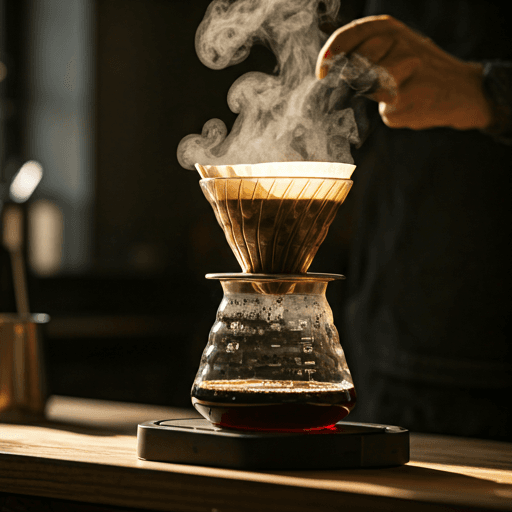
Light-to-medium roasts suit Rwandan coffee beans best, and filter brewing shows them off. Push the roast dark and you trade the florals and citrus for roast character — which is to say, you brew Bourbon at altitude and taste something generic.
Rwandan coffee at a glance
| Region | Typical altitude (bands vary by plot) | Typical flavour signature |
|---|---|---|
| Lake Kivu / West (Nyamasheke, Karongi, Rutsiro) | ~1,400–1,900m | Full-bodied and complex; caramel-toffee sweetness, citrus, red berry. The largest and most celebrated producing area. |
| South (Huye, Nyamagabe, Nyaruguru) | ~1,600–2,000m | Fuller body and stone fruit; apricot, plum, brown sugar, red fruit with a spice nuance. |
| North (Gakenke, Rulindo, Musanze) | ~1,600–2,000m | Volcanic soils; floral, intensely sweet, balanced acidity. Approachable and even. |
| East (around Muhazi and the lakes) | ~1,300–1,600m | Softer and milder; less acidity, more everyday sweetness. |
| Country basics: overwhelmingly Bourbon, with figures near 95% widely quoted (plus the Mibirizi and Jackson selections) · almost entirely fully washed · washing stations numbering in the hundreds · main harvest roughly March–August · hundreds of thousands of smallholders, most under a hectare · traceability generally to station level · fully washed lots graded by screen size and preparation rather than by cup score |
How it compares to Ethiopian and Kenyan coffee
These three get shelved together as "African coffee" and they are genuinely different.
Against Ethiopia: Ethiopia is the coffee plant's homeland, and its farms hold a huge range of indigenous landraces, usually labelled simply "heirloom." That genetic riot produces the wilder aromatics — jasmine, bergamot, and in sun-dried lots, blueberry. Rwanda is the opposite: one variety, one processing style, a much narrower and more consistent target. Ethiopia is more startling; Rwanda is sweeter, rounder and more predictable. Our Ethiopian coffee guide covers that origin in depth.
Against Kenya: a closer neighbour but a sharper contrast in the cup. Kenya's SL28 and SL34 varieties, plus its processing conventions, produce that famous blackcurrant intensity and a mouth-puckering, juicy, high-toned acidity. Kenya announces itself. Rwanda's Bourbon says the same broad thing more quietly — orange where Kenya is blackcurrant, redcurrant where Kenya is cassis, silky where Kenya is structural. If Kenyan acidity is too much for you, Rwanda coffee beans are very often the answer.
Burundi, incidentally, is the genuine sibling — same Bourbon, same washing-station model, same hills, same potato defect. The two are frequently mistaken for each other, and reasonably so.
The bottom line
Rwandan coffee is what happens when one naturally sweet old variety meets high volcanic hills and a processing system built from almost nothing in a couple of decades. The Bourbon gives it the sugar and the red fruit. The altitude gives it the structure. The washing stations gave it the cleanliness and consistency that let the world notice — and they are why your bag names a station rather than a farmer.
Drink it washed, drink it light or medium, brew it as filter, and expect orange, red fruit, florals and a silky finish. If a cup ever tastes of raw potato, shrug, tip it and grind another dose. The rest of the bag is likely to be lovely.