
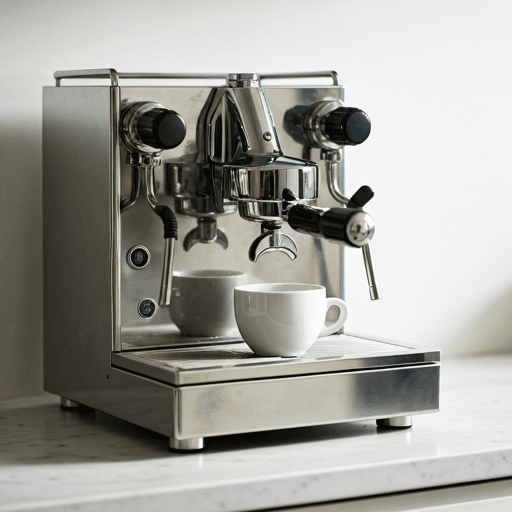
Rocket espresso machines are premium, Italian-built home and prosumer espresso machines, made near Milan and prized for their solid build quality and classic stainless-steel looks. The Rocket coffee machine range spans compact heat-exchanger models built around the commercial E61 group, larger heat-exchanger machines, dual-boiler flagships with PID temperature control, a compact travel option, and a line of matching grinders. This guide walks through that lineup tier by tier and explains what separates a heat exchanger from a dual boiler, so you can see where each Rocket espresso machine fits.
Because the range shifts with model years and varies by market, treat the specific model names and revisions here as a snapshot rather than a fixed catalog. The shape of the lineup, though, has stayed remarkably consistent: one accessible E61 machine, a couple of fuller-sized E61 machines, dual-boiler machines for people who want precise control, a small portable, and a flagship showpiece at the top.
What are Rocket espresso machines?
Rocket Espresso is an Italian manufacturer based in the Milan area, focused on the enthusiast and light-commercial end of the market rather than mass-produced bean-to-cup automatics. The machines are semi-automatic: you grind, dose, tamp and pull the shot yourself, which is exactly what many home baristas want from a machine they plan to keep for years. Hallmarks shared across almost the whole range include a 58mm commercial-style portafilter, the heat-retaining E61 brew group on most models, brass boilers, stainless-steel bodies, and a vibration pump feeding either an internal water tank or a plumbed-in line on setups that allow it.
That focus places Rocket squarely in the prosumer category — a clear step up in ambition from an entry pod or single-boiler steam-wand machine, and in the same conversation as other serious home espresso machines. If you are weighing the whole category rather than one brand, our overview of high-end espresso machines sets the wider scene, and La Marzocco's home range covers another premium Italian maker worth knowing before you commit.
The Rocket coffee machine range at a glance
The easiest way to read a Rocket coffee machine lineup is by boiler design, because that one choice drives the price tier, the footprint and how the machine behaves when you brew and steam at the same time. The table below groups the familiar families qualitatively. Cost across the whole range sits firmly in the premium bracket, so we describe relative positioning in words rather than numbers — there are no prices here, and no single "best" pick, because the right tier depends on how you drink coffee.
| Rocket line | Boiler type | Stand-out | Best for |
|---|---|---|---|
| Appartamento | Heat exchanger, E61 | Slim body with cut-out side panels; small footprint | A first serious E61 machine and tighter counters |
| Mozzafiato / Giotto | Heat exchanger, E61 | Fuller size, larger tank, PID on newer revisions | Enthusiasts wanting a roomier HX setup |
| R58 | Dual boiler + PID | Independent brew and steam control, twin gauges | Milk drinks and dialed-in brew temperature |
| R Nine One | Dual boiler + PID (flagship) | Pressure profiling and top-tier finish | A statement home setup and showpiece |
| Porta Via | Compact / portable | Small, travel-minded design | Travel and very limited space |
| Grinders (e.g. Fausto, Faustino) | — | Matching looks, stepless adjustment | Pairing a grinder with the machine |
Heat-exchanger E61 machines
The heart of Rocket's catalog is its heat-exchanger (HX) machines built on the E61 group. A heat exchanger sits inside a single steam boiler and pulls fresh water through it on demand, so the machine can brew a shot and steam milk near-simultaneously from one boiler — a big convenience over a basic single boiler that makes you wait between the two. The trade-off is that brew temperature is governed indirectly by the boiler, so many HX owners do a quick "cooling flush" before a shot to settle the group at the right point. The E61 group itself is a heavy, chrome-plated icon that stabilizes temperature and adds a satisfying, mechanical feel to starting a shot.
Rocket Appartamento
The Appartamento is the compact, most accessible E61 machine in the range and a hugely popular first heat-exchanger machine, recognizable by the cut-out circles on its side panels. It keeps the 58mm portafilter, E61 group and vibration pump of its bigger siblings in a noticeably slimmer body, which is why it lands on so many smaller kitchen counters. It is a machine in its own right rather than a stripped-down one, so it earns a full write-up: see our dedicated Rocket Appartamento guide for a closer look at what it does well and where its limits are.
Mozzafiato and Giotto
Step up from the Appartamento and you reach the Mozzafiato and Giotto families — fuller-sized E61 heat-exchanger machines with a larger footprint, bigger water tank and, on newer revisions, added conveniences such as PID temperature control and a shot timer. The two lines are close mechanical cousins; the most visible difference tends to be styling and control layout rather than a change in how the machine brews. These are the machines to look at when the Appartamento's compact size is not a priority and you want more capacity and refinement while staying in the HX world. Exactly which features appear on a given revision varies by model year, so confirm the current specification for the unit you are considering.
Dual-boiler machines with PID: the R58 and R Nine One
Above the heat exchangers sit Rocket's dual-boiler machines, where a separate brew boiler and steam boiler each do one job. That separation lets a PID hold your brew temperature to a tight, repeatable target while the steam boiler runs hot and independent for milk, which is why serious milk-drink drinkers and anyone chasing consistency gravitate here. The Rocket Espresso R58 is the well-known dual-boiler workhorse of the range, with twin pressure gauges, PID control and adjustable brew and steam temperatures — a machine built to be dialed in and left dialed in.
At the very top, the R Nine One is Rocket's flagship. Beyond its dual-boiler, PID foundation it adds pressure profiling, letting you shape how pressure ramps and tapers through a shot for finer control over extraction, wrapped in the range's most premium finish. It is as much a showpiece as a tool. If you want to compare a dual boiler from a comparable prosumer maker, our explainer on the ECM Synchronika covers a machine in the same class and philosophy.
Compact and portable: the Porta Via
The Porta Via is the outlier in the lineup — a small, travel-minded espresso machine for people who want real espresso in a genuinely compact package or somewhere counter space is scarce. It trades the big E61 group and boiler mass of the flagship machines for portability, so it is a different proposition from the rest of the range rather than a smaller version of it. Think of it as a specialist choice for a specific use case, not the default recommendation for a home kitchen.
Rocket's grinders
Rocket also makes a line of grinders — models such as the Fausto and Faustino families — designed to sit alongside its machines with matching styling and stepless grind adjustment. This matters more than it might sound: espresso is unforgiving about grind, and a machine of this caliber only performs when it is fed a consistent, finely adjustable grind. You do not have to buy a Rocket grinder to run a Rocket machine, but every one of these machines assumes a capable grinder is part of the setup, whatever brand it wears.
What to look for across the Rocket espresso range
Whichever tier you are drawn to, a handful of decisions cut across the entire Rocket espresso range. Work through these and the right family usually reveals itself.
- Heat exchanger vs dual boiler. HX machines (Appartamento, Mozzafiato, Giotto) brew and steam together from one boiler and cost less, at the price of a small flush routine for temperature. Dual boilers (R58, R Nine One) give independent, precise brew and steam temperatures for more money and a larger machine.
- PID temperature control. A PID holds brew temperature to a set target for shot-to-shot consistency. It is standard on the dual boilers and appears on newer HX revisions — confirm whether the specific model you are eyeing includes it.
- The E61 group. Almost every Rocket machine uses this classic commercial group. It is durable, temperature-stable and widely serviced, which is part of why these machines are seen as long-term keepers.
- Plumb-in vs tank. All the machines run from an internal water tank; several also support a plumbed-in water line for a permanent setup. If a fixed water connection matters to you, check that the specific model and configuration allows it.
- Footprint. These are substantial machines. The Appartamento is the slimmest of the full-size options and the Porta Via the smallest overall; the Mozzafiato, Giotto and dual boilers need real counter and height clearance.
- A good grinder. Budget for one. No machine in this range reaches its potential paired with a weak grinder, so plan the grinder as part of the purchase, not an afterthought.
Which tier is right for you?
If you want your first proper E61 machine and value a smaller footprint, the Appartamento is the natural starting point. If size is not a concern and you want more capacity and refinement while staying in the heat-exchanger world, look at the Mozzafiato or Giotto. If you drink a lot of milk-based coffee, or you simply want the tightest temperature control and repeatability, the dual-boiler R58 is the machine built for that, with the R Nine One and its pressure profiling waiting at the top for anyone who wants the flagship. And if portability is the whole point, the Porta Via is the specialist answer.
Rocket's appeal, across every one of these tiers, is consistency of philosophy: heavy, serviceable, classically styled Italian machines meant to be lived with for a long time. Pick the boiler design that matches how you drink, pair it with a grinder that can keep up, and any machine in the range will reward the ritual. Whichever way you lean, spending time understanding the trade-offs first is the surest route to a setup you will still be happy with years from now.