
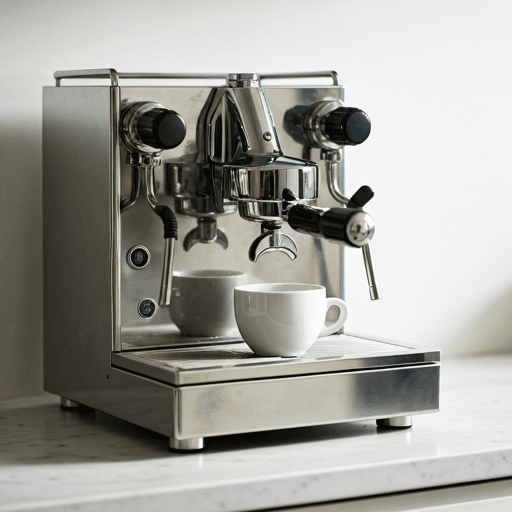
A La Marzocco coffee machine is a premium, hand-built Italian espresso machine engineered for temperature stability and years of hard daily use. It is the kind of machine that anchors specialty coffee bars around the world and, increasingly, serious home kitchens. Founded in Florence in 1927, La Marzocco pioneered the dual-boiler, saturated-group design that keeps brew temperature rock-steady shot after shot. This buying guide walks the full range, from cafe flagships to compact home models, and explains what to weigh before you choose one.
What Is a La Marzocco Coffee Machine?
La Marzocco is an Italian manufacturer that has specialized in high-end espresso machines since brothers Giuseppe and Bruno Bambi opened their Florence workshop in 1927. The name, and the company's red heraldic lion, comes from the Marzocco, the historic symbol of Florence. Today the company is headquartered in Scarperia, in the Mugello hills roughly 30 km (about 19 miles) north of Florence, where machines are still largely hand-assembled.
What sets a La Marzocco coffee machine apart is a consistent engineering philosophy rather than any single model. In 1970 the company patented its first semi-automatic dual-boiler machine, the GS (Gruppo Saturo, or "saturated group"). Separating the brew boiler from the steam boiler, and saturating the group head with water from the brew boiler, gave the machine unusually stable extraction temperatures. That thinking still runs through the whole lineup, from a high-volume cafe flagship down to a single-group machine on a kitchen counter.
These are premium-tier machines. Across the board they sit at the luxury end of the market, and the home models are among the priciest domestic espresso machines you can buy. What you are paying for is commercial-grade components, thermal stability and longevity rather than a long feature list.
The Commercial Range
La Marzocco built its reputation behind the bar, and the commercial range is still the heart of the company. These are the workhorses you see in specialty coffee shops; most are offered in one-, two- or three-group configurations and are plumbed into a water line so they can keep pace with a busy service. Named here purely as factual examples:
- Linea Classic is the machine that defined the modern La Marzocco look. Introduced in the 1990s, the Linea (Italian for "line") is the archetypal reliable, no-drama cafe workhorse, and its silhouette went on to inspire the home models.
- Linea PB is an updated Linea developed with barista Piero Bambi's input, adding programmable dosing, refined ergonomics and, on the digital PB X, automated controls for high-throughput bars.
- KB90 is built around a "straight-in" portafilter for a faster, less strenuous workflow, with an integrated group scale for gravimetric (weight-based) shots.
- GB5 is the high-capacity flagship, aimed at busy hotels, restaurants and large cafes, wrapped in the ornate Florentine styling with red lily emblems.
- Strada was designed with competition baristas and is the pressure-profiling machine, letting the barista shape pressure across the shot.
- Leva is a modern take on the classic lever machine, pairing a spring-lever group with electronic monitoring for pre-infusion and profiling.
You do not need to memorize the lineup. The takeaway is that every cafe model shares the same saturated-group, dual-boiler DNA; they differ mainly in workflow, capacity and how much control the barista wants over each shot.
The Home Range: Linea Mini, Linea Micra and GS3
For decades La Marzocco was strictly a cafe brand. That changed relatively recently: the company launched a dedicated home division in the mid-2010s and brought its core engineering, scaled to a countertop, to the domestic market. Three machines form the heart of the home lineup.
- Linea Mini is a scaled-down Linea, with a genuine saturated group head and dual boilers in a compact stainless body. Introduced around 2015, it is the iconic "little cafe machine" for the home, heavier and classically built, and for many people the aspirational home espresso machine.
- Linea Micra is the newer, smaller and lighter home model, launched in 2023. It warms up faster, adds app connectivity and typically sits at a somewhat more approachable, though still premium, price than the Mini, which makes it the easiest entry point into the range.
- GS3 is effectively a commercial single-group machine reworked for prosumers and boutique cafes, and has been serving that niche since the 2000s. The La Marzocco GS3 uses the same saturated group and dual-boiler system with a digital PID controller, and comes in two versions: AV (auto-volumetric, with programmable shot buttons) and MP (mechanical paddle, for hands-on flow and pressure control). The Marzocco GS3 sits above the Mini and Micra as the most capable, and most expensive, of the home-friendly machines.
La Marzocco has since extended the home line with domestic versions of the Leva and Strada, but the Linea Mini, Linea Micra and GS3 remain the core home range. If you are torn between the two most popular options, that decision deserves its own head-to-head: see La Marzocco Linea Micra vs Mini for a direct comparison of size, warm-up, steam power and connectivity.
Signature Engineering: What You Are Actually Paying For
All La Marzocco coffee machines share a handful of design choices that explain both the price and the reputation. Understanding them is the fastest way to know whether the brand is right for you.
Dual boilers
A separate brew boiler and steam boiler mean the machine can extract espresso at a precise temperature while steaming milk at full power, with neither task starving the other. This is the backbone of consistent milk drinks back to back. If the concept is new to you, our overview of dual-boiler espresso machines explains why it matters.
Saturated group heads
Rather than bolting the group onto the boiler, La Marzocco makes the group head part of the brew boiler itself, so it stays at brew temperature and water saturates it continuously. The practical payoff is thermal stability: the first shot of the morning and the fiftieth land at nearly the same temperature.
PID control and build quality
Digital PID temperature control lets you dial in and hold a target brew temperature to within a fraction of a degree. Combine that with commercial-grade internals, stainless construction and a design built to be serviced rather than thrown away, and you have machines that many cafes run for a decade or more. That longevity is a large part of the value story.
La Marzocco Range at a Glance
A quick map of the lineup. Cost is described only in broad tiers; every machine here sits at the premium-to-luxury end.
| Machine / line | Home or cafe | Notable features |
|---|---|---|
| Linea Classic | Cafe | The archetypal multi-group workhorse; simple and durable |
| Linea PB / PB X | Cafe | Programmable dosing, refined ergonomics, digital options |
| KB90 | Cafe | Straight-in portafilter, built-in group scale, high volume |
| GB5 | Cafe | High-capacity flagship with ornate Florentine styling |
| Strada | Cafe | Pressure profiling for full control across the shot |
| Leva | Cafe | Modern spring-lever group with electronic monitoring |
| Linea Mini | Home | Compact saturated-group dual boiler; classic, heavier build |
| Linea Micra | Home | Smaller, lighter, faster warm-up, app connectivity |
| GS3 (AV / MP) | Home / prosumer | Single-group commercial engine; volumetric or manual paddle |
What to Look For If You Are Buying for Home
If you are considering a home model, the questions are less about the badge and more about your kitchen, your routine and your patience. A few practical points to weigh:
- Footprint and height. These are substantial machines. Measure your counter depth and, crucially, the clearance under your cabinets. The Micra is the most space-friendly; the Mini and GS3 need more room and take more weight.
- Plumb-in versus tank. The home machines can typically run from an onboard water reservoir or be plumbed directly into a water line. A reservoir gives you flexible placement; plumbing in is tidier for daily use but ties the machine to one spot.
- Warm-up time. Dual boilers take time to reach temperature. The Micra is quickest, warming up in only a few minutes; expect the Mini and GS3 to want a longer warm-up, so many owners run them on a timer or smart plug to be ready in the morning.
- Milk and steam power. All of these steam well, but the GS3 and Mini generally offer more headroom for back-to-back milk drinks than the compact Micra, which matters if you make several lattes at once.
- The learning curve. A La Marzocco does not make espresso for you. Great results still depend on your dose, distribution, tamp and technique. Budget time to dial in, not just money to buy in.
- Grinder pairing. This is the one most people underestimate. A precise, stable grinder does as much for cup quality as the machine itself, so plan for a serious grinder alongside any of these.
- Servicing and support. Because parts are shared across the range and widely available, these machines are designed to be maintained rather than replaced. Factor in access to a good technician, or your own willingness to learn basic upkeep, as part of long-term ownership.
If you are still weighing the brand against the wider field, our general guide on how to choose an espresso machine walks through the trade-offs, and high-end espresso machines puts La Marzocco in context alongside other premium makers.
Upkeep, Water and Running Costs
Owning a machine at this level comes with a little responsibility, and it pays off in cup quality and lifespan. Two things matter most:
- Water quality. Espresso machines are sensitive to scale. Most owners use filtered or remineralized water balanced for espresso to protect the boilers and keep the taste clean; hard, untreated tap water is the fastest way to shorten a machine's life.
- Routine care. Daily backflushing on machines with a three-way valve, regular cleaning of the group and portafilter, and periodic descaling or professional servicing keep shots tasting right. None of it is difficult, but none of it is optional either.
Ongoing costs beyond the coffee itself are modest and best thought of qualitatively rather than as a fixed number: water filters, cleaning tablets and the occasional gasket. The bigger recurring investment is a good grinder and fresh beans, not the machine's upkeep. Handled well, a La Marzocco is genuinely a buy-it-for-a-decade purchase.
Is a La Marzocco Right for You?
A La Marzocco rewards people who want cafe-level consistency at home and intend to keep the machine for a long time. It is deliberate, heavy and demanding of good technique and a good grinder, and it asks a premium price for that pedigree. If you value simplicity, speed or a smaller budget, a capable bean-to-cup or mid-range espresso machine may serve you better. But if temperature stability, build quality and the pleasure of a machine built to last are what you are after, the range, from the approachable Linea Micra to the iconic Linea Mini and the prosumer GS3, is one of the most respected in espresso for good reason.