
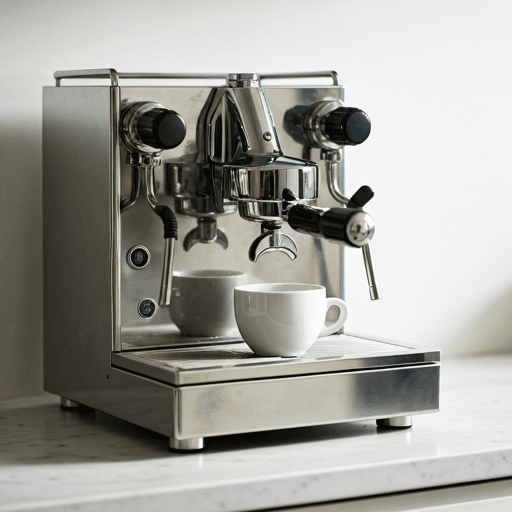
The Rocket Appartamento is a compact Italian prosumer espresso machine built around the commercial-style E61 group and a heat-exchanger boiler, which means it can pull a shot and steam milk at nearly the same time. Made by Rocket Espresso of Milan, it is best known for its slim, design-led body with the distinctive cut-out circles in its side panels, and it is widely regarded as one of the friendliest first steps into E61 machines. This guide covers what the machine is, who it suits, the specs worth knowing, how a heat exchanger compares to single- and dual-boiler designs, and what you will need alongside it.
What is the Rocket Appartamento?
The Rocket Appartamento is a heat-exchanger (HX) espresso machine for the home and enthusiast market. "Prosumer" is the usual label: it borrows commercial hardware, most obviously the E61 brew group, and packages it in a footprint and price aimed at serious home baristas rather than cafes. It is handmade in Italy, uses copper and brass internals, and is one of Rocket Espresso's most recognizable domestic models thanks to those perforated side panels.
The defining trick of the heat-exchanger layout is that a single boiler holds hot water for steam while a thin tube (the heat exchanger) runs through that boiler and flash-heats fresh water on its way to the group for brewing. Because brew water and steam are drawn from the same always-hot boiler, you can brew espresso and steam milk together instead of waiting between the two. For anyone making milk drinks, that is the single biggest practical difference between an HX machine like the Appartamento and a basic single-boiler unit.
Who the Rocket Appartamento is for
This is a machine for someone who has decided they want to learn real espresso and is ready to move past pod systems and entry-level single-boilers. If you make a latte or cappuccino most mornings, want proper steaming power for microfoam and latte art, and like the idea of a machine you can maintain and upgrade for years, the Appartamento sits squarely in that bracket.
It is also a design piece. The polished stainless body and colored panel inserts are a genuine part of the appeal, and the machine is compact enough to earn a permanent spot on a kitchen counter. It is not, however, a plug-and-forget appliance. It has no built-in grinder, no automatic milk system, and it rewards a bit of practice with timing and dialing in. If you want push-button convenience, a bean-to-cup or pod machine will suit you better; if you want to develop actual barista skills on capable gear, this is a common landing spot. For the wider picture of picking a first machine, our guide on how to choose an espresso machine is a good companion read.
Key things to know about the Rocket Espresso Appartamento
Most of what makes the Rocket Espresso Appartamento worth its premium is under the hood. Here are the parts that matter, with the usual caveat that exact figures and fittings vary by revision, so confirm the spec sheet for the version you are looking at.
The E61 group
The E61 is a heavy, chrome-plated brass brew group first designed in the early 1960s and used across countless commercial and prosumer machines. It works by thermosiphon: hot water constantly circulates from the boiler through the group to keep brew temperature stable, and its design gives a gentle pre-infusion as you lift the lever. Practically, the E61 means the Appartamento shares a vast ecosystem of baskets, gaskets, and upgrades, and its behavior is well understood by the community. It also takes several minutes to fully heat up from cold, which is normal for the design.
Heat exchanger, not a stock PID
The classic Appartamento manages boiler pressure with a pressurestat rather than a display-driven PID temperature controller. Brew temperature is regulated by the heat exchanger and the constantly circulating E61 group rather than a digital readout. In practice, HX machines can run a touch hot after sitting idle, which is why many owners do a quick "cooling flush" (a short run of water through the group) before pulling a shot. This is a well-documented habit, not a fault. Note that Rocket has released later variants that add PID control, so whether a given unit has one depends on the model and revision.
58mm portafilter and steam wand
The Appartamento uses a commercial-standard 58mm portafilter, so baskets, tampers, and distribution tools are easy to source. It typically ships with single and double spouted portafilters, and a bottomless (naked) portafilter is a popular add-on for watching extraction. The steam wand draws from the boiler and delivers strong, cafe-grade steam, which is what lets you texture milk properly for flat whites and cappuccinos. Steam power is one area where a good HX machine clearly outclasses most entry single-boilers.
Pump, water tank, and footprint
The machine runs a vibration pump (compact and reasonably quiet, as opposed to a rotary pump) and is fed from an internal water reservoir of roughly 2.5 liters. The Appartamento is generally a tank-only machine rather than a plumbed-in one; plumb-in is a feature you tend to find further up the Rocket range, so if direct water connection matters to you, verify it for the specific model and setup. The footprint is a headline feature: at around 27cm wide it is notably slim for an E61 heat-exchanger, which is a big reason it fits kitchens that could not house a larger machine. It weighs around 20kg, so it is solid but not immovable.
You still need a good grinder
This cannot be overstated: the Appartamento does not include a grinder, and espresso is only as good as the grind feeding it. Budgeting for a capable espresso grinder alongside the machine is essential, not optional. A great machine with a weak grinder will underperform a modest machine with a great grinder. Factor the grinder into the total cost before you decide.
Heat exchanger vs single boiler vs dual boiler
Understanding where the Appartamento sits means understanding three boiler philosophies. Each is a reasonable choice; they simply trade off differently.
Single boiler machines use one boiler for both brewing and steaming and switch between the two, so you brew, then wait for the boiler to reach steam temperature, then steam. They are the most affordable and compact route into real espresso, but the wait between shot and steam is a workflow compromise for milk drinks.
Heat exchanger machines like the Appartamento remove that wait: one boiler stays at steam temperature while the exchanger supplies brew-temperature water on demand, so brewing and steaming happen together. The trade-off is that brew temperature is less precisely dialed than on a PID-controlled dual boiler, hence the cooling-flush habit.
Dual boiler machines run separate boilers for brew and steam, each independently temperature-controlled (usually by PID). This gives the most precise, repeatable brew temperature and effortless simultaneous brewing and steaming, at the cost of more size, complexity, and money. If that precision is your priority, our overview of dual-boiler espresso machines lays out the case. For a broader look at the top tier overall, see our guide to high-end espresso machines.
Rocket Appartamento at a glance
A qualitative summary of the key features and why each one matters. The Appartamento sits at a premium, prosumer price point; we describe cost in words rather than figures because pricing shifts by market and revision.
| Feature | Rocket Appartamento | Why it matters |
|---|---|---|
| Boiler type | Heat exchanger (single copper boiler, roughly 1.8 L) | Brew and steam at the same time without a full dual-boiler footprint |
| Brew group | Commercial E61 group | Thermosiphon temperature stability, gentle pre-infusion, huge parts and upgrade ecosystem |
| Portafilter | 58mm commercial size | Standard baskets, tampers, and distribution tools are easy to find |
| Temperature control | Pressurestat on the classic; some later revisions add PID | HX manages brew temp via the group rather than a stock digital readout |
| Steam | Dedicated steam wand off the boiler | Strong, cafe-grade steam for proper microfoam and latte art |
| Pump | Vibration pump | Compact and reasonably quiet; not a rotary or plumb-in pump |
| Water supply | Reservoir tank, roughly 2.5 L (typically not plumbed in) | Tank-fed simplicity; plumb-in tends to live higher in the range |
| Footprint | Compact for an E61 HX machine (around 27cm wide) | Fits counters that could not house a larger heat-exchanger |
| Grinder | Not included | Needs a good separate espresso grinder to perform |
| Cost | Premium, prosumer tier | An investment machine well above entry pod or single-boiler units |
Revisions, colors, and the Rocket Appartamento white option
Part of any honest Rocket Appartamento review is acknowledging that "the Appartamento" is really a small family that has evolved over time. The core machine has stayed remarkably consistent, but there are variants worth knowing about:
- Panel colors: the standard polished-steel body takes colored panel inserts, and a Rocket Appartamento white insert is one of the popular choices alongside other tones, letting you match the machine to your kitchen.
- Serie Nera: a matte-black-panel version that swaps the polished side panels for bold black, giving the same machine a darker, more contemporary look.
- Later revisions: Rocket has issued updated versions over the years, and certain newer variants add PID temperature control that the original did not have. Because these details change, always check exactly which revision a listing refers to before assuming a feature is present.
Functionally, the differences between the standard finish and the Serie Nera are cosmetic; the meaningful spec changes are the ones tied to newer revisions, which is why the "confirm the exact spec" advice runs through this whole guide. To see how the Appartamento fits against its stablemates such as the Mozzafiato, R58, and the flagship models, our companion piece on the wider Rocket espresso machines range is the place to go.
Living with it: the honest trade-offs
What owners consistently praise is the build quality, the steaming power, the compact size relative to its class, and the sheer longevity and repairability of an E61 machine. What they flag as trade-offs is the warm-up time from cold, the cooling-flush routine that comes with heat exchangers, the lack of a stock PID on the classic model, and the fact that it is tank-only. None of these are defects; they are the character of the category. If you want a screen full of settings and one-touch milk, this is not that machine, and that is the point.
It is also worth being realistic about the total commitment. Between the machine, a proper grinder, a decent tamper, fresh beans, and the learning curve, the Appartamento is the centerpiece of a small setup rather than a standalone purchase. For most people who go this route, that is exactly the appeal: it is gear you grow into rather than out of.
The bottom line
The Rocket Appartamento earns its reputation as a gateway E61 machine by pairing genuinely commercial brewing hardware with a compact, handsome body and the everyday convenience of simultaneous brewing and steaming. It asks for a good grinder, a little patience with warm-up and temperature, and a premium budget in return for a machine that can serve excellent espresso and milk drinks for years and be maintained rather than replaced. If that balance of capability, character, and craftsmanship matches what you want from a morning coffee ritual, it is easy to see why the Appartamento remains such a well-loved first step into the world of prosumer espresso.