
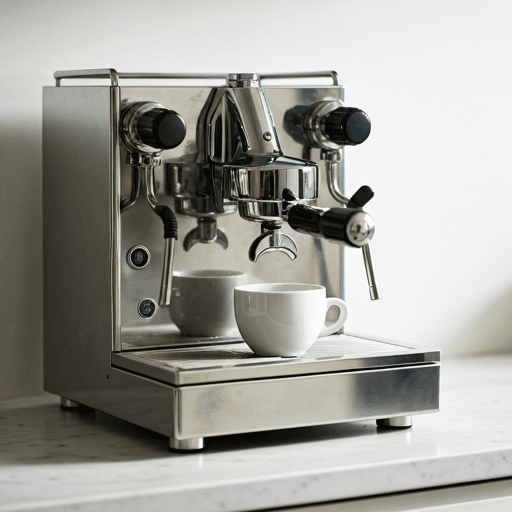
The ECM Synchronika is a high-end, German-built prosumer espresso machine prized for its commercial-grade build and rock-steady temperature control. It pairs twin boilers with the classic E61 group head, a near-silent rotary pump and PID control, so a dedicated home barista can brew and steam at the same time at precise, repeatable temperatures. This guide explains what it is, what its headline features actually give you, who it suits, and how to weigh it honestly against the wider prosumer field.
This is not a ranked review or a price list. Think of it as a map of the machine, so you can decide whether it fits the way you make coffee.
What is the ECM Synchronika?
The ECM Synchronika is a manual, pump-driven espresso machine made by ECM (the name traces to Espresso Company Milano) and hand-built in the Heidelberg area of Germany. "Manual" here means you control the workflow: you grind, dose and tamp into a 58mm portafilter, lock it into the group head, and pull the shot yourself. It is the opposite of a one-touch, push-button machine, and that is the point. Enthusiasts choose it precisely because it gives them control.
Visually it is a stainless-steel box with two pressure gauges, a pair of side paddles for steam and hot water, and the unmistakable polished E61 group jutting from the front. Under the casing sits the feature that defines it: a Synchronika dual boiler layout, with one boiler dedicated to brewing and a separate, larger one for steam.
Built like a cafe machine, sized for a home
The Synchronika borrows its core components from commercial espresso machines and packages them for a kitchen counter. The internal layout is famously tidy and serviceable, gaskets and valves are widely available, and the machine is designed to be maintained and repaired rather than thrown away. That repairability, plus the heavy stainless construction, is a big part of why this ECM espresso machine has such a loyal following.
Key features and what they give you
It is easy to get lost in the spec sheet, so here is what each major feature actually does for you in the cup and at the wand.
| Feature | What it gives you |
|---|---|
| Dual boilers (separate brew and steam) | Brew and steam at the same time, each at its own ideal temperature, with no waiting or "temperature surfing" |
| PID temperature control | You set a target brew temperature and the machine holds it shot to shot, the foundation of repeatable espresso |
| E61 group head | Proven thermal stability and built-in mechanical pre-infusion that gently wets the coffee puck before full pressure |
| Rotary pump | Quiet, smooth, consistent pressure delivery, and the option to plumb the machine into a water line |
| Tank or plumbed-in water | Flexibility to start from the internal reservoir and convert to mains water later |
| Optional flow control | Lets you vary water flow and pressure during the shot for pressure profiling and finer extraction tuning |
| Commercial steam boiler | Strong, dry steam for fast, glossy milk texturing and latte art |
The dual boilers and PID
A dual boiler is the headline. One boiler heats water for the shot and is held by PID at your chosen brew temperature; the second, larger boiler makes steam. Because they are independent, you can dial espresso temperature to the degree while keeping powerful steam on tap, and you never have to wait between pulling a shot and steaming milk. For anyone making back-to-back milk drinks, that parallel workflow is the single biggest practical advantage. If you want the concept in depth, see our explainer on dual boiler espresso machines.
The E61 group head
The E61 group head is a heavy, thermosyphon-heated brewing group first designed in 1961. Hot water circulates through its mass continuously, which keeps temperature steady, and its design provides a brief mechanical pre-infusion as you lift the actuation lever, softening the start of extraction. The trade-off is mass: all that metal takes time to come up to temperature, which feeds into the warm-up point below.
Rotary pump, tank or plumbed in
The Synchronika uses a rotary pump rather than the vibratory pump found in cheaper machines. It is quieter, delivers smoother pressure, and crucially allows the machine to be plumbed directly into a water line. You can run it from its internal tank and switch to plumbed-in later, which is a genuinely useful upgrade path for a long-term setup.
Optional flow control
ECM offers a flow control device for the E61 group. Fitting it lets you manually vary water flow during the shot, opening the door to pressure profiling: a gentle ramp-up, a long pre-infusion, or a tapered finish. It is an enthusiast feature, not a requirement. Plenty of owners pull excellent espresso without it, but it is there if you want to chase that last bit of nuance.
Why enthusiasts love it
- Temperature stability. Dual boilers and PID make every shot start from the same place, which is the bedrock of consistency.
- Build quality. Heavy stainless steel, commercial-grade internals, and a finish that holds up for years.
- Serviceability. A clean internal layout and broad parts availability mean it can be maintained, descaled and rebuilt rather than retired.
- Workflow and looks. The paddle controls, gauges and polished group make daily use feel deliberate, and the machine is genuinely good-looking on a counter.
In short, a prosumer espresso machine like the Synchronika is bought by people who want near-commercial results and intend to keep the machine for a long time.
The trade-offs, honestly
No machine is all upside, and it would be dishonest to pretend otherwise.
- Premium price tier. This sits firmly at the high end. It is a significant investment, not an entry-level buy.
- Large and heavy. It needs real counter space and a sturdy surface, and it is not something you shuffle around casually.
- Longer warm-up. That E61 mass and twin boilers take time to reach full thermal stability from cold, typically the better part of 20 to 30 minutes, though newer versions add a faster heat-up mode that gets you to a shot far sooner. Many owners run it on a timer.
- A learning curve. It is manual. You still need a good grinder, fresh beans and practice with dose, tamp and milk. The machine rewards skill rather than replacing it.
If you have never pulled a shot, you can absolutely learn on it, but know that it asks more of you than a pod or super-automatic machine. Our guide to how to make espresso at home covers the fundamentals you will lean on.
Who the ECM Synchronika suits, and who can skip it
It suits you if you are a serious home barista who wants cafe-grade espresso and proper milk drinks, values build quality and repairability, enjoys the hands-on ritual, and is happy to invest at the premium end for a machine that should last many years.
You can comfortably skip it if you want one-touch convenience, you mostly drink black coffee and rarely steam milk, counter space or budget is tight, or you would rather not wait for warm-up and learn manual technique. In those cases a bean-to-cup, a pod machine, or a more compact single-boiler machine will make you happier.
How to choose: the ECM Synchronika versus the field
The Synchronika is one option in a competitive prosumer category. Weigh it against a few decisions rather than against price alone.
Dual boiler vs heat exchanger vs single boiler
A dual boiler gives independent brew and steam temperatures and simultaneous use. A heat exchanger (HX) machine uses one steam boiler with a pass-through for brew water; it can brew and steam together too, but brew temperature is less precise and needs a little technique to manage. A single boiler is the most affordable but makes you switch between brewing and steaming. For milk-drink lovers chasing consistency, dual boiler is usually the upgrade that matters most.
Flow control or not
Decide whether pressure profiling appeals to you. If you love tinkering and light roasts, flow control is a draw. If you mostly want reliable, great espresso, the standard machine is plenty.
Plumb-in or tank
If you can plumb to a water line, the rotary pump makes for a clean, refill-free setup. If not, the tank works fine and you keep the option open.
The wider prosumer field
Comparable machines worth knowing as context include Profitec (the Pro 700 shares much of its engineering with ECM, as both brands are run by the same family), Rocket Espresso, the flow-control-equipped Lelit Bianca, and the cafe-derived La Marzocco Linea Mini. Each has a different balance of looks, features and workflow, and several are made by closely related manufacturers. The right one comes down to fit, not a scoreboard. For a structured way to compare, use our checklist on how to choose an espresso machine and our broader overview of the best espresso machines.
A quick how-to-choose checklist
- Drinks: Do you make milk drinks back-to-back? That favours a dual boiler.
- Space and weight: Measure your counter and check the surface can hold a heavy machine.
- Patience: Are you fine with warm-up time and manual technique, or do you want push-button speed?
- Grinder budget: Pair any prosumer machine with a capable grinder; the grinder matters as much as the machine.
- Longevity: Value serviceability and parts support if you plan to keep it for a decade.
- Extras: Decide if flow control and plumb-in are must-haves or nice-to-haves.
The bottom line
The ECM Synchronika is a benchmark prosumer machine: a German-built, dual-boiler, E61 workhorse that trades convenience and a premium price for stability, build quality and control that can last a lifetime. If you love the craft of espresso and want results close to a great cafe at home, it earns its place. If you would rather press a button and walk away, a different category will serve you better, and that is a perfectly good answer. To keep comparing, explore the dual boiler category and the wider field of home espresso machines.