
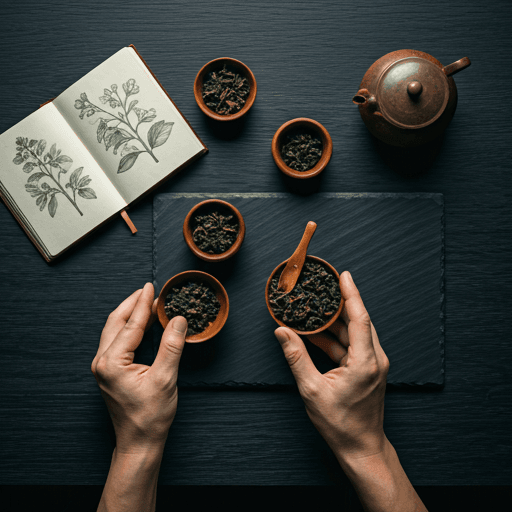
Oolong vs jasmine tea is a comparison between two things that are not really the same category. Oolong is a type of true tea defined by how the leaf is processed — a partial oxidation that lands it between green and black tea. Jasmine tea is a scented tea: a base leaf, most often green, that has been perfumed with jasmine blossoms until it drinks with a sweet, floral aroma. In short, oolong tells you how the leaf was made, while jasmine tells you what fragrance was added to a base.
That is why the two are not opposites and not interchangeable. One is a processing style; the other is a scenting style. Below is the short answer, a side-by-side table, and then a closer look at what each really is, how they taste, and how to brew them.
Oolong vs jasmine tea: the short answer
The difference between oolong and jasmine tea comes down to what the label is describing. Oolong names a category of leaf — one that has been partially oxidized, sitting somewhere on the spectrum between un-oxidized green tea and fully oxidized black tea. Jasmine tea names a finished, scented product — usually a green tea (occasionally a white tea or even an oolong) that has been layered with fresh jasmine flowers so it takes on a perfumed, floral lift. So oolong's character comes from oxidation, while jasmine's aroma comes from the blossoms added to whatever base was used. Neither is "better"; they simply answer different questions about the tea in your cup.
Oolong vs jasmine tea at a glance
If you only remember one line, make it this: oolong is a how it was processed tea, and jasmine is a what it was scented with tea. Here is the quick decoder.
| Attribute | Oolong | Jasmine tea |
|---|---|---|
| What it is | A type of tea defined by partial oxidation | A scented tea — a base leaf perfumed with jasmine blossoms |
| Category | A processing style (green-to-black spectrum) | A scenting style layered onto a base |
| Base leaf | Camellia sinensis, partially oxidized and often rolled or roasted | Usually a green tea; sometimes white or even an oolong |
| Where the flavor comes from | Oxidation, rolling and sometimes roasting | The base tea plus added jasmine aroma |
| Taste | Floral-and-creamy to toasty-and-dark | The base tea's character plus a sweet, perfumed floral lift |
| Caffeine | Moderate, varies | Depends on the base, usually a moderate green, varies |
| Water temperature | Hot, roughly 85-95 C | Cooler for a green base, roughly 75-85 C |
| Re-steeps | Many — built for multiple infusions | A few, depending on the base |
| Origin | Chinese in origin, also famous in Taiwan | Chinese in origin |
| Best for | A complex, oxidation-driven cup you can re-steep | A fragrant, floral, aromatic cup |
Prefer more than a table? Read on — the distinction is easy to grasp once you see what each word is actually describing.
What oolong is
Oolong is a partially oxidized true tea, made from the same plant, Camellia sinensis, that gives us green, white and black tea. What sets it apart is where the tea maker stops oxidation. After withering, the leaves are bruised — tossed, shaken or rolled — which kicks off oxidation, and that process is allowed to run only part of the way before heat "fixes" the leaf. Because a maker can halt it anywhere along the line, oolong is less a single flavor than a whole spectrum: a light, green oolong can be barely oxidized and close to a green tea, while a dark, roasted one can be heavily oxidized and closer to a black tea.
Many oolongs are then rolled into tight beads or long twists, and some are roasted, adding another layer of aroma and body. That range and complexity is exactly why oolong is prized, and why the same leaves can be re-steeped many times, each infusion revealing something new. This piece keeps the focus on the comparison, so for the full portrait — the styles, the regions and the processing in depth — see our guide to oolong tea explained.
What jasmine tea is
Jasmine tea is not a type of leaf at all — it is a scenting method. Producers take a finished base tea and layer it with fresh jasmine blossoms, traditionally overnight, so the tea slowly absorbs the flower's fragrance. The blossoms are often removed after scenting (sometimes repeated over several nights for a stronger aroma), and what you brew is tea leaves carrying a sweet, heady, floral perfume rather than a cup full of petals.
The base is most often a green tea, which is why many people mentally file jasmine tea under "green." But the base can also be a white tea for a more delicate result, or occasionally an oolong for a rounder one. So the character of any jasmine tea depends on two things stacked together: the base leaf and the jasmine scenting on top. For the full story on how it is made and the styles you will find, see our explainer on jasmine tea; if you are curious about the wellness angle specifically, our overview of jasmine tea benefits covers that side.
The key difference: a processing category vs a scenting style
Here is the heart of the jasmine tea vs oolong question. Oolong is a processing category — it tells you the leaf has been partially oxidized. Jasmine tea is a scenting style — it tells you a base leaf has been perfumed with jasmine. They live on different axes entirely, which is why comparing them is a little like comparing "roasted" with "vanilla-flavored": one describes how something was made, the other describes an aroma added to it.
Everything else flows from that. Oolong's flavor is built in during production, through oxidation, rolling and roasting. Jasmine tea's defining aroma is added afterward, from the blossoms, and its underlying flavor is simply whatever base was used. This is the single most important thing to understand about the difference between oolong and jasmine tea: one is a way of processing the leaf, the other is a way of perfuming a leaf that has already been processed.
The overlap: is jasmine tea an oolong?
Usually no — but here is where the two categories touch. Because "jasmine tea" only specifies the scenting and not the base, you can absolutely find a jasmine oolong: an oolong leaf that has been scented with jasmine flowers. In that case a single tea is both an oolong (by processing) and a jasmine tea (by scenting) at the same time. So "is jasmine tea an oolong?" has no fixed answer: most jasmine teas use a green base, a smaller number use white, and some do use oolong. The categories are not mutually exclusive — they can overlap in the same cup. It is a helpful reminder that these two words are answering different questions rather than competing for the same slot.
How they taste
Side by side, the taste contrast is really a contrast of range versus signature. Oolong covers a lot of ground: a light, rolled oolong can be creamy, buttery and intensely floral, with orchid or lilac notes; a darker, roasted oolong turns toasty, nutty and rich, sometimes with stone fruit, honey or roasted grain. It generally has real body and a long, evolving finish, and it is a tea you can sit and analyze cup after cup.
Jasmine tea, by contrast, has a clear signature: whatever the base tastes like, plus a sweet, perfumed jasmine lift on top. With the usual green base you get a soft, grassy, gently vegetal cup lifted by that unmistakable floral fragrance — aromatic and refreshing, leaning sweet. Where oolong asks you to explore a spectrum, jasmine tea offers a consistent, fragrant, floral experience. If you enjoy the floral, greener end of oolong and want to see how that side compares with a plain green tea, our guide to oolong vs green tea maps that out.
Caffeine: both moderate, both variable
Both teas tend to sit in the moderate range for true tea, generally below a cup of coffee, but the honest answer is that it varies. Oolong's caffeine depends on the specific leaf, the harvest and — most of all — how you brew it. Jasmine tea's caffeine depends on its base: a green-based jasmine tea usually lands in the moderate green-tea range, while a white or oolong base shifts it a little. In both cases, hotter water, more leaf and a longer steep pull out more caffeine, so brewing method moves the needle more than the label does.
Treat any number you read as a rough guide rather than a promise, since leaf, grade and steeping all change the result. Responses to caffeine vary from person to person, and this is general information, not medical advice — if caffeine, sleep, pregnancy or medications are a concern for you, go by how you feel and check with your own healthcare provider.
How to brew each
The processing difference carries straight into the teapot. Oolong generally likes it hot — roughly 85-95 C, and some darker, roasted styles take water close to boiling — which coaxes out its aromatics. Oolong also shines with multiple short infusions: the same leaves can be re-steeped several times, and rolled oolongs in particular unfurl and reveal new layers with each pour, especially brewed gongfu style with a small pot and plenty of leaf.
A green-based jasmine tea wants gentler treatment, much like the green tea underneath it. Cooler water, roughly 75-85 C, and a shorter steep keep it sweet and floral rather than bitter, since a green base scorched with boiling water can turn harsh and lose its delicate perfume. A jasmine tea built on a white or oolong base can take a slightly different approach, so let the base guide you. These temperatures are starting points, not rules — the specific leaf, your kettle and your taste all move the target, so adjust and taste as you go.
Oolong or jasmine tea: which should you choose?
Choosing oolong or jasmine tea really comes down to what you are in the mood for. Reach for oolong when you want range and depth — a complex, oxidation-driven cup you can re-steep and tune from floral-and-green to dark-and-roasty depending on the leaf you pick. Reach for jasmine tea when you want fragrance and comfort — a soft, sweet, floral cup whose aroma fills the room before you even sip. Many tea drinkers keep both around and let the moment decide: oolong for a slow, contemplative session, jasmine for an easy, aromatic everyday brew. And if you want the best of both, remember that a jasmine oolong exists precisely so you do not have to choose.
The bottom line
Oolong and jasmine tea are not rivals so much as answers to different questions. Oolong describes a leaf that has been partially oxidized, giving it a broad spectrum of flavor from creamy-floral to toasty-dark. Jasmine tea describes a base leaf — usually green — that has been perfumed with jasmine blossoms, giving it a signature sweet, floral aroma on top of whatever it started as. One is about how the leaf was made; the other is about the fragrance added to it. Understand that, and the two stop competing and simply take their places on your shelf — one for depth, one for perfume, and sometimes, in a jasmine oolong, both at once.