
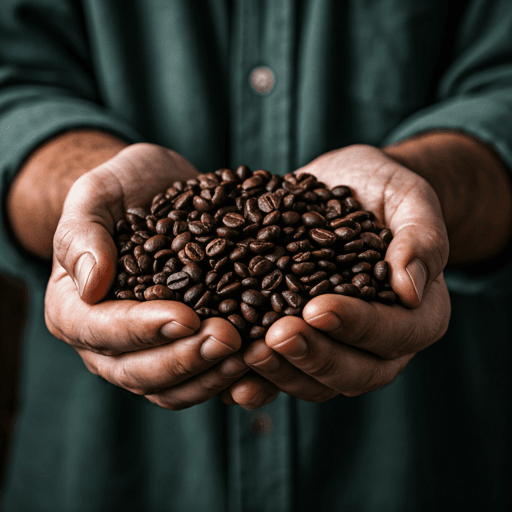
The mokka coffee variety is a dwarf arabica plant commonly described as producing the smallest seeds of any arabica in commercial cultivation — and it is a plant, not a drink. Mokka the variety is not the mocha beverage built from espresso and chocolate, not the moka pot that sits on a stovetop, and not Mokha, the Yemeni port whose name all three borrowed. Four different things share one root word, and mixing them up is the most common error made about this coffee.
What earns Mokka a page of its own is physical. Its seeds are so small and so round that buyers regularly mistake a clean, perfectly ripe Mokka lot for underdeveloped coffee, for screened-out smalls, or for a bag of peaberries. Almost everything else worth knowing about the variety — the sorting headaches, the way it behaves in a roaster, the reason plantings stay small — follows from that single trait.
What the mokka coffee variety actually is
Mokka — also spelled Mocca, and occasionally Moka — is a compact, densely branched arabica with narrow leaves, small cherries and very small round seeds. In its dwarf form it is usually described as growing to roughly waist-to-shoulder height, closer to a hedge than a tree, against the height an unpruned Bourbon will reach. Hawaiian growers and specialty writers have long described it in the same terms: a low-yielding dwarf mutation associated with Bourbon that produces the smallest beans of any arabica.
Two honesty notes belong here, up front. First, the public record on this variety is thin and partly contradictory. It is a specialty-trade name with a well-established set of descriptions but no single authoritative technical entry behind it. The World Coffee Research arabica variety catalog — the closest thing the sector has to a shared reference, covering Typica, Bourbon, Caturra, Catuai, Pacamara, SL28, SL34 and dozens more — carries no Mokka, Mocca or Moka entry at all. That absence does not mean the plant is fictional; it means the agronomic data most varieties can be checked against simply has not been published for this one. Treat any confident figure you see for Mokka's yield, altitude ceiling, planted area or disease ratings with suspicion, because there is nothing public to check it against.
Second, a variety name on a bag is not a quality grade. "Mokka" tells you something real about seed size and plant habit. It tells you nothing about ripeness at picking, drying discipline, storage or roast. A poorly picked Mokka is a poorly picked coffee.
At a glance
| Attribute | What is generally reported | Confidence |
|---|---|---|
| Plant habit | Dwarf, very bushy, narrow leaves; a taller Hawaiian form also exists | Widely and consistently described |
| Seed size | Exceptionally small and round; growers describe lots rarely exceeding screen 14 | Consistently described, not independently measured in public data |
| Cherry size | Small, matching the seed | Consistently described |
| Yield | Low | Universally described, never quantified in any public source |
| Harvest | Slow and awkward by hand — small cherries on dense branching | Reported by growers, not measured |
| Disease resistance | No documented resistance to leaf rust or coffee berry disease; treat it as susceptible | Nothing published either way |
| Lineage | Most often described as a Bourbon-side dwarf mutation; Brazilian, Ethiopian and Yemeni routes all circulate | Disputed — see below |
| Where grown | Best known from Maui, Hawaii; scattered small plantings elsewhere | Documented for Hawaii, anecdotal elsewhere |
Seed size is the defining trait — and the whole story
Coffee is sorted by screens: perforated plates whose holes are measured in sixty-fourths of an inch. Screen 18 is about 7.1 mm across, screen 16 about 6.4 mm, and a great deal of specialty arabica is bought as 16-up or 17-up. Growers of Mokka consistently describe lots that rarely exceed screen 14 — roughly 5.6 mm — and specialty review coverage has reached for the same image from the other direction, calling them "tiny, split-pea-like beans." Roasters handling Hawaiian Mokka alongside other varieties on the same farm have described it arriving two to three screen sizes below everything else in the mill.
Two or three screens does not sound dramatic until you remember what a screen is: a threshold. A whole variety sitting below the usual threshold means every downstream tool calibrated for normal arabica is calibrated wrong.
The seeds are also round rather than the usual flattened oval, which is what generates the most persistent confusion at the green desk. Mokka is repeatedly mistaken for peaberry — the single rounded seed that forms when only one of a cherry's two ovules develops. The distinction matters and it is easy to check: Mokka seeds are small and rounded but still carry the flat face and centre cut of a normal two-seed cherry, so a Mokka lot is a whole small-seeded variety, while a peaberry lot is a sorted fraction pulled out of an otherwise ordinary one.
What tiny seeds cost: sorting, grading and screening out
The first cost lands in the mill. Grading systems in many producing countries build minimum screen sizes into their export grades, so a coffee that sits below screen 15 can be pushed toward a lower grade on geometry alone — regardless of how carefully it was picked or dried. A Mokka lot run through a standard screening set-up can end up substantially in the reject or "smalls" stream, with the plant's normal, healthy seeds treated as defect-adjacent material.
The second cost lands in density and colour sorting. Gravity tables and optical sorters are set for a target bean profile. Feed them a seed that is small, round and unusually dense and the settings that protect a Typica lot will happily eject a Mokka one. Re-tuning a whole line for a small volume of coffee is a real disincentive at a mill handling many growers.
The third cost is the mixed-lot problem. If a farm interplants Mokka among larger-seeded varieties and mills them together, the result is a bimodal screen distribution — a wide spread of bean sizes in one bag — and that is a defect from a roasting point of view even when every individual seed is sound. Growers who take Mokka seriously keep it separate from the tree onward. That separation, not the variety name, is what makes a clean lot possible.
Roasting a small, dense seed
Small seeds heat faster than large ones for a simple geometric reason: as a bean gets smaller, its surface area falls more slowly than its mass, so there is proportionally more surface for heat to enter through and a shorter distance to the centre. A profile built for screen 17 coffee, applied unchanged to a screen 13 or 14 Mokka, will usually run the surface ahead of the core development you were aiming for — colour arriving early, the roast reading darker than it has actually developed.
Density pulls the other way. Mokka is generally described as a dense seed, and dense seeds resist heat penetration and tolerate more energy early on. The practical consequence is that Mokka is unforgiving rather than simply fast. It wants its own profile, not a scaled version of someone else's, and colour is a less reliable guide than usual because the reference points in a roaster's memory were formed on bigger beans.
Two habits help. Judge by time and temperature milestones rather than by eye, because a very small bean looks further along than it is. And do not put Mokka through the drum inside a mixed-screen batch expecting an even result — roast it on its own, or accept that something in the batch will be under- or over-done. A worked example makes the trap concrete: take a profile that reliably drops a screen-17 washed lot a little over four minutes after the start of first crack, run a screen-13 Mokka on the same gas and airflow settings, and first crack tends to arrive earlier and quieter, the surface darkens ahead of schedule, and dropping on the familiar colour cue lands the roast short on development. The fix is to plan the profile around the milestone times you want and let colour be the last thing you consult, not the first.
Why the plantings stay small
Every grower account of this variety converges on the same two words: low yield. Specialty review coverage calls it an "extraordinary, low-bearing variety," and the description is echoed everywhere the plant appears. Small cherries on a compact bush mean less coffee per tree, and Mokka does not compensate with volume the way a Caturra does. The public record never quantifies this — no reliable published yield figure exists — but the qualitative agreement is unusually consistent.
Harvest labour is the second constraint, and it compounds the first. Small cherries held on dense branching are slow to strip by hand, so a picker moves through a Mokka row far more slowly than through a conventional one and comes away with less weight for the same time spent. Reports from Colombian growers who have worked with Hawaiian-sourced Mokka seed add a further wrinkle: the trees there are said to have grown taller than expected, pushing much of the cherry high into the canopy and making picking harder still, with grafting onto more compact rootstock offered as the response. Those reports are grower accounts rather than published trial data, and should be read that way. Either way, the ceiling on Mokka's spread is not really agronomy or climate — it is the arithmetic of a slow pick.
There is no published evidence that Mokka carries resistance to coffee leaf rust or coffee berry disease. Absent that evidence, the safe assumption for a grower is that it is as susceptible as any traditional arabica, and it should be sited and managed accordingly.
Lineage: what is documented and what is claimed
This is where the record gets genuinely tangled, and the honest answer is that the sources disagree with one another.
- The Bourbon-side dwarf mutation account. The most common technical description holds that Mokka is a dwarf mutant on the Bourbon side of arabica, in the same broad family of spontaneous compact mutations that produced other short-statured arabicas. For that parent's own story, see our Bourbon coffee variety guide.
- The Brazilian route. Specialty review coverage describes the Hawaiian material as having reached Kaanapali on Maui by way of Brazil, derived from very old varieties still grown in parts of Yemen. This is the most frequently repeated route in print, and it is still a route, not a pedigree.
- The Ethiopian seedstock account. Hawaiian growers have also described their Mokka seed stock as Ethiopian in origin, pointing to the narrow leaves and small seeds as consistent with that. It sits alongside the Brazilian account rather than replacing it.
- The Yemeni-heritage assumption. Much popular writing simply traces the plant to Yemen because of the name, and that reasoning is backwards. It needs saying plainly: Mokka the variety and the coffee historically shipped from the port of Mokha under the "Mocha" trade name are not the same thing. "Mocha" in that sense was a shipping designation covering many Yemeni landraces, not a single plant, so the link to Mokka the variety is a naming one. Some sources do claim an ancestral Yemeni derivation reaching Hawaii indirectly, but no verified pedigree supports it.
The Hawaiian story adds a further twist that most sources accept: at some point a Mokka plant crossed with Typica, producing a taller tree that keeps the small cherries, narrow leaves and tiny seeds. That taller form is what has been grown commercially on Maui, which is why Hawaiian Mokka is often described as a tree rather than the dwarf hedge the name implies. Accounts of exactly how the material arrived differ — one traces Maui plantings back to a single tree at a Hawaii research station holding Brazilian material from the mid-twentieth century, another to university field trials — and we are not in a position to adjudicate between them. No breeder, no release year and no verified parentage should be quoted as settled fact.
A low-caffeine claim also circulates, usually by analogy with another famous dwarf. It is not established for Mokka. No published measurement of caffeine content in this variety appears in the public record, and the writers who have raised the comparison have themselves flagged it as uncertain. Treat "Mokka is naturally low in caffeine" as an unverified claim.
Mokka is not mocha, moka, or Mokha
Worth restating, because the four terms will keep colliding for as long as coffee is sold. Mokka, also spelled Mocca or Moka, is a plant — a variety of coffee tree. Mocha is a drink. A moka pot is a stovetop brewer. Mokha is a port on Yemen's Red Sea coast that was the hub of the early coffee trade and lent its name to the other three; that history belongs to our Yemeni coffee guide rather than to this page. The practical test is where the word appears. In the variety field on a bag of green or roasted coffee, it means the plant. On a café menu, it means the drink. On a shelf of brewing equipment, it means the pot.
Where Mokka is actually grown
The centre of gravity has long been Maui, on former West Maui plantation land converted to coffee from the 1990s onward, where Mokka became the island's signature variety and the best-known commercial source of it anywhere. That production has not been stable: the 2023 wildfires on West Maui disrupted the area badly, and the availability of Hawaiian Mokka should not be assumed from older writing about it. The wider Hawaiian picture, including Kona and the other islands, is covered in our Hawaiian coffee guide. Beyond Hawaii, Mokka appears only in small experimental and microlot plantings — Colombian growers have worked with Hawaiian-sourced seed, and occasional lots surface from other Latin American origins. Nowhere is it a volume crop, and nowhere outside Hawaii is it a settled part of the local variety mix.
How it compares with its dwarf and Bourbon relatives
| Trait | Mokka | Laurina | Bourbon |
|---|---|---|---|
| Stature | Dwarf and bushy; a taller Typica-influenced form on Maui | Short, conical | Tall if unpruned |
| Seed | Very small, round, dense | Small, pointed and angular | Normal arabica size and shape |
| Yield | Low | Low | Moderate |
| Caffeine | Low-caffeine claims are unverified | Documented well below normal arabica | Normal |
| Record quality | Thin; no entry in the main variety catalog | Studied, including genetic work | Extensively documented |
The useful contrast is with the other famous low-yield curiosity, the Laurina coffee variety. Both are compact, both are stubbornly unproductive, both survive on reputation rather than agronomics. The difference is documentation: Laurina has been genetically characterised and its reduced-caffeine trait measured, while Mokka's paper trail is largely commercial. When someone tells you the two are "basically the same thing," what they mean is that each is a dwarf arabica kept alive by curiosity — a shared category, not evidence of a relationship.
What it tastes like, honestly
Descriptions converge on a heavy, syrupy body, deep cocoa and dried-fruit character, warm spice, and a soft rather than piercing acidity. Dry-processed lots have drawn more polarised notes: specialty reviewers have described fermented fruit character that reads sweet and floral but also markedly astringent, which is a fair warning that the processing decision drives a lot of what ends up in the cup. Growers working with long fermentations report bright fruit and malt-and-brown-sugar sweetness, which again says as much about the process as the plant.
Two caveats. The body is the most consistently reported trait, and it is genuinely unusual for a seed this small. And the cocoa note has a circular problem attached: people expect chocolate from anything called Mokka, which makes that descriptor unusually prone to suggestion. Be sceptical of your own palate here, and be equally sceptical of competition results quoted as a property of the variety — a placing belongs to a specific lot from a specific farm in a specific year, never to a variety as a category.
The bottom line
Mokka is a dwarf arabica defined by one thing: seeds small enough to break the assumptions built into grading screens, sorting equipment and roast profiles. That trait is also its ceiling — low yield and slow picking keep plantings tiny, and no published agronomic record exists to make a case for expanding them. Approach it as a curiosity with an unusually heavy body for its size, roast it on its own terms rather than a borrowed profile, and remember that the name carries three unrelated coffee meanings before you ever reach the plant.