
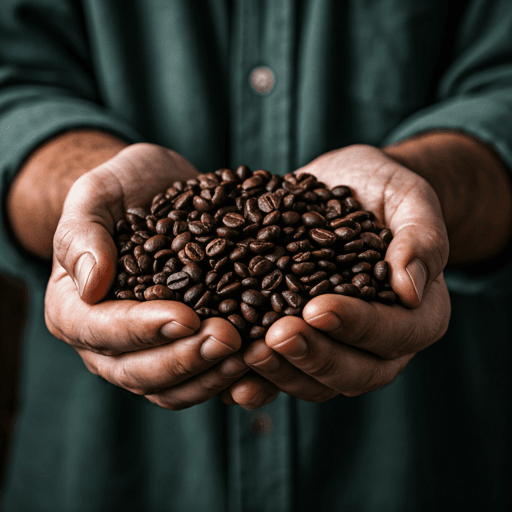
The mibirizi coffee variety is an old arabica selection named for the Mibirizi mission area in south-western Rwanda, and it is one of the two workhorse plants standing behind more than a century of Great Lakes coffee. It has been bought, sold and labeled as a Bourbon for generations. The genetics disagree: World Coffee Research's variety catalog places Mibirizi in the Bourbon-Typica group as Typica related, not on the Bourbon side. That single mismatch is the most interesting thing about the plant, and it is what this page is about.
None of this makes Mibirizi rare or exotic. It is the opposite: a durable, unglamorous, rust-prone survivor that smallholders across Rwanda, Burundi and the eastern Democratic Republic of Congo have been picking for generations, usually without the name ever reaching a bag.
What the mibirizi coffee variety actually is
Mibirizi (also written Mbirizi) is a traditional arabica selection rather than a modern bred cultivar. There is no release year, no breeding program record and no named breeder to credit, because nobody bred it in the sense that Catimor or Ruiru 11 were bred. It is old field material that was multiplied, distributed, and eventually given the name of the place it was distributed from.
That distinction matters when you read variety lists. Modern cultivars come with paperwork: a cross, a generation, a research station, a release date. Mibirizi comes with an oral history and a genetic classification, and the two do not tell quite the same story. World Coffee Research itself opens its entry by noting that the origin of Mibirizi is poorly documented. Anyone who quotes you a precise introduction year, a mission founding date or a percentage of national plantings for Mibirizi is filling in blanks the public record does not fill.
The name marks a place of multiplication, not a person
Mibirizi is a mission area in south-western Rwanda, in the hills inland of Lake Kivu, in what is now the Rusizi area near the Burundian and Congolese borders. The commonly repeated account is that coffee seed introduced under the German colonial administration was handed on to Rwandan Catholic missions, and that Mibirizi was one of the stations where those trees were planted and multiplied for onward distribution to farmers.
So the variety carries a toponym. Mibirizi is not named after a breeder, a farm or a cross; it is named after the seed's address. That is a common pattern in African coffee naming and it is the single most useful thing to understand about it, because it means the name records a distribution channel rather than a genetic identity. Whatever was growing at Mibirizi and went out to farmers became "Mibirizi", regardless of what was actually in the seed lot.
Which is exactly why the lineage is murky. A place-name variety is only as genetically tidy as the nursery it came from, and mission nurseries a century ago were not running isolation blocks.
Documented, claimed and disputed: the Typica surprise
This is the part worth reading slowly, because the internet flattens it into confident one-liners in both directions. Here is the honest breakdown of what can be said, and with how much confidence.
| Claim | Status | What can actually be said |
|---|---|---|
| Mibirizi groups with Typica-related material | Documented | World Coffee Research's variety catalog classifies Mibirizi within the Bourbon-Typica group and describes it as Typica related. That is a classification from genetic testing rather than a story handed down. |
| It came from Guatemalan material introduced under the German administration and passed to Catholic missions | Claimed, and plausible | The account is attributed to the Belgian colonial-agriculture writer Edmund Leplae and is repeated in the WCR entry: material referred to simply as "Guatemala" was introduced in the 1910s and distributed to Rwandan missions in the following decade. Guatemala's plantings at that time are described as overwhelmingly Typica, which is why this route and the genetic classification agree with each other. It remains an attributed account, not a proven pedigree. |
| Mibirizi is a natural mutation of Bourbon | Disputed, and probably folklore | Widely repeated in origin write-ups and on packaging. It is not supported by the published classification, and it is best read as a legacy of trade shorthand rather than as botany. |
| Field populations later mixed with Bourbon-lineage material | Claimed, and very likely | WCR states it is very likely that Mibirizi plants were subsequently mixed with French Mission plants of Bourbon lineage introduced from Kenya. Either way, a century of farmer-saved seed in interplanted smallholdings does not preserve clean populations. |
| An introduction year for the variety as such, a mission founding date, a yield figure, a hectare count or a cup score | Not established | Numbers of this kind circulate freely and disagree with one another. Treat any precise figure as unsourced unless it names where it came from. |
The clean summary: the genetics point to Typica, the most-repeated history points to a Typica-planted country as the source, and the trade name points to Bourbon. Two of those three agree, and the odd one out is the commercial label.
As for why a Great Lakes bag says "Bourbon" at all, that is a whole argument about how the word works as a family label rather than a plant identity, and it belongs to our Jackson variety explainer, which makes the case in full. One line here is enough: on a Rwandan or Burundian bag, "Bourbon" is usually a category, not a claim about a specific tree. If you want the underlying botany of the two lineages themselves, they have their own pages: Typica and Bourbon.
Mibirizi at a glance
| Attribute | Mibirizi |
|---|---|
| Type | Traditional arabica selection, not a modern bred cultivar |
| Genetic group | Bourbon-Typica group, classified as Typica related |
| Named for | The Mibirizi mission area, south-western Rwanda |
| Stature | Tall |
| Leaf tip color | Green or bronze |
| Bean size | Large |
| Yield potential | Medium to low |
| Optimal altitude | High: broadly above about 1,600 m near the equator, and above roughly 1,300 m at higher latitudes |
| Typical planting density | Around 1,000 to 2,000 trees per hectare under single-stem pruning |
| Quality potential at high altitude | Rated exceptional in the WCR catalog |
| Coffee leaf rust | Susceptible, with no meaningful resistance |
| Coffee berry disease | Susceptible |
| Nematodes | Not established |
| Nutrition requirement | Low; described as tolerant of low-input management |
| First production | Around year three |
| Where grown | Rwanda and Burundi in the catalog; also reported in eastern DR Congo |
How Mibirizi behaves in the field
Mibirizi is a tall tree with the open, upright architecture typical of old arabica selections, and it is planted at the wide spacing that stature demands: roughly a thousand to two thousand trees per hectare under single-stem pruning, against the far denser hedges that compact cultivars allow. Tall stature also means bending branches or reaching at harvest, and more ground per tree.
Productivity is honest rather than impressive. The catalog rating is medium to low, and the plant first produces around its third year. What it offers instead of yield is toughness. It is described as resilient under low management and adverse conditions, with a low nutrition requirement and reasonable drought tolerance: the profile of a tree that keeps going on a smallholding where fertilizer is intermittent and pruning happens when there is time. Bean size is large, which matters commercially, because Great Lakes coffee is screen-graded and large beans sort into the top grades.
The critical agronomic fact, and the one most often left off marketing copy: Mibirizi has no disease resistance worth the name. It is susceptible to coffee leaf rust and susceptible to coffee berry disease. It survives in the region largely because Great Lakes coffee sits high, much of it between roughly 1,400 and 2,000 m, and cool high-altitude conditions suppress rust pressure far more effectively than any trait this plant carries. Push the same tree down the hill into warmer, wetter air and it will show you exactly how little protection it has. Where rust and berry disease pressure rises, the answers available are cultural management, fungicide programs and replanting with resistant material, never the variety itself.
The trade-off is the familiar one across old arabica selections: susceptibility and modest yield bought with high-altitude cup quality. WCR rates Mibirizi's quality potential at high altitude as exceptional, which is the reason it has not been replaced everywhere despite the agronomics.
What Mibirizi tastes like, honestly
Two honest statements have to sit side by side here.
The first is that Mibirizi is part of the flavor signature people recognize as Great Lakes washed coffee: clean, high-toned citric acidity, an orange-to-red-apple sweetness, a rounder and juicier body than the acidity leads you to expect, and floral or black-tea top notes in the best lots. Descriptions of the variety specifically tend to emphasize delicate floral aromatics and a silky, honeyed sweetness. That profile is real, and Mibirizi trees are a large part of what produces it.
The second is that almost none of it is attributable to the variety alone. Great Lakes coffee is a washing-station system. Cherry from hundreds or thousands of small farms is delivered, floated, sorted, depulped, fermented, washed, graded in channels and dried on raised beds as one lot. The station's fermentation discipline, its water, its drying protocol, its altitude band and its cherry-sorting standards all leave larger fingerprints on the cup than the difference between Mibirizi and the Bourbon-lineage trees standing next to it. Separated single-variety Mibirizi lots exist, but they are the exception, produced deliberately because someone asked for them.
So the fair claim is this: Mibirizi is capable of an outstanding, sweet, citric, clean cup at altitude, and it contributes to a regional profile. But if a bag promises a specific flavor because the coffee is Mibirizi, that is a marketing sentence, not a technical one. For how the regional cup character actually gets built, our guide to Rwandan coffee covers the growing regions and the station system in detail.
Where it is actually planted today
Mibirizi is a Great Lakes plant and essentially nowhere else. WCR's catalog names Rwanda and Burundi, where it is grown by smallholders and is described as likely the oldest variety still in the ground in Rwanda. It is also commonly reported in the Kivu provinces of eastern DR Congo, which shares the region's varietal history: the well-maintained Mibirizi population in western Rwanda is described as the source for introducing Mibirizi seed into the germplasm collection at Mulungu in DR Congo, which is one reason the variety lists across the three countries look so alike.
It rarely stands alone. In practice Mibirizi trees are interplanted with Bourbon-lineage material, Bourbon Mayaguez and Jackson selections being the usual companions, often in the same plot and sometimes in the same row, planted at different times by different generations of the same family. When the cherry reaches the washing station it is pooled. The station lot, not the tree, is the traceable unit, and the variety line on a spec sheet is very often an honest approximation reading something like "Bourbon, Mibirizi, Jackson" rather than a measured composition.
One naming trap is worth flagging. There are washing stations and localities in the region that carry the name Mibirizi or Mbirizi as a place. A bag reading "Burundi Mbirizi" may be telling you which station wet-milled the coffee, not which variety was picked. Read the spec sheet, not the front label.
How Mibirizi compares with its neighbors in the plot
| Attribute | Mibirizi | Bourbon Mayaguez | Jackson |
|---|---|---|---|
| Genetic group (WCR) | Typica related | Bourbon related | Bourbon related |
| How it reached the region | Attributed to Guatemalan material distributed via missions; poorly documented and hedged | Believed route from Central America through the collection at Mayaguez in Puerto Rico, then Mulungu in DR Congo, then Rwanda around the 1950s | An early twentieth-century selection that reached East Africa in the 1920s; the onward route into Rwanda is not well documented |
| Stature | Tall | Tall | Tall |
| Yield potential | Medium to low | Described as vigorous and productive | Reported as high |
| Leaf rust | Susceptible | Susceptible | Susceptible |
| Usually sold as | "Bourbon", or unnamed | "Bourbon" | "Bourbon" |
The row that does the work is the first one. Three varieties that share a region, a stature, a vulnerability and a commercial label do not share a lineage. Mibirizi is the outlier, and it has been hiding in plain sight under another family's name for as long as the region has exported coffee.
A variety name on a Great Lakes bag is local history, not a quality grade
This is the practical takeaway. In the Great Lakes, variety names encode where seed came from and who handed it out: a mission, a research collection, a colonial administration. They are historical records. They are not quality tiers, and they are not reliable predictors of what is in the cup, for three reasons.
- Populations are mixed. A century of farmer-saved seed in interplanted smallholdings means "Mibirizi" on a farm today may be a population rather than a pure line.
- Lots are pooled. The washing station, its day lot and its drying discipline determine most of what you taste.
- The label is loose. "Bourbon" on a Rwandan or Burundian bag is a habit of trade, and Mibirizi is the clearest proof that the habit is imprecise.
None of that is a reason to ignore variety information. It is a reason to read it as context, meaning this coffee comes from a region with old, tall, rust-susceptible trees grown high, rather than as a promise about the cup.
The bottom line
Mibirizi is the Great Lakes' quiet survivor: an old, tall, large-beaned, fully rust-susceptible arabica selection named after the mission area that multiplied and distributed its seed, capable of an exceptional cup when it is grown high and processed carefully, and sold for generations under a family name the published classification says is not its own. The documented part is the Typica-related grouping. The plausible part is the Guatemalan route through mission channels, which fits that grouping neatly. The confident claims, a mutation of Bourbon, a specific introduction year, a share of national plantings, are the parts to treat with skepticism. If a separated Mibirizi lot from a strong station at altitude comes your way, read it first as a coffee made by that station and that elevation, with a tree behind it that has been carrying somebody else's name for a very long time.