
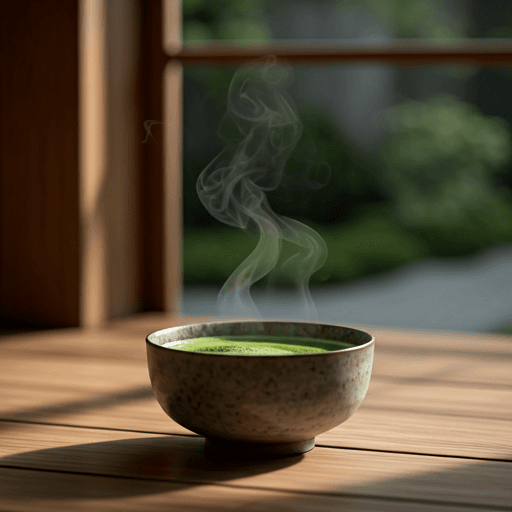
A matcha whisk, or chasen, is a single piece of bamboo carved into dozens of fine, springy prongs that break up clumps and aerate matcha into a smooth, lump-free, gently frothy bowl. If you want cafe-quality matcha at home, this humble tool does more for texture than anything else in the kit. This matcha whisk guide covers what a chasen actually is, how prong count changes the foam, how to whisk properly, how to care for the bamboo so it lasts, and what a typical matcha whisk set includes.
We will keep the focus on the whisk itself. For the full spread of gear — the bowl (chawan), scoop (chashaku), and sifter — see our companion matcha set essentials guide, and for the drink step by step, our how to make matcha walkthrough.
What is a matcha whisk (chasen)?
The chasen is a traditional Japanese tea utensil carved from one node of bamboo. The lower half is the handle; the upper half is split into a fan of thin, curled tines that taper to whisker-fine tips. Because matcha is stone-ground whole tea leaf rather than something you steep and strain, that powder wants to clump and float — a wet lump on top, a gritty layer at the bottom. The many flexible prongs of a bamboo matcha whisk cut through the powder and lash tiny air bubbles into the liquid, producing the even suspension and soft crema-like foam that define a well-made bowl.
No glue, screws, or joints are involved: a good chasen is cut from a single piece of bamboo, which is part of why it flexes as one springy unit and why it is treated as a consumable that wears out over months of use rather than a forever tool. You will see them made from pale white bamboo (the most common), smoked or soot bamboo, and darker purple bamboo (kurochiku); the color is largely aesthetic and does not change how it performs.
Prong count: how many tines does a matcha whisk need?
Prong count is the spec people obsess over, and it genuinely affects the foam. Chasen range from roughly 16 tines up to 120 or more, and the rule of thumb is simple: more prongs mean finer, faster, more stable foam with less effort, while fewer prongs give a looser, thicker mix.
- 16 to 30 prongs (araho, or "coarse-prong"): stiff and sparse, built for thick, paste-like koicha matcha where you knead rather than froth. Not the everyday choice for most people.
- 70 to 80 prongs: a solid, slightly firmer whisk that handles thin everyday usucha and copes better with thicker preparations too.
- 80 to 100 prongs (kazuho or "hundred-prong"): the versatile all-rounder. This is the sweet spot most guides recommend for a first whisk — enough tines for a smooth, well-aerated bowl of thin matcha, without being so delicate it feels precious.
- 100 to 120+ prongs: the finest, whippiest foam with the least arm work, but the tips are more fragile and the whisk usually costs a little more.
If you are buying one chasen and mostly drinking lattes and thin matcha, an 80-to-100-prong kazuho is the safe default. You do not need to chase the highest number on the shelf — beyond about 100 tines you are paying for marginal refinement and a slightly more delicate tool.
Bamboo chasen vs. the alternatives
A bamboo whisk is the classic answer, but it is not the only way to mix matcha. Each option trades foam quality for convenience or durability. Note that costs below are relative and qualitative — a chasen is an inexpensive kitchen item, not an investment.
| Whisk type | Foam quality | Effort | Care | Relative cost |
|---|---|---|---|---|
| Bamboo chasen | Finest, most even microfoam; the traditional benchmark | Moderate — a brisk 15 to 30 seconds by hand | Soak, rinse, air-dry on a stand; wears out over time | Low to moderate |
| Handheld electric frother | Good, but bubblier and coarser than bamboo | Low — the motor does the work | Wipe the wand clean; needs batteries or charging | Low to moderate |
| Spring / coil (flat) whisk | Decent and consistent; less refined than a chasen | Moderate | Durable metal; rinse and air-dry, hard to break | Low |
| Fork or kitchen whisk | Poor — struggles to break clumps, thin foam | High and frustrating | Dishwasher-safe | Lowest (you already own one) |
When an electric frother makes sense
A battery-powered handheld frother is the most popular shortcut: it whips a fast, foamy bowl with almost no effort and is genuinely convenient for iced matcha and lattes where you are adding milk anyway. The trade-off is a slightly larger, less silky bubble structure and a motor that eventually dies. If you are leaning toward that route — or already froth milk for coffee — our milk frother guide covers the handheld and stand options in detail. Spring whisks (a coiled metal loop on a handle) sit in between: nearly indestructible and travel-friendly, though purists find the foam less elegant than bamboo.
How to use a matcha whisk
Whisking is a wrist motion, not a stirring one, and the single most common mistake is drawing slow circles — that just chases the powder around and leaves it flat. Here is the essential technique; for the full recipe with amounts, water temperature, and sifting, follow our how to make matcha steps and the broader guide to enjoying matcha.
- Soak the tips first. Before the very first use, and briefly before each bowl, rest the prong tips in warm (not boiling) water for a minute or two. This softens the bamboo, makes the tines more flexible, and helps prevent the delicate tips from snapping.
- Start with a smooth paste. With sifted matcha and a small splash of not-quite-boiling water in the bowl, press and stir gently to work out the clumps before you add the rest of the water.
- Whisk in a "W" or "M" motion. Hold the handle lightly, keep the tines just off the bottom of the bowl, and move the whisk briskly back and forth in a zig-zag — a W or M shape — using your wrist and forearm, not big circles. Keep it fast and light.
- Finish on the surface. After 15 to 30 seconds you will see a fine, even layer of foam. Slow down and lift the whisk in a gentle circle across the top to pop the largest bubbles and leave a smooth microfoam, then draw it straight up out of the center.
Speed matters more than force. A rapid, relaxed wrist builds better foam than pressing hard, and pressing the tips flat against the bowl is a quick way to break them.
How to care for and store your chasen
A bamboo whisk is a consumable — prongs will eventually thin, splay, or break — but good habits easily double its life. The enemies are trapped moisture (mold) and prongs that dry in a splayed, misshapen fan.
- Rinse, never scrub with soap. Swish the whisk in warm water right after use to release the matcha; skip detergent, which the porous bamboo will absorb. Avoid the dishwasher entirely.
- Air-dry fully. Shake off excess water and let it dry completely in open air, tips up, before storing. Bamboo that stays damp in a drawer will mold.
- Store on a whisk stand. The best care investment is a small ceramic whisk holder called a kusenaoki. Resting the wet whisk over its dome as it dries pulls the prongs back into their outward-curling shape so they do not splay inward or clump together. It is the difference between a whisk that keeps its fan and one that goes lopsided in a month.
- Retire it gracefully. When several prongs have snapped and the foam suffers, replace the whisk. Many people keep an older, splayed chasen for stirring or cleaning duty and reserve a fresh one for drinking.
What a matcha whisk set usually includes
Because a bare whisk can splay without support, a matcha whisk set is often the smarter first purchase, and it bundles the whisk with the pieces that keep it in shape and make preparation easier. A typical set includes:
- The bamboo chasen itself, usually an 80-to-100-prong all-rounder.
- A whisk stand (kusenaoki), the ceramic dome that preserves the prong shape as the whisk dries — arguably the most valuable extra.
- A bamboo scoop (chashaku) for measuring the powder, and sometimes a small sifter to break up clumps before whisking.
- A bowl (chawan) in fuller sets, wide enough to swing the whisk without splashing.
Sets vary widely, and the bowl and scoop overlap with the wider toolkit we cover separately in the matcha set essentials guide. If you already own a suitable bowl, buying just the whisk plus a stand is a perfectly good minimalist start; the stand is the piece not to skip.
The bottom line
For the smoothest, best-textured bowl, a traditional bamboo chasen is still the tool to beat — pick an 80-to-100-prong kazuho if you are buying one, soak the tips, whisk in a fast W motion rather than a slow circle, and dry it on a ceramic stand so it holds its shape. An electric frother is a fair, low-effort substitute, especially for lattes, but the bamboo whisk is what turns clumpy green powder into the silky, lightly foamed matcha that makes the ritual worth it.