
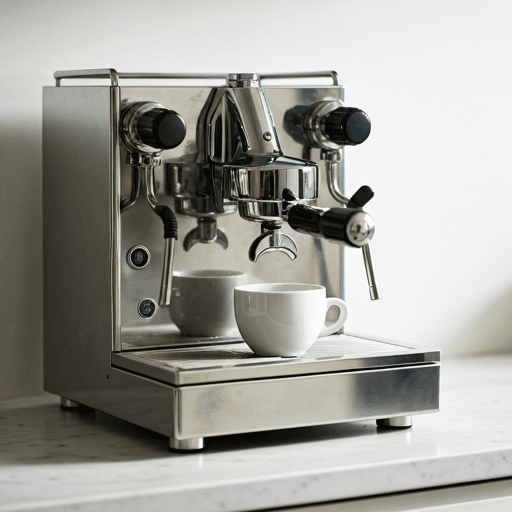
Lelit is an Italian maker of home and prosumer espresso machines whose range climbs from simple, compact single-boiler models up to the enthusiast, flow-control Lelit Bianca. If you are weighing one Lelit against another, the honest short answer is that the "best" model is the one whose boiler type and features match how you actually make coffee: espresso-only or lots of milk, one drink or several back-to-back, plug-and-play or hands-on pressure profiling. This guide walks the lineup as factual examples, explains the jargon, and lays out who each machine tends to suit, without a single ranked "best" verdict.
What is Lelit?
Lelit is a long-established Italian company that designs and builds espresso equipment aimed at the home and "prosumer" market, the enthusiast tier that sits between a cheap kitchen machine and a full commercial setup. The brand is known for solid stainless bodies, 58mm commercial-style hardware on its mid and upper machines, and its own LCC (Lelit Control Center) electronics that handle temperature, pre-infusion and cleaning routines. Rather than one flagship, Lelit offers a ladder of models so you can buy in at the level that matches your budget, your counter space and how deep you want to go into the craft.
Because the whole range shares a house style, moving up the ladder mostly means adding a more capable boiler system, more precise temperature control and, at the top, real-time control over the shot itself. If you are still deciding whether an espresso machine is even the right path, it is worth reading a general primer like our guide on how to choose an espresso machine before you focus on any one brand.
The Lelit espresso machine range at a glance
Here is the core lineup most buyers compare, from entry level to flagship. Specifications vary by version and revision, so treat these as a map rather than a spec sheet, and confirm the details of the exact model you are looking at.
| Model | Boiler type | Signature feature | Tends to suit |
|---|---|---|---|
| Anna | Single boiler | Compact footprint, PID on current versions | Beginners, espresso-first, tight counters |
| Victoria | Single boiler | 58mm group, LCC, programmable pre-infusion | Learners who want room to grow |
| MaraX | Heat exchanger (E61) | Smart dual-sensor temperature control | Milk drinkers wanting a classic café feel |
| Elizabeth | Dual boiler | Simultaneous brew and steam, very programmable | Busy households making several milk drinks |
| Bianca | Dual boiler (E61) | Flow-control paddle for pressure profiling | Hands-on enthusiasts who love to tinker |
Lelit Anna: the compact single boiler
The Lelit Anna (the PL41 family) is the traditional entry point. It is a single-boiler machine with a small brass boiler and, on current versions, a PID controller that holds brew temperature far more steadily than the basic thermostat of older units. A single boiler heats one vessel for both brewing and steaming, so you pull your shot, then wait a short while for the boiler to climb to steam temperature before texturing milk. That makes the Anna genuinely good at straight espresso and workable for the occasional cappuccino, but slower if you make milk drinks constantly.
Its footprint is small and its build is honest for the tier. If you mostly drink espresso or the odd flat white, want to learn the fundamentals, and value a machine that fits a crowded kitchen, the Anna is a sensible starting rung. For a wider look at value-focused options across brands, our roundup of the best budget espresso machines gives useful context on what you gain and give up at this level.
Lelit Victoria: a single boiler with more control
The Lelit Victoria (PL91T) keeps the single-boiler simplicity but adds the features that make learning easier. It uses a 58mm commercial-style group and portafilter, so accessories such as baskets, tampers and screens come from the same large ecosystem the enthusiast world uses. It runs Lelit's LCC control with PID, a genuine programmable pre-infusion routine and a small display, and it typically warms up quickly. A three-way solenoid valve releases pressure after the shot so the puck comes out drier and cleaner.
In practice the Victoria is the "grow into it" single boiler: still one boiler, so milk steaming means a short switch and wait, but with far more say over temperature and the start of the extraction. It suits someone who wants to develop real barista habits on 58mm gear without stepping up to the size, cost and heat-up time of a heat exchanger or dual boiler.
Lelit MaraX: the heat-exchanger favourite
The Lelit MaraX is often the machine people mean when they talk about a "first serious" espresso machine. It uses a heat-exchanger design with a classic E61 group head, which lets it brew and steam at the same time, a big jump in convenience over any single boiler. The clever part is Lelit's dual-sensor system paired with a PID: it manages the relationship between the group and the steam boiler so you get consistent brew temperatures without the "cooling flush" ritual older heat-exchanger machines demand. There is even a mode that trades some steam power for faster, cooler brewing when you drink mostly filter-style light roasts.
The trade-off is that a heat-exchanger sits between a single and a dual boiler in how precisely you can dial brew temperature independently of steam, and the E61 group means a longer warm-up, commonly in the region of 20 to 30 minutes for the group to fully saturate. For someone who makes cappuccinos and lattes daily and loves the look and feel of a traditional café machine, the MaraX is a comfortable, well-liked middle of the range.
Lelit Elizabeth: a compact dual boiler
The Lelit Elizabeth (PL92T) brings true dual-boiler performance into a surprisingly compact body. Two separate boilers, each with its own PID, means one is always ready to brew while the other holds steam, so you can pull a shot and steam milk simultaneously with no waiting and no compromise on either temperature. It keeps the 58mm ecosystem with a saturated-style group rather than an E61, which trims warm-up time and bulk, and it is one of the most programmable machines at its price, with pre-infusion, temperature and cleaning routines all handled through the LCC display.
Because it skips the heavy E61 group, the Elizabeth heats up faster than the MaraX and stays smaller than the Bianca, which is a real advantage in a home kitchen. It suits a household that makes several milk drinks back to back and wants dual-boiler consistency without the footprint or ceremony of a flagship. If the dual-boiler idea is new to you, our explainer on dual boiler espresso machines covers why two boilers matter for milk-heavy routines.
Lelit Bianca: the flow-control flagship
The Lelit Bianca is the top of the ladder and the machine that put Lelit on many enthusiasts' wish lists. The current Lelit Bianca V3 is a dual-boiler, E61 machine with two stainless boilers (a larger steam boiler and a dedicated brew boiler), dual pressure gauges, a 58mm portafilter and, on the V3, a rotary pump. Its defining feature is the manual flow-control paddle mounted on top of the group: by turning it you change how much water flows through the puck in real time, which lets you shape the pressure across the shot, a gentle pre-infusion, a peak, then a decline, all by hand.
That flow control is what pushes the Bianca from "excellent machine" into "playground for the curious." It also carries practical touches: a repositionable water tank, a plumb-in option, insulated boilers and, on the V3, faster heat-up and several power modes. It is unmistakably a premium, hands-on tool, and it rewards someone who genuinely enjoys chasing extraction. If you are shopping at this level, it is worth reading widely about the tier first; our overview of high-end espresso machines puts the Bianca in context alongside its rivals.
What to look for when choosing a Lelit
The model names matter less than a handful of underlying choices. Get these right and the right Lelit tends to pick itself.
Single vs heat exchanger vs dual boiler
This is the biggest decision. A single boiler (Anna, Victoria) is compact and affordable but makes you switch between brewing and steaming, which is fine for espresso-forward drinkers and slower for milk lovers. A heat exchanger (MaraX) brews and steams at once from one boiler with a heat-exchange tube, a great everyday balance. A dual boiler (Elizabeth, Bianca) gives independent, precise control of brew and steam temperature at the same time, the most flexible and the most expensive path.
PID and temperature stability
A PID controller holds your brew temperature to a tight, repeatable target, which matters enormously for consistent espresso. Every current machine here offers PID in some form; the difference is how much it controls. On a dual boiler you set brew and steam temperatures independently, whereas a heat exchanger manages them in relation to each other.
Flow control and pressure profiling
Flow control, the Bianca's paddle, lets you vary water flow and therefore pressure during the shot. It is a powerful creative tool for lighter and specialty roasts, but it is optional joy, not a requirement. Plenty of superb espresso is pulled at a steady nine bars with no paddle at all, so only pay for flow control if tinkering appeals to you.
Tank vs plumb-in
Most of these run from a refillable water tank, which is simplest for a home kitchen. The MaraX, Elizabeth and Bianca can be plumbed directly into a water line, handy if you make a lot of coffee or hate refilling, though the conversion is usually a one-time job best left to a technician. Whichever you choose, water quality strongly affects both taste and scale build-up.
Footprint, warm-up and a good grinder
E61 machines like the MaraX and Bianca are heavier and take longer to warm up; the saturated-group Elizabeth and the little Victoria and Anna are lighter and quicker. Measure your counter, including height under cabinets, before you commit. And remember the single most important companion purchase: a quality burr grinder. Even the Bianca cannot rescue stale, unevenly ground coffee, so budget for the grinder as part of the setup, not an afterthought.
Which Lelit suits you?
To translate all of that into plain guidance: the Anna fits an espresso-first beginner in a small space; the Victoria suits a learner who wants 58mm gear and room to improve; the MaraX is the daily milk-drinker's classic all-rounder; the Elizabeth is the compact dual boiler for a busy, several-cups household; and the Bianca is for the enthusiast who wants to profile shots by hand. None is "better" in the abstract, they simply sit at different points on the effort-versus-convenience curve.
Whatever rung you land on, a Lelit is a machine you can learn on and keep for years, and the skills transfer straight up the range if you ever upgrade. Take your time, be honest about whether you want a tool that just works or a hobby you want to sink hours into, and let that, rather than the temptation of the flashiest paddle, decide which one comes home.