
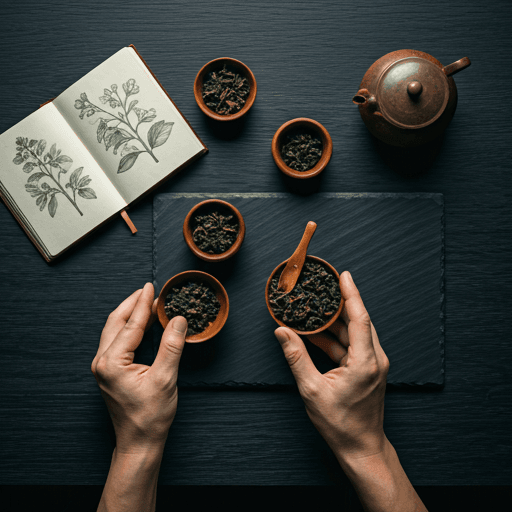
Most of the world's tea grows in warm, humid belts close to the equator. Krasnodar tea does something almost improbable: it grows near the top of the map, on the Black Sea coast of southern Russia, where winters bring snow and hard frost. That contradiction is exactly why it fascinates tea drinkers. It is a real single-origin black tea from a place that agronomists once declared too cold to grow tea at all.
Because its gardens sit around 43 to 44 degrees north, this is routinely described as the northernmost tea in the world. It is a small, stubborn, largely hand-picked product with a soft, sweet character all its own, and a story that runs through Georgia, the Caucasus mountains, and a single determined farmer near Sochi.
What is Krasnodar tea?
Krasnodar tea is tea grown and processed in Krasnodar Krai, a region on Russia's southern Black Sea coast that includes greater Sochi. It is made from the same plant as every other tea in the world, Camellia sinensis, but from cold-hardy selections that survive winters far harsher than the tropics where most tea thrives. The overwhelming majority of it is made as black tea, though some producers now also make green and other styles.
It holds a genuine claim to fame. For more than a century it was widely regarded as the world's northernmost commercially grown tea, and even as other cold-climate origins have emerged in more recent years, Krasnodar remains one of the northernmost tea origins on the planet. It is also the main source of genuinely home-grown Russian tea rather than the imported leaf that fills most Russian teapots. If you are new to the category itself, our primer on what black tea is is a useful companion, and the broader map in our guide to the types of tea explained shows where a leaf like this sits among greens, oolongs and whites.
Where Krasnodar tea grows: terroir at the edge
The gardens hug the narrow strip of coast and foothills around Sochi, sheltered between the Caucasus mountains and the sea. That geography is the whole secret. The Black Sea acts as a heat reservoir that softens the extremes, while the mountains provide drainage, mist and cool nights. Plantations are often cited at altitudes commonly around 400 meters above sea level, climbing higher on some slopes, in the valleys behind the resort town.
This is genuinely marginal terroir for tea. Winters can drop well below freezing, and a bad cold snap can damage or kill bushes, so growers depend on frost-hardy plants and sheltered sites. The trade-off is a long winter dormancy: the plants rest, then flush slowly through the warm season, roughly late spring into early autumn. Many tea people argue that this slow, stressed growth is what concentrates flavor and gives northern-grown leaf its distinctive gentleness. As a piece of Black Sea tea country, Krasnodar sits at the far northern end of a coastline that also produces the better-known Georgian and Turkish teas further south.
A short history: how tea reached Russia's south
Russians were enthusiastic tea drinkers for centuries before they grew any of their own, importing leaf overland from China and, later, by sea. Attempts to grow it domestically began in the 19th century, and they mostly failed. By many accounts, a run of hard frosts near the Kuban and Sochi killed even the hardiest bushes, and Tsarist-era agronomists concluded that tea could not be grown in the empire north of Georgia.
The breakthrough is usually credited to a single farmer. In the early 1900s, commonly dated to around 1901, a peasant named Iuda Koshman, who had worked on tea plantations in Georgia and absorbed cold-weather growing practices there, planted tea at the mountain settlement of Solokh-Aul near Sochi. Using seed and know-how from the south, he coaxed frost-tolerant bushes into surviving the winters, and his first successful harvests followed within a few years. It was proof that the "impossible" could be done.
Production expanded under the Soviet Union. From the 1930s, new plantations were laid out around Sochi and the first tea factories were built, turning a curiosity into a modest industry. State farms such as the one at Dagomys became well known, and Krasnodar tea entered kitchens across the country as a point of national pride. The tradition of gathering around a samovar belongs to this wider culture; if you want the drink rather than the leaf, our Russian tea recipe covers the brewed, spiced side of that story, which is distinct from the single-origin leaf described here.
Estates and grades of Krasnodar tea
Today the industry is small and clustered around Sochi. Several estates carry regional names you will see on packaging, including Matsesta (Matsestinskaya), Dagomys, Solokh-Aul, Khosta, Adler and Shapsugsky. Of these, the Matsesta and Dagomys operations are the ones most often described as commercially significant. Much of the best leaf is still hand-picked in small batches, which keeps volumes low and quality variable but often high.
Grades follow familiar black-tea lines rather than a unique local system: expect everything from whole large-leaf grades prized by enthusiasts down to more ordinary broken leaf for everyday brewing. Because output is limited and the region is a resort area, a lot of Krasnodar tea is sold close to where it is grown, which is part of why it stays comparatively little-known elsewhere. Producers are frequently reported to avoid heavy chemical inputs and to leave leaves to mature a touch longer on the bush than is typical, both of which are often linked to the tea's gentle character.
What Krasnodar tea tastes like
At its best, Krasnodar black tea is light-bodied, smooth and gently sweet rather than bold and tannic. Tasting notes commonly mention caramel and honeyed sweetness, a soft floral aroma, a slight brightness or tartness, and a recurring note of dried fruit, currants and raisins in particular. The liquor tends toward a clear amber to reddish-amber, and astringency is usually low, which makes it an easy, mellow cup that many people drink without milk.
Quality varies with the season and the picking, as it does with any hand-made tea, and a poor batch can taste thin. But a good large-leaf Krasnodar is prized precisely because it does not taste like a generic strong breakfast blend. It leans delicate and aromatic, closer in spirit to a soft Chinese black tea than to a brisk lowland one. As with any tea, the same leaf can taste quite different depending on how you brew it.
Krasnodar tea at a glance
| Attribute | Detail |
|---|---|
| Origin | Krasnodar Krai, Russia (greater Sochi, Black Sea coast) |
| Latitude | Around 43–44°N — among the world's northernmost commercial tea |
| Plant | Camellia sinensis, cold-hardy selections adapted from Georgian stock |
| Elevation | Commonly cited around 400 m, higher on some slopes |
| Main styles | Mostly black tea; some green and other styles |
| Harvest | Roughly late spring to early autumn |
| Picking | Much of the best leaf still hand-picked, small batches |
| Flavor | Light-bodied, sweet, floral; caramel, currant and raisin notes; low astringency |
| Notable estates | Matsesta, Dagomys, Solokh-Aul, Khosta, Adler, Shapsugsky |
How Krasnodar tea compares to neighboring origins
Krasnodar does not exist in isolation. It sits at the northern tip of a whole Caucasus and Black Sea tea zone, and its closest relatives share both geography and, in part, ancestry. The most direct kinship is with Georgian tea: Koshman learned his craft on Georgian plantations, and the two traditions grew from overlapping plant material along the same coastline. Our dedicated guide to Georgian tea goes deeper into that side of the family, which tends to run a little softer and more herbaceous.
Turkish tea, grown mainly around Rize on the southeastern Black Sea, is a useful contrast in the other direction. It sits a bit further south, is produced at large volume, and is typically brisker, more tannic and deep red when brewed strong in the traditional stacked pot. Azerbaijani tea from the Caspian side rounds out the regional picture as a mild, everyday black. Against all of these, Krasnodar's calling card is its extreme northerly position and its soft, aromatic, low-astringency profile.
| Origin | Where it grows | Approx. latitude | Typical character |
|---|---|---|---|
| Krasnodar (Russia) | Black Sea coast near Sochi | ~43–44°N | Light, sweet, floral, low astringency |
| Georgian tea | Western Georgia (Guria, Adjara and beyond) | ~41–42°N | Soft, mellow, sometimes fruity or herbaceous |
| Turkish (Rize) tea | Northeast Turkey, Black Sea | ~41°N | Brisk, tannic, deep red brewed strong |
| Azerbaijani tea | Caspian coast, Lankaran area | ~38–39°N | Mild, sweet, everyday black |
How to brew Krasnodar tea
Because it is a delicate black tea, Krasnodar rewards a slightly gentler hand than a robust breakfast blend. A good starting point is fresh water just off the boil, around 90–95°C (roughly 195–205°F), with about 2–3 grams of leaf per cup and a steep of around three to four minutes, adjusting to taste. Over-steeping can pull out an unwelcome edge and flatten the tea's natural sweetness, so it is worth tasting early. Whole large-leaf grades in particular open up beautifully with a shorter first steep and often give a second infusion.
As a black tea, it contains caffeine. A typical cup of black tea is often cited somewhere in the range of roughly 30 to 70 mg per 8-ounce serving, but the exact level varies with the leaf, the quantity you use and how you brew it. Some drinkers value the compounds that black tea may contain as part of a balanced routine, though this is not medical advice and individual responses vary.
The bottom line
Krasnodar tea matters less for its volume, which is tiny, than for what it represents: a genuine, home-grown Russian tea coaxed out of the coldest corner of the tea-growing world. Its terroir on the Sochi tea coast, its improbable frost-defying history, and its soft, sweet, faintly fruity cup make it one of the most distinctive single-origins you can seek out. If you enjoy exploring the edges of where tea can grow, this northernmost tea, and its Caucasus neighbors, belong on your list.