
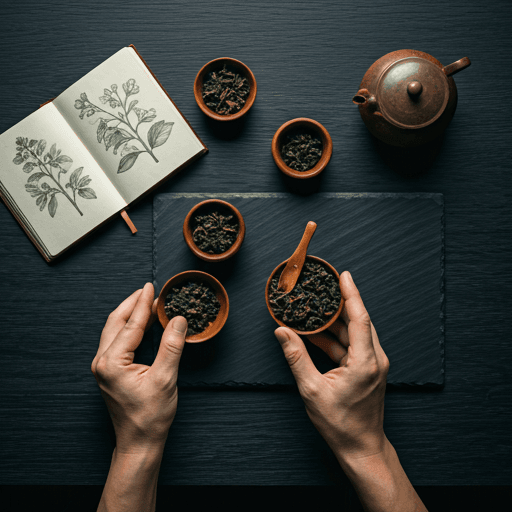
Georgian tea is tea grown in the Republic of Georgia, on the humid Black Sea coast of the Caucasus, one of the northernmost places on earth where the tea plant will grow. It carries a dramatic story: a late-1800s founding, a Soviet-era rise to enormous scale, a near-total collapse after 1991, and, today, a small-batch, organic revival built on old and rewilded gardens.
What is Georgian tea?
Like all true tea, Georgian tea comes from Camellia sinensis, the same plant behind green, white and oolong. What sets it apart is not a plant or a single flavour but a place and a history. Note that this is Georgia the country, the South Caucasus nation on the Black Sea, and not the U.S. state of the same name; "Georgia tea" in the tea world always means the former. The country sits at roughly 41 to 42 degrees north, right at the cold frontier of where tea can be farmed at all. Most Georgian tea is black or green, made largely by hand in the modern revival. For the wider category the black side sits inside, see our guide to what is black tea.
If tea origins are usually a story about tropical hills, Caucasus tea is the exception: a leaf shaped by real winters. The bushes go dormant under frost, pests are knocked back by the cold, and the plants push out a short, concentrated crop in the warm months. That single fact, tea at the edge of the possible, is what makes this origin worth knowing.
The land: a cold-frontier, Black Sea terroir
Georgia's tea grows in the country's west, on the lowlands and foothills that run down to the Black Sea. Three things make the land work at such a northern latitude. The sea acts as a heat reservoir, softening the winter cold that would otherwise kill the bushes. The Greater Caucasus mountains wall off the freezing air masses that sweep down from the north. And the region is genuinely wet, with rainfall that by many accounts reaches around 2,000 to 2,500 mm a year, falling on acidic, mineral-rich soil that tea loves.
The result is a humid subtropical pocket at a latitude where tea has no real business thriving. Just up the same coast, Russia's Krasnodar region, up around the Sochi shore, is usually cited as the world's northernmost commercial tea, roughly 43 to 44 degrees north, and Georgia sits just below it. This is Black Sea tea in the most literal sense: the water is the reason the leaf survives.
The one thing to remember: boom, collapse and revival
The distinctive thing about Georgian tea is its arc. Tea was first trialled here in the mid-1800s; Prince Mikheil Eristavi is credited with planting Chinese seed in Guria around 1847. But the industry was truly built at the end of the century. A Chinese tea master, Lao Jin Jao, whose name is also written Lau Jau Djau, arrived on the coast in the 1890s with a team of growers and set up at Chakvi, in Adjara. Tea made there from Georgian-grown leaf won a gold medal at the 1900 Paris World Exposition, putting the young origin on the map.
Under the Soviet Union the scale exploded. Georgia became the main tea supplier for the entire USSR, its gardens spread across tens of thousands of hectares. By some accounts Georgian leaf supplied roughly 90 percent or more of the Soviet tea drunk from Moscow to the Pacific. But the priority was tonnage, not finesse: harvesting was mechanised like hedge-trimming, drying was rushed, and quality slid even as volume soared.
When the Soviet Union dissolved in 1991, the guaranteed market and the subsidies vanished almost overnight. Georgia went through hard, unstable years, and the tea sector was among the casualties. Plantations were abandoned, factories closed, and much of the land went wild. The plain fact is that an industry which had employed a whole region largely collapsed within a decade.
The revival is the hopeful third act. Since the 2000s, small producers, returning families and outside enthusiasts have reclaimed abandoned and half-wild gardens, some untended for decades, to make hand-crafted specialty black and green tea in small batches. Because harsh winters kill most pests without any spraying, much of this new production is naturally organic, an accidental gift of the cold that the modern makers have turned into a signature.
The growing regions
Four western regions carry almost all of Georgia's tea, each with its own character.
| Region | Where it sits | Known for |
|---|---|---|
| Guria | Historic heartland near the coast, where the first bushes were planted | Well-balanced, classical cups; the birthplace of the industry |
| Adjara | Coastal, centred on the village of Chakvi | The 1900 gold-medal ground and old research station; teas resemble Guria's |
| Samegrelo | Humid, river-fed lowlands | Smooth, mellow, softly sweet, easy-drinking teas |
| Imereti | Higher canyons and plateaus, up toward about 1,000 m | More complex, vigorous cups; shade-grown and rewilded estates |
Frost-hardy plants: the Kolkhida cultivar
Growing tea this far north took plant breeding, and that is a genuinely Georgian contribution. Through the 20th century, Soviet-era researchers on the coast, most famously the breeder Ksenia Bakhtadze at her Anaseuli laboratory, crossed hardy Chinese small-leaf tea with larger-leaved assamica-type plants to create frost-tolerant hybrids. She is credited with more than a dozen named varieties, grouped by how much cold they could take, with the hardiest reportedly able to survive frosts toward minus 15 C. The best known is the high-yielding "Kolkhida" cultivar. These bred-for-cold plants are why tea grows at all at this latitude, and they are part of what gives revival teas their brisk-yet-clean character. Because green tea is such a large part of the modern revival, our guide to green tea benefits is a useful companion.
What Georgian tea tastes like
Cold-climate leaf tends to be lighter-bodied and cleaner than tea from the hot tropics, and Georgian tea reflects that. The green teas are the calling card: fresh and grassy, gently floral, softly sweet, with a mild edge and little of the harsh bitterness of over-fired green tea. The black teas are usually smooth and mellow, leaning honeyed and malt-light rather than big, dark and tannic, though higher-grown Imereti leaf can turn genuinely complex. Small revival makers also turn out white and oolong-style teas, so a single garden can offer several very different cups. Where all of this sits among the world's tea styles is mapped in types of tea explained.
Georgian tea at a glance
| Aspect | What to know |
|---|---|
| Origin | Republic of Georgia, western Black Sea coast (Guria, Adjara, Samegrelo, Imereti), around 41 to 42 degrees north |
| Plant | Camellia sinensis, including frost-hardy hybrids bred locally (the Kolkhida cultivar and Bakhtadze clones) |
| Styles | Mostly black and green; some white and oolong from revival makers |
| Caffeine | A true tea, so it contains caffeine; black is typically higher than green |
| Climate | Humid subtropical, rainfall up to roughly 2,000 to 2,500 mm, acidic mineral soil, a real winter dormancy |
| Signature | Cold-frontier terroir plus a boom-collapse-revival history; hand-made and largely organic today |
How it compares to its Black Sea neighbours
Georgia is not alone on this northern tea frontier; it belongs to a small club of cold-climate origins around the Black and Caspian seas, and the contrast is instructive. Just up the coast, Russia's Krasnodar region grows the world's northernmost commercial tea. Across the water, Turkey's Rize province on the eastern Black Sea is a huge producer of brisk everyday black tea, most of it machine-harvested at scale. Further east, along the Caspian coast around Lahijan, growers make a mild, soft black tea. What separates Georgia today is intent: where its neighbours mostly run large, mechanised operations for volume, the Georgian revival has staked its identity on small-batch, hand-made, often-organic specialty tea drawn from old and rewilded gardens. The same cold frontier, a very different philosophy.
The bottom line
Georgian tea is one of the tea world's great comeback stories in a cup: a leaf grown at the cold northern edge of what is possible, launched with a Paris gold medal, scaled up to feed an empire, nearly lost after 1991, and now being coaxed back by hand. Look for the green teas first for the clearest taste of the terroir, reach for an Imereti black when you want more depth, and brew it gently to keep its clean, delicate character. To get the most from the whole-leaf styles the revival makers favour, see how to brew loose-leaf tea.