
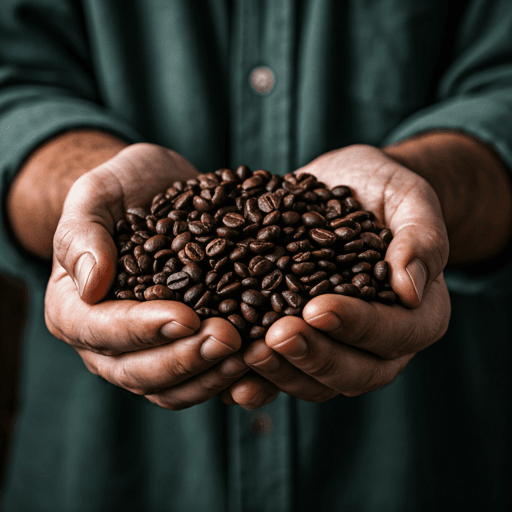
Among the many varieties that carry a little Coffea canephora in their veins, Icatu holds an unusual place. It was one of the first deliberate attempts to weave robusta's toughness into an arabica plant while keeping the cup drinkable, and it did so through a long, patient program of laboratory crossing and backcrossing rather than by adopting a natural field hybrid. The result is a tall, generous, distinctly Brazilian tree that spread widely across the country's coffee belt and went on to become a parent of later varieties.
Icatu is easy to confuse with the compact rust-resistant cultivars that dominate much of Latin America, because both lean on robusta ancestry for disease tolerance. But they come from entirely different breeding lineages, and Icatu's silhouette gives the game away: where a Catimor or Sarchimor is a short, bushy dwarf, Icatu stands tall and vigorous. This guide traces its origins, genetics, agronomy and cup character, and flags the places where the public record is thin or disputed.
What is the Icatu coffee variety?
The Icatu coffee variety is an interspecific arabica developed by the Instituto Agronomico de Campinas (IAC) in Campinas, in the Brazilian state of Sao Paulo. The IAC is one of the oldest and most influential coffee-breeding institutions in the world, and its varieties underpin a very large share of the plants grown across Brazil. Work on Icatu is generally traced to a program begun around 1950 under the agronomist Alcides Carvalho, with commercial release commonly dated to the early 1990s (most sources say 1992, a few say 1993).
What makes Icatu different from a garden-variety arabica is that its genome carries introgressed material from robusta (Coffea canephora). Arabica and robusta are different species with different chromosome counts, so combining them is not straightforward; breeders had to bridge that gap deliberately. The payoff was access to robusta's well-known disease resistance, and the challenge was doing so without dragging robusta's coarser flavor into the cup. If you want the background on why these two species behave so differently, our explainer on arabica versus robusta beans lays out the contrast.
Lineage: robusta genes backcrossed into arabica
The usual account of Icatu's parentage runs like this. Breeders started with a cross between robusta (Coffea canephora) and an arabica line — most sources name Bourbon Vermelho, or Red Bourbon. Because robusta is a diploid and arabica a tetraploid, the robusta parent's chromosomes were artificially doubled so the two could be crossed and produce fertile offspring. The resulting interspecific hybrid was then repeatedly backcrossed to arabica lines, principally Mundo Novo, with Bourbon also in the background.
Backcrossing is the key idea. Each generation, breeders crossed the hybrid back to a pure arabica parent and selected the seedlings that kept the robusta-derived disease resistance while shedding as much of robusta's other baggage as possible. Over several cycles, the population became overwhelmingly arabica in its genetics and character, retaining only the fragments of canephora DNA that carried the desired traits. This process — introducing a slice of one species' genome into another and then diluting the rest away — is called introgression, and it is what makes Icatu an "interspecific" arabica rather than a simple selection or a spontaneous mutation.
Because different sources describe the exact crosses, generations and dates slightly differently, it is fair to treat the fine detail as approximate. What is consistent across accounts is the shape of the story: a lab-made robusta-into-arabica hybrid, repeatedly backcrossed to Brazilian arabica workhorses like Mundo Novo, selected over decades at the IAC.
A tall plant, not a compact Catimor dwarf
One of the most important things to understand about Icatu is its stature. It is a tall, vigorous, high-yielding tree — noticeably taller than compact cultivars such as Caturra or Catuai — with strong lateral branching and heavy cherry production. Reports commonly credit it with substantially higher yields than Mundo Novo, sometimes cited in the range of roughly 30 to 50 percent more cherry, though such figures depend heavily on management and environment and should be read as indicative rather than precise.
This tall habit sets Icatu apart from the family of short, bushy rust-resistant cultivars that many drinkers lump together. The Catimor and Sarchimor groups are dwarfs bred for high-density, easily harvested plantings. Crucially, they draw their robusta ancestry from a completely different source: the Timor Hybrid, a spontaneous arabica-robusta cross discovered in the field, crossed with the dwarf mutations Caturra (for Catimor) or Villa Sarchi (for Sarchimor).
So while Icatu and the Catimor/Sarchimor dwarfs all owe their leaf-rust tolerance to robusta somewhere up the family tree, they reached it by separate routes: Icatu through a deliberate IAC laboratory cross with chromosome-doubled robusta, the dwarfs through a natural hybrid found on Timor. And they look nothing alike in the field. If a farm's rust-tolerant trees are tall and upright, they may well be Icatu; if they are knee-to-chest-high bushes, they are more likely Catimor or Sarchimor derivatives.
Rust tolerance from robusta ancestry
Icatu's headline agronomic selling point is tolerance to coffee leaf rust (Hemileia vastatrix), the fungal disease that has reshaped coffee farming worldwide. That tolerance is inherited from its robusta ancestry, and many descriptions also credit it with resistance to root-knot nematodes.
It is important to be precise about the nature of this resistance. Icatu's protection is best described as partial or quantitative rather than absolute. Some older literature called it strongly rust-resistant, but more recent assessments tend to describe it as moderately susceptible rather than fully immune — better than a defenceless classic arabica, but not bulletproof. Rust resistance in coffee is also notoriously unstable over time, because the fungus evolves new races that can overcome a plant's defences. Resistance that looks durable in one decade or region can erode in another. In short, Icatu offers a meaningful, useful reduction in rust pressure, not a permanent guarantee, and growers still manage it as part of a broader disease strategy.
Selections: Vermelho, Amarelo and Precoce
Icatu is not a single uniform clone but a group of related selections released by the IAC. The most commonly cited are:
- Icatu Vermelho — the red-cherry form, the most widely planted and the one most often meant when people simply say "Icatu."
- Icatu Amarelo — a yellow-cherry form, paralleling the red/yellow pairs seen in other Brazilian varieties like Catuai and Bourbon.
- Icatu Precoce — an early-maturing selection whose cherries ripen sooner than the standard type, which can help spread out harvest labour and timing.
The name itself comes from the indigenous Tupi-Guarani language. Its exact meaning is reported differently from source to source: it is variously translated as roughly "very good," or as "bonanca" / "bonanza" in the sense of smooth sailing or the calm after a storm. The general sentiment — something positive and favourable — is consistent, but the precise gloss should be treated as commonly-repeated tradition rather than settled fact.
| Trait | Icatu at a glance |
|---|---|
| Breeder | Instituto Agronomico de Campinas (IAC), Brazil |
| Type | Interspecific arabica (robusta introgression) |
| Stature | Tall, vigorous |
| Key parents | Robusta hybrid backcrossed to Mundo Novo / Bourbon |
| Rust | Partial, non-durable tolerance |
| Selections | Vermelho (red), Amarelo (yellow), Precoce (early) |
Cup quality and role as a breeding parent
On the table, Icatu is respectable rather than exceptional. It is usually described as clean and pleasant, low in acidity, medium to full in body, with sweet chocolate, malt or molasses notes — a solid, easy-drinking Brazilian profile. Cup quality is also widely said to have improved across successive generations of selection as breeders refined the lines. Even so, Icatu has historically been rated a step below the classic Bourbon and Typica lineages prized in specialty coffee, a common trade-off in varieties that carry interspecific ancestry for the sake of yield and disease tolerance.
Where Icatu has arguably had its greatest impact is as a genetic building block. Its most notable offspring is the Catucai group, which arose as a natural cross between Icatu and Catuai — the name literally fuses the two parents' names. First selected in the late 1980s from within a Red Icatu population, Catucai combined Icatu's disease tolerance and vigour with Catuai's more compact frame, and it went on to become an important variety in its own right across several Brazilian growing regions. Icatu genetics thus live on well beyond the original selections, threaded into the wider family of modern Brazilian cultivars.
For growers, Icatu remains a pragmatic choice: a hardy, productive, robusta-backed arabica that trades a little cup refinement for reliability. For drinkers, it is a reminder that a great deal of everyday Brazilian coffee owes its resilience to a decades-long breeding project that quietly borrowed a few useful genes from the other coffee species.
Frequently asked questions
Is Icatu an arabica or a robusta coffee?
Icatu is classified as an arabica. It is an interspecific arabica, meaning a small amount of robusta (Coffea canephora) genetic material was introduced into an arabica background and then diluted through repeated backcrossing to arabica lines. In practice its genetics and character are overwhelmingly arabica, with only fragments of robusta DNA retained for traits like disease resistance.
How is Icatu different from Catimor?
Both owe their leaf-rust tolerance to robusta ancestry, but they come from different programs and look different. Icatu is a tall, vigorous tree bred at Brazil's IAC from a deliberate cross with chromosome-doubled robusta. Catimor is a compact dwarf derived from the naturally occurring Timor Hybrid crossed with Caturra. If the plant is tall it is more likely Icatu; if it is a short bush, more likely Catimor.
Is Icatu resistant to coffee leaf rust?
It carries partial, robusta-derived tolerance to coffee leaf rust rather than complete immunity. Modern assessments often describe it as moderately susceptible rather than fully resistant, and because the rust fungus evolves new races over time, any such resistance can weaken. Icatu reduces rust pressure meaningfully but is still managed as part of a wider disease-control strategy.
What are Icatu Vermelho, Amarelo and Precoce?
They are the main selections within the Icatu group. Icatu Vermelho is the red-cherry form and the most widely grown; Icatu Amarelo is a yellow-cherry form; and Icatu Precoce is an early-maturing selection that ripens sooner than the standard type. All share the same tall, high-yielding, robusta-introgressed background.
What does the name Icatu mean?
The name comes from the Tupi-Guarani language of Brazil. Its meaning is reported differently across sources — commonly translated as roughly "very good," and elsewhere as "bonanca" or "bonanza" in the sense of calm, favourable conditions. The upbeat sentiment is consistent, but the precise translation is best treated as tradition rather than a fixed definition.